Mafia might feel a bit old-school in the way it presents itself, but there’s a compelling mix of charm, practicality, and quietly impressive moments that deserve your attention.
I’m reluctant to kick off a review with a tired trope, but, dear reader, here we are. Mafia: The Old Country delivers the rare kind of experience that seems to be more than just the sum of its parts. On paper, I wouldn’t have assumed I’d end up enjoying it as much as I have. Yet when I pause and really think it through — you know, leaning back and narrowing my eyes — I can’t shake the feeling that I might even appreciate it a touch less. Still, if I’m honest, the stream of mob clichés arranged by developer Hangar 13 landed with real entertainment value for me.
That’s the quick version, but there’s plenty behind how I reached these thoughts. The fourth major entry in the Mafia series is fascinating in multiple ways — some of it hits the mark, some of it doesn’t, and all of it keeps you interested.
It’s clear that many of the paths it chooses have been shaped with one glaring concern in mind: keeping the game’s length under control. The Old Country is the newest entry in a growing subgenre I’ll call “condensed triple-A.” In simple terms, it’s a production with big-budget ambitions and high production values, but without the goal of consuming your schedule for more than 40 hours, or dragging on endlessly in the style of a live service. The Old Country tells its story with restraint and moves on from your mind in under 15 hours. For me, that turns out to be a strength.
I liked Mafia 3, the previous main release, but its sprawling open world and the tangled tale of betrayal and revenge that kept escalating certainly pushed things out. It’s also telling that the clearest memory I have of the game — one I genuinely enjoyed at the time — is the dull wire-tapping job you had to keep repeating. And then there was the soundtrack loaded with electrifying 60s classics. The Old Country doesn’t rely on either. Streamlined and pared back, it focuses on doing a handful of things well, so the story can keep you hooked.
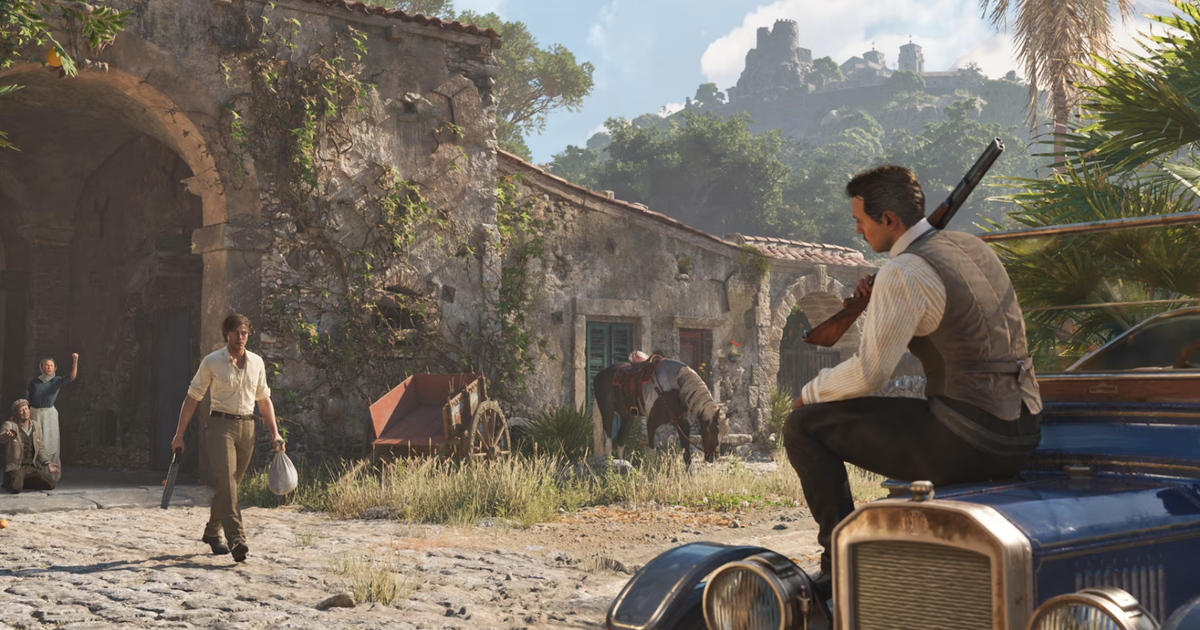
You can see this streamlining in several areas. The stretch of Sicily where the story plays out suggests an open world, but it doesn’t fully commit to that idea. Early on, you can travel around, yet there are no police patrols, no long lists of side missions, and thankfully no wires to tap. Instead, the game simply offers a charming, photo-ready backdrop for darker happenings. The world leans into a mildly “cinematic” view (editor’s note: deep sigh) — not only in how it sets up visually striking compositions around every turn, but also in the way its carefully designed look can feel a little staged. Great open worlds try to feel “alive”; The Old Country abandons that entirely, coming across as the most visually impressive Hollywood backlot you can imagine.
A strong example of this same approach shows up in the combat. In the Old Country, people settle arguments in two main ways: with weapons and firearms (and yes, you can use stealth to neutralize enemies). The whole game is rooted in the mafia, a group known for getting rough, where a simple punch isn’t on the menu. That might sound strange — or like a drawback — but in context it feels like another deliberate design decision, chosen to keep everything clean and straightforward. With the story set in the early 1900s, you get treacherous stealth, explosive firefights, and dramatic one-on-one knife duels. In other words, that’s exactly what the game delivers.
In the end, it’s the narrative that steers everything. The performances are excellent, the characters feel distinct, and the journey — which begins like a fairly familiar Cosa Nostra setup — becomes genuinely involving and impactful. Still, it didn’t start out that way for me.

not written by Mario Puzo. When you have that background, you’ve come across plenty of similar narratives, and you often start looking for something with a deeper edge. That’s also part of why Mafia 3’s writing, shaped around a Black protagonist within a weakened Sicilian mob setting, genuinely connected with me.
So when Enzo Favara is pulled out of a grim life and welcomed into a wealthy, respectable mafia family, I have to admit my interest started to drift. Even so, the opening portion of a real romance — conveyed through passing moments and small, expressive facial cues — brought me back in. Strong performances and gorgeous scenery helped too. In many cases, driving is optional, and a “skip journey” button appears often. Still, you probably won’t use it. I found myself eager to race along dirt tracks and through sleepy villages, soaking up the scenic draw of this digital Sicily: Mediterranean blue skies, lively plants, and the looming volcano far in the distance.
It’s easy to turn characters like this — sharp men in vests with bruised knuckles — into exaggerated stereotypes. To some degree, that’s true. The first time I heard Johnny Santiago’s take on Don Torrisi, I felt a small jolt: of course the quiet, rasping voice fits the role, carrying both warmth and menace, and it echoes Brando’s Corleone. But as the plot shifts and starts taking unexpected turns, something more substantial emerges. The voice acting works hand in hand with strong animation choices — the brow tightening, a threatening twist at the edge of a smile. Riccardo Frascari deserves special credit as well, portraying Enzo as a young man with inner conflict who grows and adjusts instead of settling into a straightforward, unchanging role.
Eventually,
…when you stick with it, the rewards start to show. The plot turns toward less familiar ground for stories like this one. The notion of family life operating as both a restriction and a route to a more refined way of living rises to the surface; Enzo also grows into a character with real depth. I wouldn’t say this is totally fresh material—the ideas it explores echo many well-known entries in mob entertainment—but it’s handled in an engaging way here, especially compared with typical gaming conventions, keeping you interested throughout.
It’s fair to say that this storyline overlaps with the kind of experience you’d expect from a game like this. From a design perspective, I’d describe The Old Country as leaning a bit toward formula. It leans into tradition, though. There’s the cinematic storytelling first—carrying bottles of wine or socializing at your base—then you get a pretty drive while your companions chat inside the car. When you arrive, you’ll either manage to slip in unnoticed or you’ll be spotted and the mission turns into shooting. Even when you pull off stealth, you can still end up detected partway through, with a cutscene kicking off a fight. From there, you’re forced into combat through a tight network of chest-high walls placed in convenient spots. That’s only a sizable slice of the game’s chapters. Very often, each session wraps up with a hard-hitting one-on-one knife showdown.
Overall, it’s a setup that works and is executed competently. I say “overall” because a few elements are more difficult than they should be. The stealth in particular is baffling—guards swing between being painfully oblivious and suddenly fully aware. Guidance can also be strangely unclear; on three or four occasions, I died to a grenade that was close enough to harm me but far enough that the grenade proximity warning icon never appeared. There are other small annoyances along those lines.
Still, you’ll also spot subtle touches that do land. Heavier weapons hit with a wonderfully satisfying thud, driving opponents like a brick through a glass window. Or take the road signs in the game, which shift to keep pointing you toward your next objective—something that would feel smarter if there wasn’t always a big yellow marker pointing to your target. Driving, in general, turns out to be a pleasant surprise. The cars feel old and unsteady, but they’re supported by a surprisingly detailed “simulation” driving mode, if that’s your kind of thing.
So you end up with a mix of rough edges and smoother moments. I quickly adjusted to treating them as a package deal. Broadly, these are familiar structural and mechanical ingredients, just a little too recognizable at times. You’ll likely keep running into that unsettling sensation where the narrative nudges you to weigh Enzo’s choice to kill a single unarmed man—especially after it has you mowing down thirty people without hesitation just to reach that point. Plenty of games do this, but here, Mafia tackles some particularly delicate subjects while insisting on a seriousness that makes the mismatch more noticeable.
That, I guess, is the heart of Mafia: The Old Country. The gameplay itself is fairly ordinary, and in several ways it feels like parts of its design were pulled from a time portal belonging to an earlier era. I’m reminded of the more offbeat action-adventure titles from the 360 and PS3 days, at least in terms of presentation. You can see that clearly in the mission structure and gameplay loop, as already described. At the same time, the overall production values and storytelling flair feel unmistakably current. It’s effectively a game split into two halves—these halves might appear uneven, yet they also don’t.
If you’re willing to view, as I did, the fairly unremarkable gameplay as just the framework for truly standout storytelling, then I think you’ll find yourself having a good time here. I definitely did.
The legendary Billy Shakespeare once wrote, “Brevity is the soul of wit,” and Mafia: The Old Country follows that idea. I’m not claiming its tale matches Shakespeare’s work, or even that it’s in the same league as Puzo. But it does keep hold of your attention without wasting it. Its straightforward gameplay systems and even its almost theatrical world design are all in service of one thing: the excess has been cut away.
What you’re getting here is exactly what Hangar 13 needed to communicate this story—nothing more, nothing less. Sure, you can always wish it went further, but what the past ten years or so of gaming has taught me is that a shorter, tighter experience can sometimes be better than one that drags on. Mafia: The Old Country includes plenty of caveats to fill the back of a bootlegger’s truck—but if you go in with the understanding of what you’re agreeing to, you’ll likely have a great time.
A copy of Mafia: The Old Country was independently sourced for this review by Eurogamer.