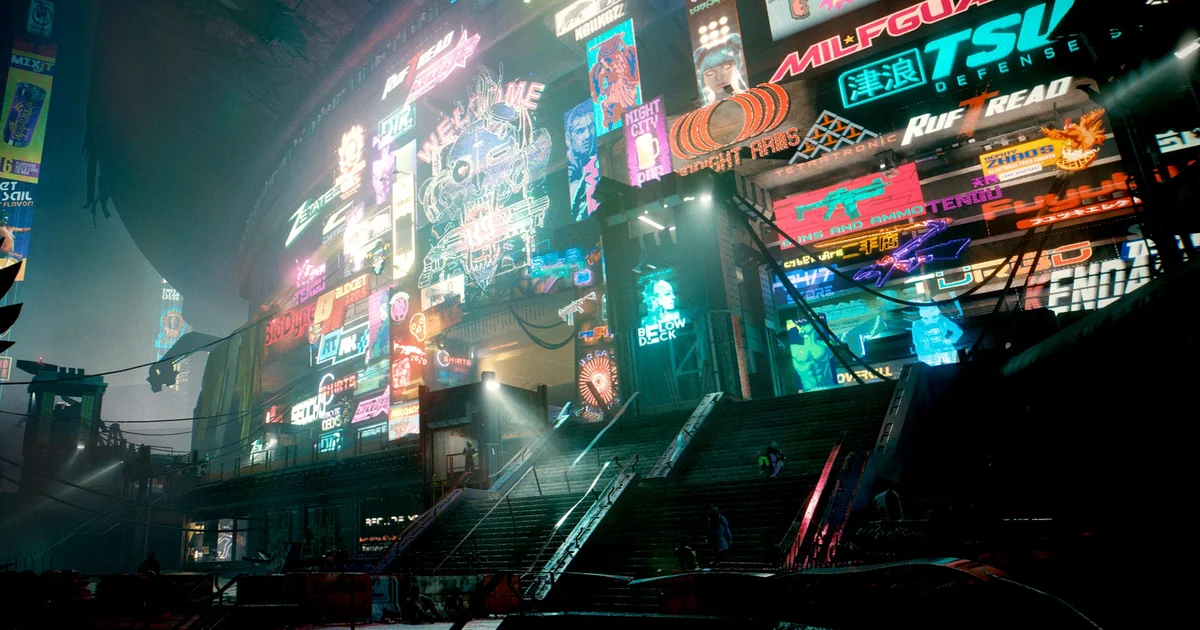
UPDATE: Digital Foundry has now completed its assessment of Cyberpunk 2077 2.0 on PC, giving particular attention to the ray tracing improvements added to the game via DLSS 3.5 ray reconstruction. The goal of this new approach is to noticeably strengthen denoising. In many ray tracing techniques today, rays are still fired, but the count stays far below what would occur in the real world—so the end result can look “grainy” and must be processed to produce a steadier, more coherent image. Depending on the specific effect, different denoisers may be needed, and each one is fine-tuned with human guidance. Ray reconstruction is designed to take some of that workload off developers, using machine learning to generate results that are both more efficient and more effective.
The end result is a sharper picture with more visible detail, less ghosting, and faster reactions when lighting shifts dramatically. Alex Battaglia calls it “a watershed moment for real-time ray tracing”, but he also stresses that it’s still a work in progress that will benefit from additional polishing—similar to what happened with DLSS 2.0 after it first launched. Posterization issues, over-aggressive sharpening, and certain smearing artifacts resemble the problems previously seen with DLSS 2.0, with low-light scenes bringing them out particularly clearly. Should this technology’s path match DLSS 2.0’s, we expect those artifacts to improve and eventually disappear as it continues to mature.
We hope you enjoy the video and see it as a useful supplement to the DLSS 3.5 conversation we shared earlier this week. The embargo covering video review material for Phantom Liberty will be lifted next week, and we’ll follow up with updates—including a deeper look at the console releases.
Original Story: How about this surprising mashup? Alex Battaglia recently led a roundtable on AI and the future of gaming graphics, sharing the stage with representatives from GPU maker Nvidia, Cyberpunk 2077 developers CD Projekt RED, and the PCMR subreddit. The discussion arrives right ahead of Cyberpunk 2077 2.0 and the Phantom Liberty expansion, and it introduces an expanded lineup of technologies, including DLSS 3.5 ray reconstruction.
The conversation is genuinely compelling and is well worth watching in full through the embedded video below. One angle I found especially interesting is the idea that, while image upscaling and frame generation might look like shortcuts developers take to avoid optimization work, they can also function as tools that let visuals reach levels that wouldn’t otherwise be possible.
Jakub Knapik from CDPR makes the point effectively by setting Cyberpunk’s path-traced visuals alongside those of Big Hero 6, the 2014 film that was among the first animated movies to use path tracing—while also showing a crowded city environment across many scenes. Producing each frame took several hours to render. Yet, not even ten years later, consumer graphics cards can render a scene with comparable graphical complexity in Cyberpunk 2077 at 60 frames per second.
- 00:00:00 Introduction
- 00:01:10 When did the DLSS 3.5 Ray Reconstruction initiative start, and why?
- 00:04:16 How did you bring DLSS 3.5 Ray Reconstruction to life?
- 00:06:17 What was it like to integrate DLSS 3.5 into Cyberpunk 2077?
- 00:10:21 What new inputs does DLSS 3.5 make use of?
- 00:11:25 Can DLSS 3.5 be used for hybrid ray tracing games, not just titles with path tracing?
- 00:12:41 What performance target does DLSS 3.5 aim to hit?
- 00:14:10 Is DLSS just a patch for weak performance optimization in PC games?
- 00:20:19 What makes machine learning so helpful for denoising?
- 00:24:00 Why is the naming of DLSS a bit confusing?
- 00:27:03 What new denoising capabilities does DLSS 3.5 bring to Cyberpunk 2077?
- 00:32:10 Will Nvidia keep prioritizing performance at native resolution even without DLSS?
- 00:38:26 What caused Nvidia to shift internally from DLSS 1.0 toward DLSS 2.0?
- 00:43:43 What are your thoughts on DLSS changes for games that don’t already include DLSS?
- 00:49:52 Where can machine learning go next in gaming beyond DLSS 3.5?
These advances are impressive, and they’re only achievable because of many different “strategies”—image upscaling, frame generation, and now ray reconstruction—alongside meaningful hardware improvements that speed up multiple stages of the ray tracing pipeline.
As Jakub notes, nearly anything that improves performance can be viewed as a strategy in its own right—right down to basic techniques like level of detail (LOD), which reduces distant geometry to save performance—so what really matters is how these tools are used.
As seen in Immortals of Aveum, there’s a real possibility to lean too hard on image reconstruction, which can leave consoles with an overly soft image and raise the hardware requirements on PCs… while Starfield didn’t take advantage of every available option, launching without DLSS or XeSS support and delivering weaker performance on Nvidia and Intel graphics cards.
As Bryan and Jacob point out, creating this kind of technology comes down to making each frame smarter. Even if teams may vary in how effectively they apply what’s available to them, the main aim is to help both developers and players strike a sensible balance between performance and visual quality.
There’s plenty more covered here than I can fit into a single write-up—such as the evolution of the different DLSS generations, how denoising improvements shaped Cyberpunk’s artistic direction, and broader thoughts on using machine learning in game graphics beyond DLSS 3.5.
It’s all fascinating material, so do check out the embedded video below. Even though there’s a visual component, I found the discussion works just as well if you treat it like an audio-only podcast. So, if you’d rather spend about an hour listening while commuting or doing chores, that option is there too.
Thanks to Bryan, Jakub, Jacob, and Pedro for taking part in this session, and be sure to stick with us for more coverage of Cyberpunk 2077: Phantom Liberty. We’ll take a closer, more detailed look at what DLSS 3.5 adds as shown in the 2.0 version of Cyberpunk, and we’ll also examine the PlayStation 5 and Xbox Series editions of the game when the time comes.