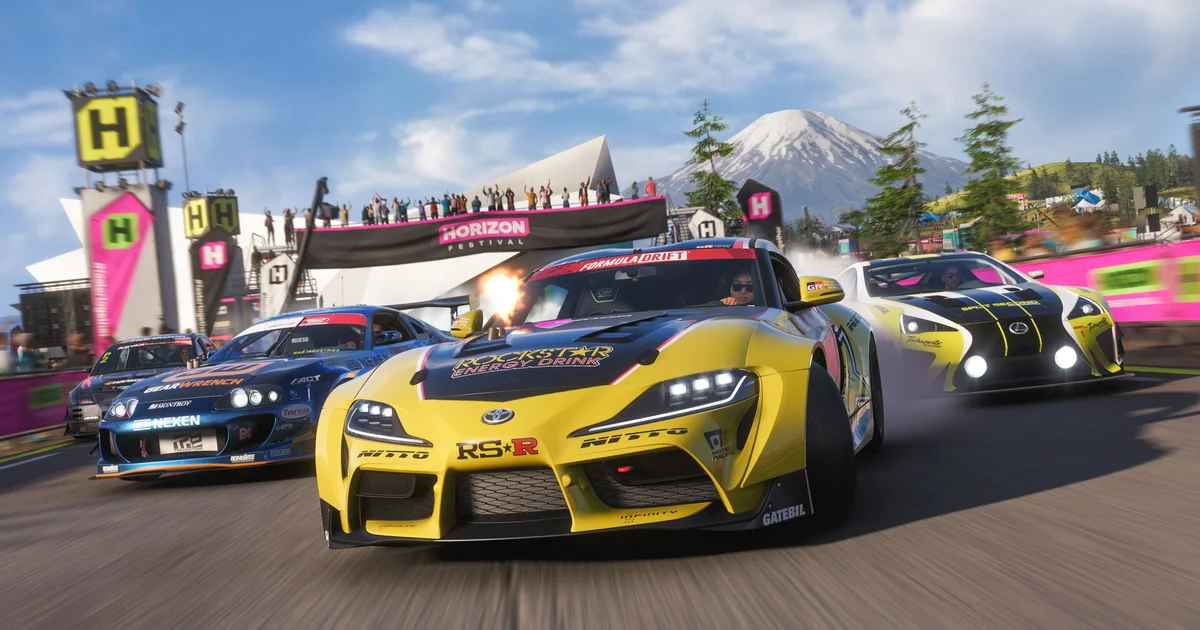
Forza Horizon 6 has borrowed at least one smart idea from Ridge Racer. It seems to understand what makes a certain kind of racing game such a joy: sometimes it feels magical, and other times it leans hard into playful, arcade-style spectacle. There’s a particular thrill in drifting around a bend now and then and looking up to see something extraordinary happen overhead. In Ridge Racer, that moment often meant a huge jet lifting off. In Horizon 6, it could just as easily be one of those sturdy twin-prop helicopters—or even a pack of jet fighters streaking across the sky. Still, like anything, games can occasionally get a little too carried away. On one occasion, I climbed to the crest of a hill and watched a massive space rocket blast off. Not too shabby, Horizon. Not too shabby.
But what about right at the start? Dear reader, within the first minute or so I ran into two bullet trains traveling side by side. I’d take a turn, and they’d zip past—fast, low, and heading toward the gleaming horizon. Welcome to Japan.
If you know the Horizon series from Forza, you’ll likely feel instantly at ease. The basic structure is the same: arcade-style racing set within a huge, travel-leaning open world. It kicks off the familiar rush of heading to a festival, just like earlier entries. A sequence of mini-events pulls you along at speed—one moment you’re weaving along roads that thread through forests, and the next you’re dropping down a snowy mountain. The futuristic concept cars with bold, pared-down tail lights are swapped out for a bright yellow Porsche. Open the accessibility options and you’ll find the same strong set of tools to shape how you play. Then, in the character creator, you can still choose prosthetics before setting your pronouns.
At its core, Horizon wants to feel like a laid-back vacation, and it invites everyone along. Even when I was playing the demo locked at 30fps in the “quality” mode (with a 60fps “performance” option set to arrive at launch), it manages to feel like a calm Sunday-afternoon spa session. Engines roar, petals drift down, and your everyday worries slowly slip away.

And true to those bullet trains, the game sets out to deliver pretty much everything you’d expect from a title built around Japan. I’ve been trying the current demo, and it already offers a solid selection of events plus a large chunk of open world. I’m genuinely impressed by the range and how carefully everything is put together. I was expecting highways lined with pink blossoms and gleaming overpasses. I was expecting lively cities and constant sightlines toward Mount Fuji. Those expectations are all met. Still, a drive that takes you across the country shifts you from rough, muddy paths to the warm glow of a beach shoreline, giving you the chance to race almost weightlessly over turquoise water. Elsewhere, a forest opens up to a lakeside framed by tidy houses—pitched roofs cutting crisp, eye-catching shapes into the skyline.
Everything feels fun here, and in true Horizon fashion it captures a sense of size and spectacle while still working within its limits. Deep in Tokyo, I sped past Tokyo Tower and the Shibuya Crossing in under forty-five seconds. Both moments felt believable, and neither one felt rushed or cramped. Yet because you often spend time traveling between events, there still isn’t quite enough driving time to make you want to jump into auto-drive.
Japan looks fantastic, but the vehicles are what really define the experience. I enjoyed trying to keep the yellow Porsche pulling strongly as I worked through tight hairpin turns in a cornering-focused tutorial—one that essentially functions as a drifting lesson. Later, once I moved into a 4X4 challenge, the GMC I drove felt almost like an oversized hearse; the way its mass carried through the controller made me pause before committing to the first turn for about ten seconds. A few minutes afterward, as we slogged across flooded rice fields, I kept worrying that this shiny beast would slip beneath the surface and never resurface.
Still, preferences have a way of taking over, and it looks like mine is leaning toward the 1989 Nissan Silvia K’s. It’s a stylish urban standout, with a body tone like the dusk-colored sky that hints a summer storm is on the way. It’s the car I chose when the campaign began, and I quickly got hooked on its 80s-inspired edge. It’s fast, yet it also feels as heavy and substantial as a refrigerator dropping from a three-story building. Timing a lap lets you handle it with real confidence, but it still carries the vibe of something a mid-level corporate professional might’ve once used in an oddly practical way—like dealing with squirrels in the Mulholland Hills after a movie deal went sideways.
What’s probably obvious by now is that I’m drawn to cars and to the thrill games can deliver through them, even if I don’t really know much about the real-world details. That’s why Horizon feels like the Forza for me, I guess: it offers a break from taking things too seriously, while still being crafted with such care that both newcomers and seasoned players can genuinely enjoy themselves. It’s also why I can appreciate the many vehicles right away. I can tell that a vivid red Celica feels completely different from a Nissan GTR with an oversized spoiler, just by how each one drives. From that, you also start to get a sense of what Horizon’s underlying “feel” is all about.
These cars stick nicely to the road, but they’re also eager to rotate into turns. There’s a touch of ease when you unexpectedly clear roadside barriers, and the debris barely seems to disturb the air. Of course, there’s another side to that, too—it’s ready to punish you when you slip up.
And that’s a key part of any racing game, isn’t it? Yesterday, I took the Silvia into a tight, sharp-turn race through Tokyo’s busy streets, and I was doing fine—until the rain started. And then what? Suddenly I was drifting around like melting ice cubes spilled onto a coffee table. I made a mistake, and the game clearly noticed. I thought that because Horizon is such an inviting title, I could treat it with a more relaxed mindset. That wasn’t the case. And honestly, that’s great news.