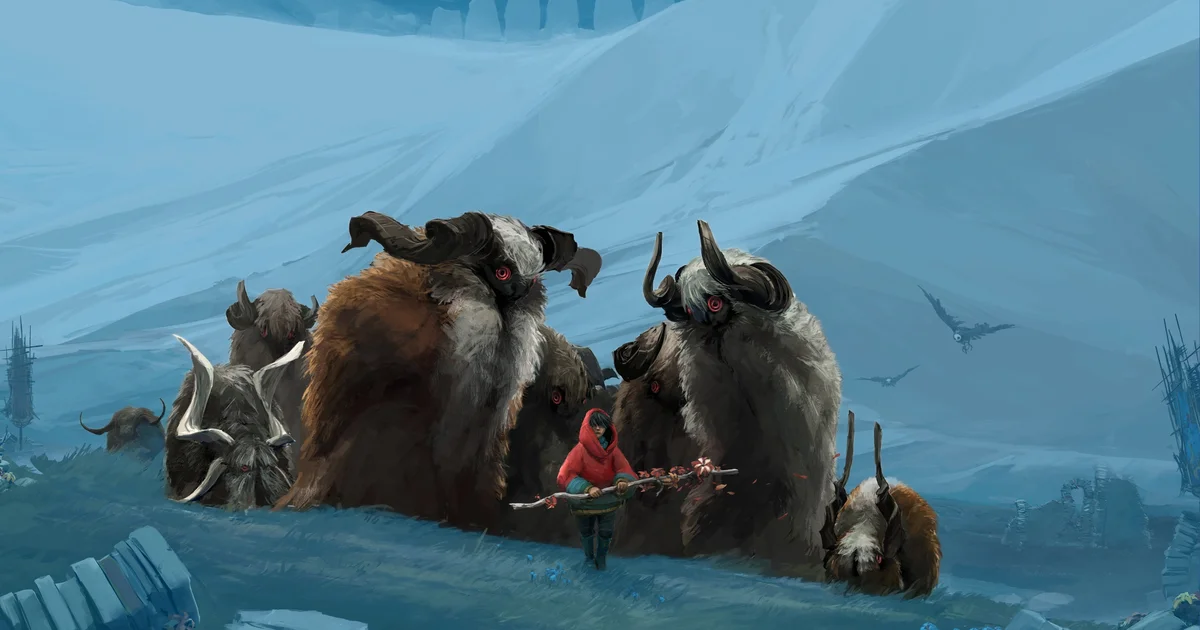
A vivid, unforgettable story unfolds less through spoken lines and more through teamwork with the environment—through motion, player choices, and striking visual expression.
Video games are especially good at sparking feelings in a small constellation of pixels, particularly when those pixels are trapped in relentless, life-or-death circumstances. Herdling belongs to a long-running line of escort-style adventures designed to tug at the heart: from Ico and The Last Guardian to the steadily growing roster of Sad Dad simulators that shape much of today’s gaming landscape.
Herdling aligns much more closely with its celebrated peers, FAR: Lone Sails and FAR: Changing Tides, than with anything else—despite its different subject matter. Where those games offer a gloomy, end-of-the-world companion pairing focused on caring for machines, Herdling centers on a group of quirky goat-like creatures, yet the overall emotional shape lands in remarkably similar places. The FAR games encouraged you to value your vehicle, sharpen your ability to control it, and ride out a rush of emotions whenever your precious rig went missing or took damage, because you were repeatedly dropped into moments that blurred your view of what mattered most.
Herdling uses the same mindset, applying it to a small gathering of Calicorns: around a dozen ram-like animals with stunning horns, shifting coats that look alive, vaguely magical traits, and a natural talent for responding to straightforward directions (move here, advance slowly, OK STOP, and so on). Your goal is to lead them across an alpine route that begins on the edge of a bleak city and climbs all the way to the mountain summit—negotiating a series of obstacles along the way, from light puzzles to airborne threats that react to sound. And yes, it’s a linear experience that includes stealth stretches—“mandatory stealth,” for anyone who isn’t fond of that idea.

If you’d rather play something more relaxed, you’ll be relieved to hear that Herdling’s obstacles aren’t especially punishing. The stealth sections mentioned earlier are almost comically forgiving. You’ll guide your herd past a sleeping “murder owl”—it only stirs if one of your slightly clumsy Calicorns knocks over any of the many stone cairns scattered throughout the route. Some of the discomfort comes from the unsettling look of the enemy design: horrifying masked birds of prey with a minibus-sized wingspan, claws like angry spiders, and an empty stare that feels intent on piercing straight through you.
Still, getting your herd around these noise-makers is surprisingly simple, because the group’s silhouette snaps neatly into place during tight turns. Even if you topple a couple of the stone stacks, the birds don’t respond with an attack. The only time I was met with aggression was during a scripted chase moment you can’t avoid. That’s perfectly fine—FAR’s games weren’t especially brutal either. What counts most is the trip itself: the emotional weight and the sense of advancement, along with the sting of failure, that come with trying to get through something difficult. The FAR titles, though, also delivered mechanical puzzles that made you feel like a capable engineer. Even just getting the vehicles moving often felt like you were running a steam engine. Major hurdles in those worlds demanded you to unravel the Big Machines and their inner logic. People didn’t get trapped endlessly with those games, yet they managed to maintain a persistent illusion—one Herdling doesn’t sustain in the same way.
And to be clear, even with the obvious differences, Herdling is so close in theme and presentation to the FAR series that you could argue it functions as a loose, thematic trilogy. So when the first Machinery Puzzle arrived, I expected a showy chain of pulleys and levers with a clever twist. I pulled a lever, and suddenly I was already about 75% done. Herdling’s connection to FAR’s intricate vehicle handling is the same kind of unpredictability you’d expect from fantastical goat herding. Your flock tends to do “More or Less” of what you tell them. They stop “More or Less” when you give the cue. It’s a bit like Surgeon Simulator, where the real challenge lives in the fuzzy, woolly gap between what you mean to do and what happens on-screen. But here, it’s not at all hard. In fact, after roughly thirty minutes, it starts to feel as natural as anything else in games.
It’s a trip with very few true detours. Of course, there are moments that ask you to slow down carefully or activate a certain number of magical plants to open a path, but overall it comes across as pretty routine. Each chapter ends with the shepherd and his herd settling in for the night beside a campfire—yet on multiple occasions, it felt like we’d barely accomplished anything that truly required rest. And that break certainly didn’t happen only at night.
It’s an odd, slightly uncanny way to experience a game. Still, the core idea lands: your herd is special, and it matters. You’re trying to keep them safe from the world’s threats. Every animal has its own charm—some enjoy a game of fetch, while others keep getting their fur dirty and knotted no matter how much you clean them. A few carry an elegant presence that hints at quiet, reflective intelligence behind those wide, googly eyes. And when one goes missing, it hurts. The easiest times for that to happen are the longer travel sequences, where the dangerous landscape—not the menacing birds—becomes the real adversary. The only Calicorn I lost was on a narrow bridge stretching across a terrifying chasm. I couldn’t reach dear Butthead fast enough, and he slipped, crying out as he fell into the abyss.
Yes, you can give them names. From that point, Butthead would occasionally return later in the story like a faint presence—searching for something intangible to sustain him, or happily playing with his still-living siblings while we skip through the meadows (and yes, there’s plenty of meadow frolicking to enjoy). In a way, I’m glad my Herdling run was so bittersweet. If I had finished without losing anyone, I would’ve avoided the guilt of losing Butthead—and I wouldn’t have felt that urge to let him move on after death each time he reappeared. It keeps us from fully grieving, lingering like a sneeze you can’t shake. It’s a serious meditation on grief, showing how losing someone disrupts your built-in sense of cause and effect and your understanding of what still “exists.” A family death isn’t just an event—it’s a shift. Not a single moment, but an endless one.
In roughly three hours, give or take, and with very little reason to replay, Herdling stands out as an almost flawless bundle of bottled emotions. For my part, I’d suggest treating it as a one-and-done experience, because it lands more sharply when you have to live with a mistake or two. Players looking for ongoing skill challenges may find it disappointing—Herdling doesn’t really build toward something more demanding. But if what you want is to lose yourself in a world and step into the kind of narrative only video games can tell—those powerful, unforgettable tales delivered not through dialogue, but through interaction, movement, and visual design, wordless conversations between game and player that hit far deeper than I expected—Herdling is an experience you shouldn’t skip.
It might not beat FAR: Lone Sails, but then again, what does?
A copy of Herdling was provided for review by Panic.