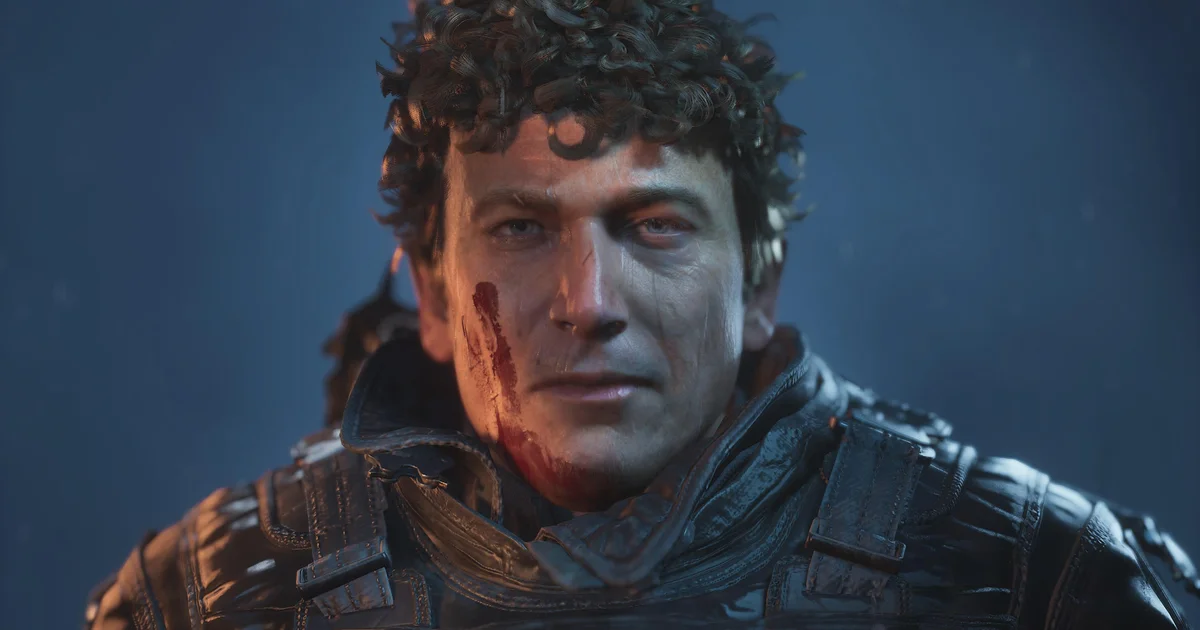
Hell is Us is a gripping, nightmarish dive into the brutal realities of warfare, but some polarizing design decisions may start to feel wearing.
Unfamiliar synths thrum and spiral within a digital drone. Soft wind chimes tinkle. An unsettling screech rolls in from afar, while the bass intensifies. Rain taps across the DualSense. So, what exactly is out there?
Hell is Us builds a strong sense of atmosphere, largely thanks to its score—more precisely, its soundscape—composed by Stephane Primeau. It bathes the game in a heavy, oppressive mood. That makes sense when you consider Primeau’s roots in a metal band: the music feels dark, eerie, and unsettling. I’d strongly suggest wearing headphones to get the full effect.
This audio sensibility fits neatly with an adventure that examines how conflict loops back on itself. Hell is Us, as the title hints, is a nightmare you step into. Malevolent entities move through muddy trenches and burn-scorched city streets; tanks sit abandoned, half swallowed by soggy wasteland; and innocent civilians (sometimes less so) are swept into the chaos of a country ripped apart by civil war and supernatural forces.
Still, because of Rogue Factor’s bold design choices, Hell is Us can occasionally come across like a nightmare you navigate without a map—full of puzzling oddities, confusing menus, and combat that doesn’t feel especially deep, all combining into a tough experience. Aggression isn’t automatically a bad thing—particularly when the game is set in such a combative, hostile world—but there’s a fine line between cryptic and tedious, and the studio doesn’t reliably manage it. You can spot echoes of sci-fi Zelda and classic survival horror in Hell is Us: dungeons to roam, quirky puzzles to solve, and aged mysteries to uncover. With that suffocating atmosphere layered on top, it delivers an experience with all the ingredients of a cult favorite. Even so, I worry it may spark division among players.
After an opening that tells a story inside a story, you’re dropped into Hadea, a land shaped heavily by the 90s—seen in the outfits on its characters, the retro digital look of its menus, and a devastated setting that feels drawn from conflicts such as Bosnia and Kosovo, along with more recent wars in Ukraine and Gaza. Hadea is split between two faiths—the Sabinians and the Palomists—each responsible for generations of suffering. But lately, spectral beings have started appearing amid the civil unrest. Protagonist Remi begins with a simple goal: slip into Hadea to search for his family—only to find himself quickly tangled in the country’s strange history.
In short, Hell is Us acts as a reflection on the horrors and pointlessness of warfare, showing how history keeps repeating itself. Pulling visual cues from today’s—yes, very current—battlefields gives the game a jarring immediacy, on top of its grim, unsettling tone. On his journey, Remi crosses paths with people from every side—religious fanatics, soldiers, frightened refugees, and ordinary bystanders—sharing stories about everyday folks carrying out horrific acts, yet he never truly commits to a clear moral stance. Good and evil blur together everywhere, and in this ruthless struggle, there are no true winners or losers: everyone suffers, and everyone deserves help. Hell is—enough—about humanity, but more specifically, it takes aim at the media and politicians using propaganda and what one character calls “a constant campaign of dehumanizing the other side.” Once cruelty is embedded in human nature and hostility toward others becomes a default condition, this war-scarred hell turns out to be impossible to escape.

On every side, you’ll meet a mix of intriguing yet unpleasant personalities, supported by a smart dialogue system that gradually reveals new ways to respond.
With absorbing character exchanges and solid little story beats captured through dialogue and recordings, Remi helps assemble the intricate world of Hadea in a way that fully pulls you in. The story’s weak point, though, sits with Remi himself. Beyond the search for his family, he fits the familiar “run-of-the-mill guy in a jacket” mold often used for protagonists. He barely talks, even though he’s voiced by Elias Toufexis (Deus Ex), and he rarely adds much commentary about what he discovers. He ends up feeling like a fairly dull lens through which to experience an otherwise compelling world. There’s definitely room to engage more deeply with the story’s themes, but Remi comes across more like an avatar built for collecting keys and throwing himself at enemies.
I’m only being a bit cheeky here, because the gameplay in Hell is Us genuinely grabs you, and the progression feels natural. Rogue Factor decided not to include signposts or a map, which means players must lean on visual and audio cues to move through each area, listen closely to conversations, and spot leads that help unlock new spaces and push the narrative forward. I really enjoy that approach. From the outset, I was fully drawn into Hadea, and this choice forced me to pay attention in a more deliberate way than I normally would—staying focused on details and appreciating how committed it is to its overall mood. For the most part, each zone is structured to stay engaging without going too far, though it can still feel like a lot.
Not having a map becomes tougher once you enter dungeons. These areas—underground tombs, ancient temples, scientific complexes, and more—each keep their own look and distinct color scheme. They often feel maze-like, with locked routes and unusual puzzles to work through, and they’re generally enjoyable to explore. But picture walking through a Zelda-style dungeon or the Spencer Mansion from Resident Evil, complete with strange keys, locks, and the usual run of hallways—except without a map to remind you what you’ve already found or where you’ve been. That’s essentially what it’s like to play Hell is Us. While I welcomed the mental workout, I still found it frustrating at times, and I suspect many players will feel the same.
The UI and menu, though, are harder to brush off.
In short, Hell is Us asks players to hold onto a huge amount of information. That ranges from the layout of locations and the details written in notes, to what is this random locker key I’ve just acquired and where exactly am I supposed to use it. The user interface does little to help you keep track of what you’ve learned, since it doesn’t offer filters—meaning you end up wasting time scrolling through scattered bits of evidence just to find the one code or another small piece of information you need. My advice: grab a pen and paper. You’ll probably find it far less frustrating.
Rogue Factor’s habit of withholding information too often results in frustration and repetition. Take side quests, or “Good Deeds,” as they’re labeled. They start during certain conversations, or sometimes after picking up an item with next to no context. After that, they’re tucked away in a menu that shows a blurred image and nothing more than a quest name. Main missions, by comparison, are structured in branching mind maps and clearly paired with evidence you’ve gathered. Good Deeds are handled in a much slimmer, less helpful way. On top of that, some of them can fail if you don’t finish them within particular time limits that aren’t clearly explained—I failed every missable quest in my run because I kept ending up in the wrong place at the wrong time. I get that the developers likely want players to think carefully about their choices and trade tips with others, but the dull, laborious feel of these quests pushed me in the opposite direction. I eventually stopped caring. Even so, it was still disappointing to walk into an area unexpectedly and learn I’d failed a task, with no explanation at all.
Then there are Timeloops—shimmering domes scattered throughout each area of the world. They’re effectively a direct illustration of the narrative’s core ideas, complete with ghostly figures representing traumatic events that loop forever. It’s a smart blend of story and gameplay, and shutting them down matters to the game. To do it, you have to get rid of a number of enemies tucked away in each region before stepping into the Timeloop, where you resolve it using a specific prism item. The catch is that there are three varieties of prism items, and you won’t know which one you need until the moment you’re actually trying to use it. Where do you find those prisms? No hints—anywhere, tucked into chests or hidden in other places around the world. Also, why can’t I apply an item straight from the inventory, instead of having to take time equipping it into my loadout first?
Overall, the game comes across less like clever mystery and more like something that hasn’t been fully polished. Many of these tasks are optional, but the main quest is both lengthy and (at least for me) mentally engaging. It had me up late, sitting in the dark, hooked by the atmosphere of this striking world—right up until its anticlimactic ending.
Side quests usually reward you with items and glyphs that bolster combat. The problem is that combat itself ends up feeling thin, which makes those rewards less meaningful than they should be. It’s tagged as “Soulslike,” but that label doesn’t quite fit here (aside from the third-person view and stamina meter). Still, the Healing Pulse ability adds something enjoyable, echoing Nioh’s Ki Pulse and Bloodborne’s Rally concept: when you land hits on enemies, particles spill out and gather into a ring around Remi. Time your button press well, and you’ll recover health in proportion to the damage you’ve just dealt. Even so, fights can feel punishing—taking damage lowers both your maximum health and your stamina, which makes recovery harder. Any parallels to FromSoftware’s style are, at best, limited.
There are four weapon categories—sword, twin axes, polearm, and greatsword—each with its own attack patterns, so your combat flow changes depending on what you pair with Healing Pulse. In addition, every weapon can be tailored with an element tied to different human emotions, along with buffs and skills specific to that emotion. However, any link to a rock-paper-scissors-style elemental approach isn’t clearly defined, and there isn’t much depth to it. Remi also carries a drone that can give extra support as you unlock more abilities, and it’s fun to experiment with. Still, combat doesn’t take long to start feeling routine, with less intellectual pressure than puzzle-solving.
The main issue is that the game leans on a relatively small set of enemy variants that cycle throughout the entire experience, paired with three difficulty levels. Some opponents are tied to colored Haze enemies, which you have to take down first, yet these strange phantom-like foes move in such unusual ways that it becomes hard to block their strikes with any real consistency. On top of that, the dodge system is anchored to the enemies instead of letting you slide laterally, which makes it far too simple to get awkwardly surrounded and then forced into a corner. Additionally, Hell is Us includes only a handful of bosses—assuming you can label these offbeat, puzzle-style encounters as bosses at all—so the combat rarely builds in a meaningful way or delivers frequent spikes that keep the pace feeling fresh. As a result, fights start to feel repetitive and exhausting while you scramble to keep track of who you’re supposed to contact, or to remember where that random locked door from the start ended up, especially when you reach about twenty hours in without a map to guide you.
Hell is Us delivers brief stretches of quiet visual wonder amid its disturbing war-themed imagery.
Even with these drawbacks, I still ended up finding Hell is Us genuinely captivating. Every time I botched a quest or couldn’t immediately recall an important clue, I’d be moving through a town that’s just been drenched in the hazy, glowing aftermath of detonated bombs—littered with bodies left in stillness—or discovering a medieval tomb packed with sacred, otherworldly secrets. Other times, I’d be drawn into an odd facility where alarm signals blare and the voices of people trapped inside reverberate through the metal-lined halls. Hell is Us really shines when it comes to atmosphere and a strong sense of exploration, something that few games today try to deliver in quite this way.
I’ll give Rogue Factor credit for its choices in design, even if some of them are bound to feel divisive. The studio clearly knows what it wants from Hell is Us, and that direction creates an experience that’s every bit as compelling as it is frustrating. If you’re curious, give it a shot—this particular hell may end up striking a chord with you.
A copy of Hell is Us was provided for review by Nacon.