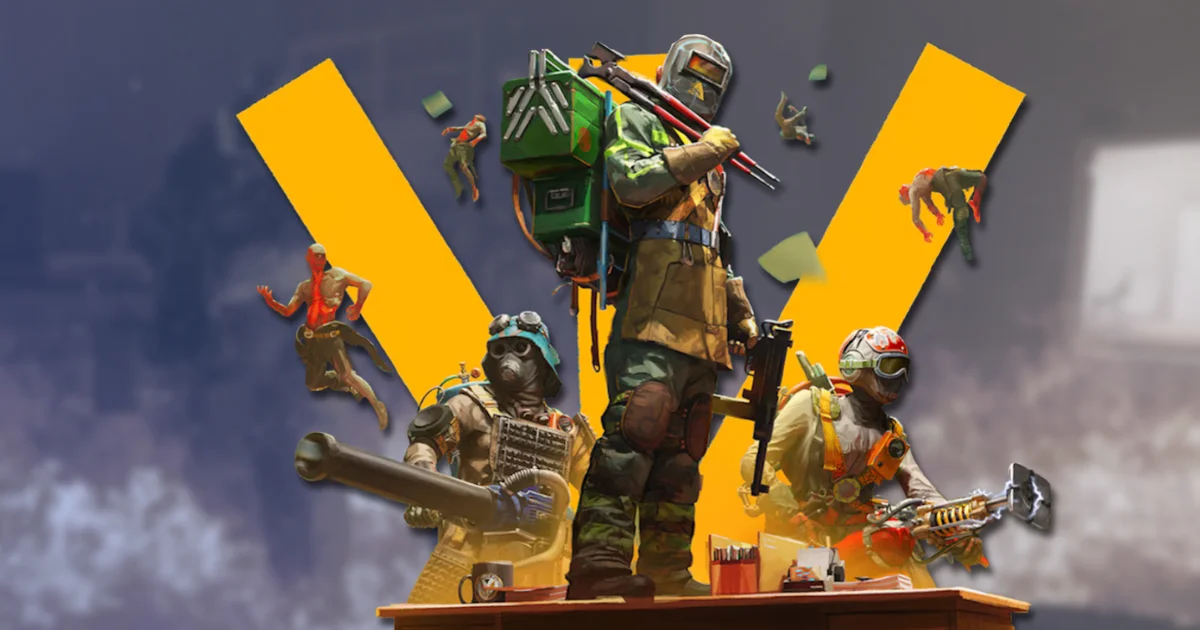
This game’s bold take on the idea of labor makes it feel like a standout experience.
In my most successful attempts—especially when I got the most surprising pairings—I ended up as the watering can operator. I tag along with two players who are far more capable while they repair machines and hold back the relentless assault, and I keep the watering going. I handle ground blazes so we can move freely and stop enemies from getting worked up by burning flames. I’ll also put out any fires my teammates accidentally trigger so they don’t have to sprint back to the closest shower station.
This approach holds up—right up until it doesn’t. I’m watering, then I round a corner and spot an elite threat waiting for me. “Oh, no,” I think. It’s RACHEL DAVIES. (Elite opponents in Firebreak always use names pulled from a fictional HR database.) Rachel Davies is engulfed in flames, floating in the air, and shredding us with devastating close-range damage. Enemies start materializing under her, and suddenly we’re swamped, cutting off any chance of getting the machinery repaired. At that point, the watering can operator’s only option is to go down quickly and with purpose.
Stepping back for a moment: Control came across as a pretty straightforward game that also seemed determined to make players see it as odd. Under the stylish chaos, it offered a familiar, satisfying blend of gunplay and physics-driven magical abilities, with plenty of fun showdowns against a range of foes that are, predictably, entertaining. FBC: Firebreak is a spinoff of Control, but the twist is that it’s a weird entry trying very hard to look ordinary. At first, it feels like a run-based co-op shooter that lands somewhere between Helldivers 2 and something along the lines of REPO. But then beneath…?
Once again, we’re back inside the Oldest House, the home base of the Federal Bureau of Control, an organization that manages whatever typically arrives alongside a theremin in a TV program. The Oldest House was the best part of Control—packed with great moments—so it’s a real pleasure to return. Polished concrete! Conference rooms dressed up with wood and glass! Unsettling Lovecraftian mines with slate roofs, with the kind of things that lurk where the shadows get thick. You get the idea.
In Firebreak, you play as a crew of endlessly replaceable janitors, and the jobs you take you often march into sections of the Oldest House that were just funny one-liners in Control. That room plastered with Post-it notes? Now it’s a mission to wipe out a Post-it infestation—and maybe take on a massive Post-it creature too. And that furnace setup that was so cleverly staged you almost feel your eyebrows start to smolder? It’s another task where you need to get machinery repaired and keep working through the turbines until they start venting again.
There are five mission types like these, each available in different arrangements that change length and difficulty. Still, they all follow the same core structure: there’s a troublesome, technical, and genuinely work-like chore for you and two other players to complete—whether that means cleaning up, fixing something, or loading an object. You’ll have something you need to avoid so you don’t end up coated in it—Post-its or that oddly tempting toxic pink goo. And you’ll also face Hiss, Control’s ghostly enemies, who show up at intervals to make your work harder.
The Hiss, along with the jobs themselves, help clarify Firebreak’s unusual loadouts. Along with a selection of firearms and grenades—some of which can be unlocked—players enter missions with one of three kits. One fires out water and is considered the most powerful option. Another sends out electrical jolts. The last one is basically just a wrench. Water puts out flames and soaks enemies. Electricity powers up machinery right away and can shock targets. The wrench repairs machines in seconds and gives you access to straightforward melee bashing.

Firebreak invites you to learn how these kits combine well—ideally, you discover it through surprise during an encounter. Douse Hiss with water, then have a teammate electrify them right after? You’re looking at major electrical damage. That’s one strong pairing, but there are plenty of other element-based strategies, and not all of them depend on the kits alone. I was around five hours in when a friend told me I could use a level’s zipline to knock out flames, for instance. Wind beats fire. Love it.
If this all sounds like it ends in a wildly chaotic experience, that’s not far off. You get conventional weapons, enemies that appear at random, elemental mayhem, and objectives that often boil down to being a little grindy. To keep things from feeling directionless, each level offers different stations you can maintain—respawn points, places to restock ammunition, and a shower area for rinsing off goo or Post-its. The overall effect is that you’re in a multiplayer match where everyone is working toward the same end, even if people periodically step aside to deal with their own immediate problems. We’re all handling that pink goo, but I’m out of ammunition, or I’m so soaked in the stuff that I can’t move. At times like that, it almost seems like a stretch to point out there are deployable gadgets and powerful abilities tied to each kit—and yet, yes, there are. For example, the wrench’s ultimate is a piggy bank, and you definitely don’t want to stand anywhere near it when it breaks.
I should clarify where I stand: I’m not bothered by tedium all that much. In real life, my favorite job was washing dishes in a restaurant, and I might still be doing it if mild hearing loss hadn’t made me realize it wasn’t the best fit. Lots of Firebreak-style elemental combos can happen in a kitchen when a dishwasher can’t hear “BEHIND YOU!”—but when tedium shows up in a game, it has to be used carefully. Since Firebreak has a system where levels can get both longer and more intense depending on your chosen settings, that kind of careful balancing goes straight into how the experience is stretched out.
Image credit: Remedy Entertainment
The most thrilling moments I’ve had with Firebreak were also the most frantic—exciting, quick, and gone before you could fully catch your breath. The stage wasn’t overly long, but it certainly wasn’t relaxing. We rushed to carry out our assigned roles and take down the Hiss, who were making every second feel difficult. Threats came from all sides, with corruptions thrown into the mix. These are random elements you can switch on and off, nudging the overall shape of a level just enough to change how it plays. There’s a spooky traffic light that slows you down (if my memory’s right), and a wrench that keeps flying through the area, steadily harming your equipment. The chaos becomes especially fun when the Hiss are flashing and the finish line is close.
That said, the toughest stages I ran into were either painfully long—load this object, bring it back in, move it on a shuttle, then wait for the departure before you can finally reach the exit—or they were so calm they felt almost dull. Here’s another workplace tale. When my wife was training as a nurse, her favorite shifts were in A and E, because there was never a quiet moment. You arrived, grabbed a Red Bull, jumped into the chaos, and before you could get another one, you were already heading home. Firebreak at its mildest can feel like an endless shift in a hushed ward. I was constantly repairing furnaces, with only the rarest interruptions from the Hiss to put my best skills to the test.
Past these details, the bigger picture is the system behind unlockable content and the perks you can collect and choose as you progress, plus extra slot options that let you build out your loadout as you grow stronger. There are some fun weapons to use, along with pleasing sprays and those ultimates that always feel like a dependable advantage. Still, the game can sometimes make you feel like it’s holding you in place—depending on whether you’ll end up doing something that isn’t very enjoyable for far longer than you’d like.
Even so, Firebreak can still throw you a curveball. Just last night, I took the risk of dialing the game up to its most chaotic settings and jumped into one of the pink room missions—it was fantastic. It was only me and one other player, both constantly busy, stretched thin every moment, yet still propping each other up while wave after wave crashed in. The sheer wildness of the game was oddly delightful and genuinely energizing. Combinations really started to click: I would soak everything with water while my partner ran in with electricity, blasting through an entire dance floor full of enemies. The mission still ran too long, but it didn’t matter, because we were doing something completely unbelievable. We kept pushing through the impossibility mines, and somehow it turned into a truly memorable run.
And that’s the heart of it: a game as unusual as this really leans on a solid player base—and with Firebreak, that support has been excellent. It’s one of the friendliest and most considerate communities I’ve seen. Just remember this: many tasks here are both tough and irritating, and you’ll need to split up duties and accept roles that aren’t always glamorous. Even so, players keep stepping up, giving me endless moments of kindness—from the person who kept throwing pings for me all the way back to the escape elevator, to another who waited at the elevator for a full minute so his teammates could return.
What a strange—and surprisingly unlikely—thing this is. If Control were built around a fairly standard action game with world-class visuals, it would make sense. But Firebreak feels as though it’s taken the opposite approach, shaping its key ideas directly out of that visual style. It’s really about mending furnaces and collecting Post-its, encouraging you to work with strangers, and—sure—throwing in some interruptions from the Hiss as you go. It’s basically Control fan fiction, and I mean that even if you never play the mission where you’re fixing those giant fans.
Code for FBC: Firebreak was provided by the publisher.