I genuinely get a kick out of Monster Hunter; and by that, I mean a great deal of Monster Hunter—seriously, I can hardly believe how many hours I’ve poured into the series over the years. I love the sheer spectacle of the hunt, I’m fond of the comically oversized blades and the ridiculous outfits built from monster materials, and, above all, I can’t help but grin at the half-cheerful, half-flirtatious “Soooo delicious!” (Thanks for bringing it back, Capcom). What I haven’t fully latched onto yet, despite giving it a sincere go and coming in with plenty of excitement, is Capcom’s lively turn-based RPG spin-off, Monster Hunter Stories. Still, with the debut of its third entry—Monster Hunter Stories 3: Twisted Reflection—I have a feeling I may finally be ready to jump in.
Why? For starters, it probably helps that I’ve been chasing something to scratch my Monster Hunter itch after I quickly cooled on last year’s Monster Hunter Wilds. That title was enjoyable enough at release, even if it felt like it couldn’t decide what it wanted to be, but after a year of post-launch updates, I’m not sure it ever truly found its footing. Monster Hunter Stories 3, on the other hand, appears to understand its purpose immediately, settling into a reassuring rhythm of turn-based fights and monster-collecting that, by the time it reaches its third outing, has clearly been polished into something special.
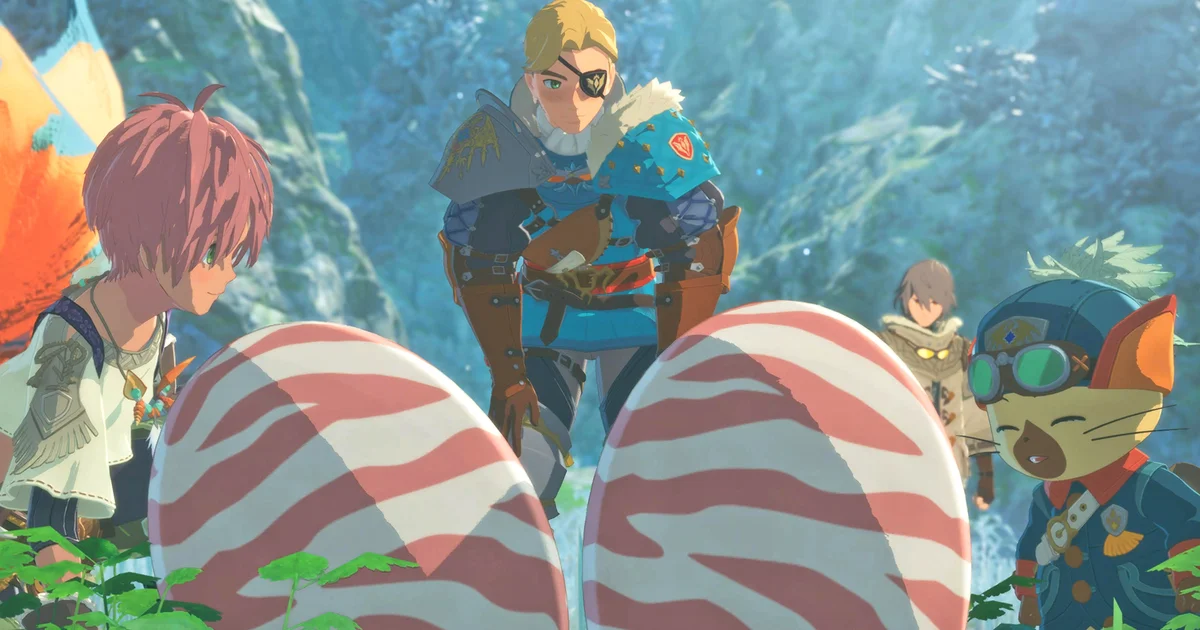
Oddly enough, the gap between the Stories games and their mainline siblings may feel narrower than ever this time, especially as the larger franchise leans more into storytelling while Monster Hunter Stories 3 carries a more “grown-up” tone. In this third chapter, the previously carefree childhood escapades from earlier Stories titles shift toward a tale about young adults and their full-grown “Monstie” companions, as they move through a world shaped by troubling blight and political instability—while the looming threat of war from the nearby kingdom hangs over everything. It’s a touch more layered than what came before, with themes that feel a bit more considered, yet at its core it remains thoroughly enchanting. The setting, Azuria, is staged beautifully—a blend of fantasy and fairy tale logic—so it’s a joy to roam. The cast is also easy to get along with (the English voice lineup is strong, even though you have to put up with a Felyne buddy whose sweet baby-voiced excitement starts to get old pretty fast). It’s a wholesome base, and from there it only keeps improving.
If you know the Stories series, the turn-based structure of Monster Hunter’s creature battles should feel familiar—something I’ve appreciated in earlier games, even if I never fully connected with it—yet it plays just as lively here. It starts with a familiar matchup triangle: Power beats Technical, Technical overpowers Speed, and Speed outstrips Power. It’s an uncomplicated foundation, and there’s a clear reason for how it grows from there. In combat, your goal is to lean toward the options most likely to land damage on your opponent, using that triangle as your guide—whether that’s through your weapons, your Monstie companions, or your skills.
Basic strikes cause basic damage (and you can even aim at specific body sections, very much in the Monster Hunter tradition), but skill maneuvers are better suited to cutting into a monster’s Wyvernheart Gauge. When that gauge hits zero, the creature drops—opening the door to a huge follow-up assault. Of course, that’s only the start. You also get head-to-head attacks; double-attacks where a rider and their monster land hits in sync; a Kinship Gauge that steadily climbs, unlocking mounted Monstie attacks, while your weapons bring their own extra layers of complexity—and sometimes their own Gauges!—to further deepen the system. It’s a hefty combat package, but it’s also a lot to take in, which is generally where I’ve stumbled in the past.

This time, though, for reasons I’m not entirely sure I can put into words—maybe because the tutorial ramps up more gradually, or maybe thanks to a more forgiving climb in difficulty—it finally “clicked.” Sure, I’m still learning a number of ideas I was already familiar with, and there’s still plenty I’m trying to fully understand. But instead of feeling a little uneasy the moment a new fight starts, I’ve been fully locked in. Major showdowns aren’t usually what you’d call quick (especially when you’re dealing with the new feral monsters, whose weak spots only appear during particular windows), yet the battles have a sprightly pace and plenty of visual style—giving them a tempo that fits Monster Hunter’s action roots.
Now that I’m finally understanding the combat, it’s easier to enjoy everything else, too. The heart of the monster-collecting loop—heading out to the field, taking eggs from Monster Dens, and hatching them back at your base—stays completely addictive, with its mischievous gacha-like pull as you hold your breath for something exciting (when I finally hatched a baby Anjanath, it was basically game over for the rest of my team). You truly form a bond with your Monsties as you fight alongside them and explore together. And the exploring itself—the happy feeling of discovery—is front and center in Stories 3. Azuria (made up of big, connected regions rather than a fully open world) feels enormous and invitingly designed: distant hilltops and intriguing depths draw you in; you’ll find yourself wondering what’s waiting on that small island surrounded by water, or what secrets are tucked away in odd corners near the edges of the map.
Sometimes the main storyline points you toward new areas, but more often than not you can wander freely as well. Whether you’re doing errands for locals, tracking down Poogies, grabbing additional eggs, or simply thinning out the local monster population to obtain the materials needed for fresh armor, weapons, and other upgrades, the game keeps you moving. It’s an excellent set of interlocking systems, with your Monsties acting as the link that ties it all together. Yes, battles are thrilling—there’s something even better about launching your Rathalos into the sky and gliding over the landscape, or darting up steep cliffs with a Tobi-Kadachi, or cutting smoothly through the water on a Plesioth—it’s even cooler than you’d expect. Plus, because Monsties share plenty of traversal overlap, you also get plenty of flexibility in how you put together your adventuring group.
I know I’m probably only at the very start of what Monster Hunter Stories 3: Twisted Reflection has to offer—maybe just seven or eight hours in—but it has already grabbed me in a way none of the earlier games managed. And no, I never imagined I’d end up enjoying a turn-based Monster Hunter side story more than the most recent mainline release, but that’s exactly what’s happening. Capcom’s latest looks fantastic, feels genuinely engaging, and delivers plenty of excitement—it’s the perfect mix of playful charm, and I’m excited to keep going. All I need now is a Khezu to add to my roster (I’d also happily take a Nargacuga), and then I’ll be completely sold.