Recently, the Digital Foundry crew met online to decide on the standout video game visuals of 2023, with Alex Battaglia, John Linneman, and Oliver Mackenzie each putting forward their favorite picks. What struck me most about their lineup—spelled out in full at the end of the piece—was how often the choices weren’t simply trying to push graphical tech to its absolute ceiling with heavy feature overload. Instead, the selected titles—especially the highest-ranked entries—were designed with care to strengthen gameplay, while working to get the most out of the (frequently constrained) hardware they were running on.
Hi-Fi Rush and Super Mario Bros. Wonder, in my view, capture this idea particularly well. Both began as first-party releases, and both stand out for their bold, unified visual identity. They present lively, imaginative worlds packed with characters whose exaggerated motion and poses draw you in. For example, Hi-Fi Rush makes the effect even more pronounced through its cel-shaded look and its “on twos” animation pacing, giving the whole experience the feel of an interactive cartoon.
In both cases, the chosen visual and animation approaches do an excellent job of supporting the moment-to-moment play. Controls feel responsive, and the environments feel full of energy and tuned to what you do—whether that means the way enemies and flowers respond in Super Mario Bros. Wonder, or how the world subtly falls in step with the music in Hi-Fi Rush.
Even though they arrived on two of the most performance-limited platforms available—the Xbox Series S and Nintendo Switch—both games still hit their targets. They delivered consistently snappy gameplay in a way that many console releases have struggled with, particularly on Switch, where this year brought a number of launches that may have been too ambitious. Just as important, neither title depended heavily on image reconstruction to compensate for a low starting resolution. That kind of approach became more common across all platforms during 2023, and it left several console releases feeling noticeably less crisp, with weaker overall image quality.
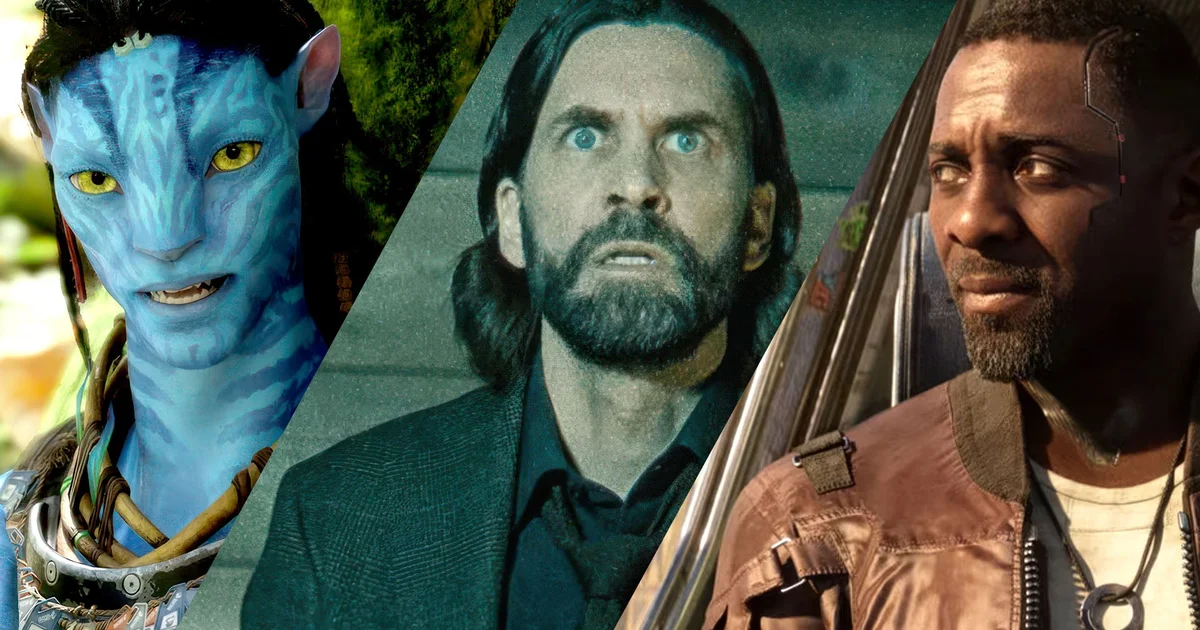
The top three slots on our list went to Cyberpunk 2077 with RT Overdrive, Avatar: Frontiers of Pandora, and Alan Wake 2. Each of these games combines sharp, efficient visuals with genuinely groundbreaking ray tracing. Two of the three also offer full path tracing on PC, which essentially swaps out the long-established simulated lighting used in traditional raster-based games for a more realistic solution that, as the saying goes, “just works.”
Even going into the beginning of 2023, I wouldn’t have expected to see this many AAA titles successfully upgraded with path tracing. The impressive path-traced retro remakes we’d encountered on PC over the past few years still created serious performance hurdles. Clearly, progress from both creative teams and graphics card makers has been substantial here, and it deserves credit. I also feel studios have gotten better at making these RT enhancements look compelling. Earlier attempts sometimes leaned too hard on the trade-off, sacrificing performance for only small improvements in visual fidelity.
When these RT and PT methods are used well, they can act like a force multiplier—allowing smaller studios to put together visually striking games without needing huge technical and art teams. For instance, it can remove the need to manually place extra lights inside a scene just to achieve a certain look. We saw a similar effect in another top 10 selection, RoboCop: Rogue City. That game leaned on Unreal Engine 5 capabilities like Lumen, Nanite, and VSMs (virtual shadow maps) to produce remarkably lifelike environments, packed with detail while sticking to an AA-sized budget.
As we move toward 2024, I hope other developers and publishers take lessons from both the achievements—and the missteps—of 2023. From where I stand, the best games of the year were the ones that had enough time to mature, using graphical techniques and technologies with judgment to back up gameplay and satisfy performance goals, rather than treating it the other way around.
None of these choices are simple or painless, especially during the realities of development, but there are at least some encouraging signs that studios are heading in the right direction. After all, the end of 2023 clearly showed more technical capability (and quality) than the start and middle of the year. With any luck, we’ll see this momentum carry into the next twelve months—and maybe even spot the arrival of fresh consoles and graphics hardware to keep things moving forward…