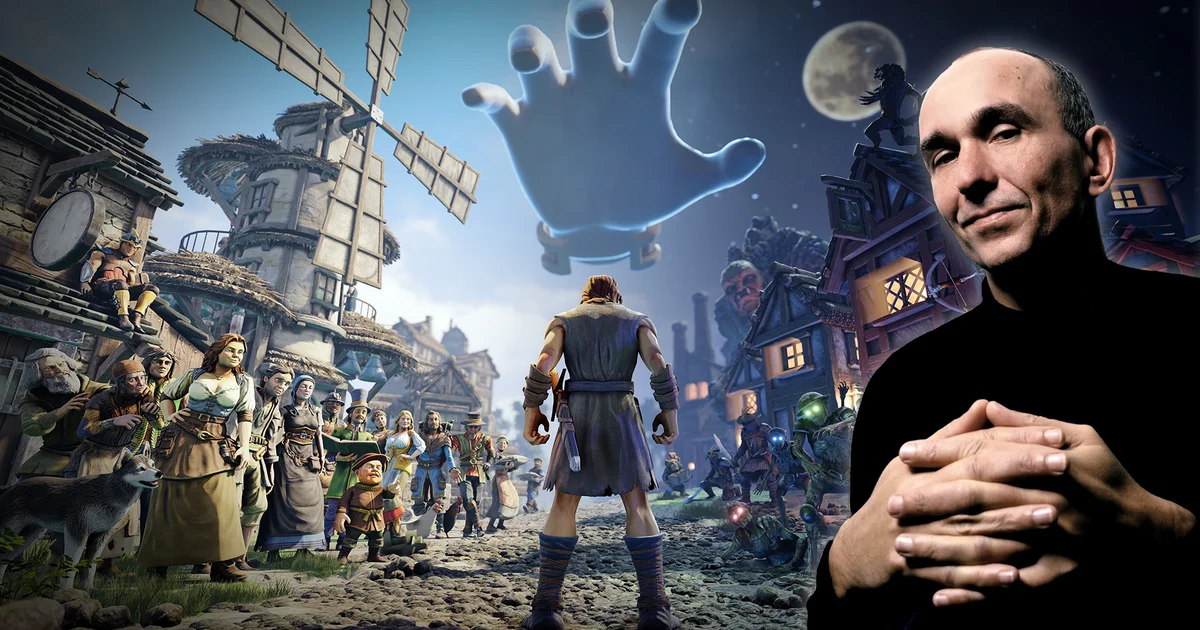
Not many creators— even after all this time— have the ability to pull you into their own energy the way Peter Molyneux does. His famous zeal has, at times, put him in hot water before, when enthusiasm and expectations didn’t fully match up with what players ultimately experienced, often leaving them to sort through the fallout. For that reason, it’s hard not to be cautious about 22Cans and Molyneux’s newest project, Masters of Albion. Still, since I have real affection for the earlier Bullfrog and Lionhead games, and because, after listening to Molyneux passionately lay out Masters of Albion for 45 minutes, it’s difficult to shake the sense that this might finally click— particularly since this out-of-the-ordinary compilation promises plenty of the ingredients I care about most.
Molyneux himself (or at least the team behind his pitch) has been quick to draw parallels to his former successes while talking about Masters of Albion, pointing toward classics such as Dungeon Keeper, Black & White, and Fable. It’s fair to say there are recognizable echoes of those fan-favorites here; Masters of Albion is a mix of many different ideas competing for attention, with a wide range of familiar touches as it fuses god-style simulations with management gameplay and action-adventure beats.
In Masters of Albion, you may hold an all-powerful divine hand— zapping enemies with mana and lifting people into the air— yet even an omnipotent being can’t get very far without money. That funding is used to buy supplies, commission new structures, bring on workers, unlock technologies, and more. This is where its city-building and business-management side starts to matter. Surprisingly, the nearest comparison seems to be 22Cans’ earlier release, Legacy, which revived several of its most appealing features (appealing, that is, until the project’s later turn toward blockchain) by building wealth around production chains designed with a strong emphasis on customization.
Your buildings— from farms and mines to smelters and factories— are put together by clicking blocks into place, in a Lego-like fashion. Usually you’ll need something like an entrance, a roof, and a delivery/collection point, but there are still decisions to make beyond that— some purely aesthetic, others tied to function. For example, you might house citizens right in their workplace, or combine building types (a smelter with a factory, for instance) to reduce travel time. Even so, it looks like the more elaborate the construction, the more likely the components won’t line up neatly, which in turn can lower overall efficiency.

That building-by-modules approach— also seen in Legacy— extends to how goods are manufactured. If you want a factory to produce pies, for instance, you’ll need to design the pie first: drag and drop components from a selection to create a blueprint, then begin large-scale production. The same idea applies to weapons, which you’ll craft using parts like blades, cross guards, hilts, and more. It looks like costs and earnings are shaped by a market simulation, while the level of complexity influences how long construction takes. And because you’re a deity, you can speed up output by sweeping your magical finger over buildings— a slightly whimsical yet very on-brand gesture for Molyneux’s most beloved games— or you can personally move materials to the delivery location to shave down production time, though that choice costs you precious moments you might prefer to use elsewhere.
Step away from the headline focus on pie-making, and the influence of Molyneux’s earlier work becomes even clearer. Viewing the world from above, the overall look and feel brings Black & White to mind as you manipulate the environment with your grand hand. Your control is limited to an active area, but you can’t command a region until its beacon is ready; once that beacon is running, your heroes move in. Take charge of one, and Masters of Albion suddenly starts to echo Fable, letting you guide them directly from a familiar third-person action-adventure perspective— for example, hacking through foes and heading to a beacon to expand your divine influence.
During the presentation, this included fighting along rough mountain paths— and, reportedly, you can also take control of animals and other humans to get around the world, though they won’t be able to attack. After a beacon is activated, you’ll have enough influence to restore it by piecing it back together from fragments scattered across the landscape. From there, all that remains is to power it with mana, and you’ll secure full control over the area (plus added benefits such as new heroes or building components). After that, it’s time to kick off another set of regional production chains.
One more key detail is worth underlining: everything described above happens during daylight, when the atmosphere is deliberately calm, giving you time to work through objectives or step into your hero’s role while exploring. Night, on the other hand, is meant to create a much messier situation— monsters move to attack your colonies and the genre shifts again, this time taking cues from tower defense. That suggests the final stretch of each day should be devoted to preparing for an assault. In regular mode, time advances on its own; in casual mode, you choose when the day ends and night arrives. Either way, you’ll want to cover your settlement’s weak spots with heroes or build costly modular turrets topped with a trebuchet or ballista to hold out until dawn. And yes, there’s a permadeath mode if you decide to use it.
So that’s Masters of Albion— at least most of what was packed into Molyneux’s 45 minutes of uninterrupted hands-on time. A few pieces are still hard to pin down, too; for example, the way third-person exploration plays out hasn’t been explained in depth yet. And my cautious skepticism probably won’t loosen until I’ve tried the game myself. Still, as a demonstration of ideas, the way Masters of Albion’s very different systems flow together is genuinely intriguing, and I can’t pretend the Bullfrog fan in me and the Lionhead admirer in me aren’t— perhaps a little naively— curious, and even hopeful, about what comes next.
Honestly, I’d like it to succeed. Part of that is, of course, selfish— I miss games of this sort, and I’m drawn to this kind of bold, wide-ranging creativity. And if it truly ends up being Molyneux’s last game, as he recently told Eurogamer, it would be satisfying (speaking as someone who has gotten a great deal of enjoyment from the titles he helped shape in the past) to see him close out on a high note. Of course, this isn’t just a Molyneux effort; 22Cans is also involved, and this time includes well-known names like former Media Molecule lead Mark Healey, serving as art director. Russell Shaw, the composer behind Fable and Dungeon Keeper, is handling the music, alongside Ian Wright, whose design credits include Fable 2, Black & White 2, and Alien: Isolation. Whether their combined talents can produce something truly special remains to be seen— but we’ll learn more when Master of Albion opens into Steam early access on April 22nd.