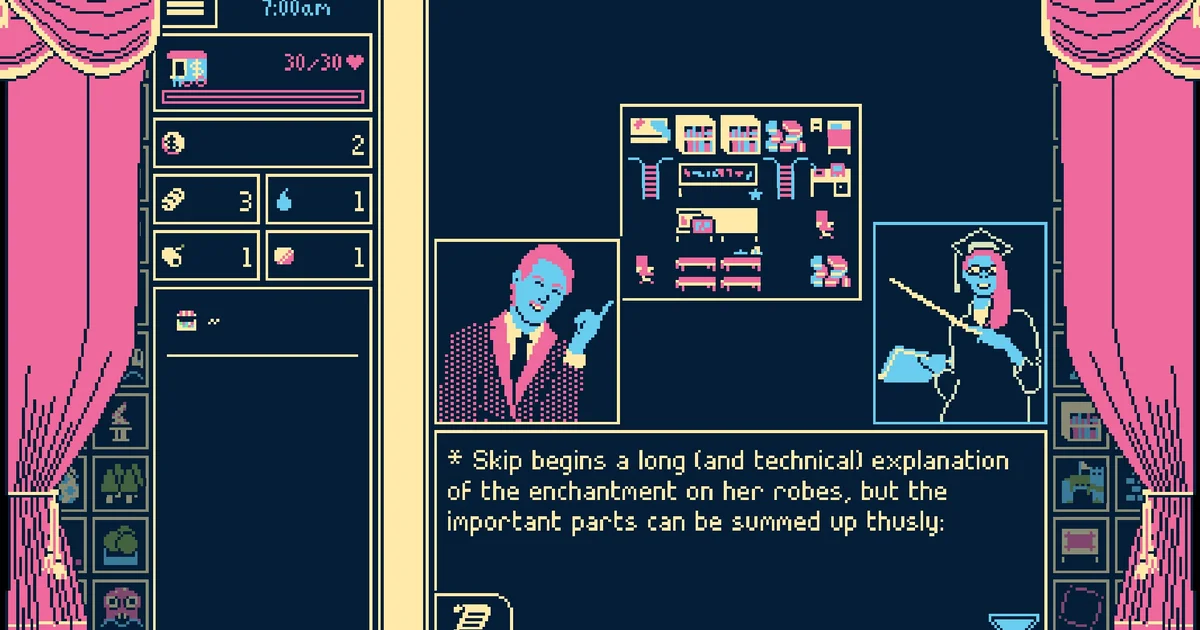
This blend of styles captures its own inventive spark and offers plenty to enjoy.
Should you spare the egg? Sure—why not. The twist is that the egg is actually a football, and this particular football brings a quirky yet unforgiving mood to the game. Keep the football alive—can a football even be allowed to die?—and you’ll gain some sort of satisfying payoff. Let the football run out, and you’ll be giving up more than you might expect. It makes sense that this unusual opportunity to own a football comes with an upfront cost. You’re rewarded right away for taking on the challenging responsibility of protecting it. And remember: the football is probably an egg. So what now?
Titanium Court stands out as an important—and often thrilling—illustration of how game design can work, at least as I see it, because it captures the sensation of being genuinely taken by a game. I mean that in a precise way. It’s not a romantic story, and even within a single play session, the plot and the ever-growing cast can be tough to keep straight. At first, a lot of the emotional momentum feels uncertain; meanwhile, curveballs like the arrival of the football can come across as oddly random.
Still, I’m convinced the game is powered by affection. It’s deeply invested in its own originality, imagination, and impressive level of detail. It seems to relish the momentum it creates as it turns one moment into the next. It enjoys tossing eggs at you—and then insisting they’re footballs. Mostly, it’s delighted to turn that playful material into yet another layer of inventive mechanics for you to work through.
You can see that especially in how unclear so much of the game remains during the opening stretch. Titanium Court keeps cutting into its own flow, offering extra context and shades of meaning, or even overturning an idea it just introduced, or adding a surprise turn. After putting in enough time, I can boil my current understanding down into something simpler: it’s essentially a creative and ridiculous investigation of what match-three games can do with their storytelling. Yet why reduce it when Titanium Court thrives on layered complexity?
Take a breath. Each morning, I wake up and move through the rooms and gardens of an unfamiliar court. I assume the place is run by faeries, and I could easily matter—at least a little—in that faery world too. I probably picked this up during the early part of the game, but honestly, friends, Titanium Court passes along so much context across so many subjects that I’m left struggling to hold onto everything.
So what I truly understand boils down to this: I stand up, then I go eat. In these ordinary moments, I learn a little more about the game’s world—similar to how grabbing a shower leads to a quick match-three sequence with soap and foam, or how visiting the library does something different, or how unlocking a new room opens the chance to view a new painting, meet a new stranger, and trade brisk, back-and-forth dialogue. Even my first magic lesson adds to my understanding, only to learn I’ll be the one teaching the next session, even though I’m pretty certain I don’t know anything about magic. Why is that?
Much of what you encounter both builds on and complicates the broader structure, delivered through smart, playful writing and endearing little characters that move inside tiny setups. When major events hit, you get pixel-art scenes that act like metaphors—something like a home run!—a cat with a mouse clenched in its mouth!—along with portraits of various members of your court, who usually look like 1980s magicians in thin ties and sharp suits with cuffs pulled up. Nothing is hidden up these sleeves.

That odd sense of nostalgia is part of the charm. The little bits of artwork and the portraits bring back the feeling of stacked playing cards popping onto the screen at the end of a round of Windows Solitaire. The whole game’s color scheme leans into the sweetness of childhood ice cream, with soft pinks and beiges. When battles finally show up, they play on a grid that feels like a tempting mega-slice of Battenberg cake. Delightful! Doesn’t the entire game come off as as cozy and cheerful as marzipan?
In terms of combat, this is where the experience shifts from a whimsical visual novel and its nod to A Midsummer Night’s Dream into a more authentic match-three setup. I call it authentic because plenty of match-three elements carry over. For example, matching from the bottom to give yourself the best shot at a cascade of good fortune falling in from above. And speaking of that luck from above: Titanium Court faces the same problem that affects every game that tries to make match-three into a fighting mechanic. In other words, it doesn’t always feel properly balanced. You can’t foresee what’s sitting above the part of the board you can actually see. You have no idea what might be hanging overhead.
Plenty of games address this with clever workarounds. Take Gyromancer, for example—dear Gyromancer—which turned your own wasted moves into strikes aimed at your opponent, not so much punishing you because of chance as because of your own lack of finesse. I’d describe Titanium Court’s method as having two parts. First, it rarely takes itself too seriously. Second, it hides any concerns about fairness under a flood of oddball ideas—gimmicks, eggs, footballs—along with birdcages, strange jars, and plenty more…
Let’s not overcomplicate it. Fights are split into two different stretches. During High Tide, you gear up for battle by running a match-three round on the tiles you’re given—tiles that show the battleground you’ll be fighting over,
meaning every tile pulls double duty. On the one hand, they supply resources; on the other, they shape how the clash ultimately plays out.
Mountains produce stone, while rivers provide water. Even so, mountains also form ground that troops move through slowly, and water blocks units that don’t have boats. So, right at the start of each battle, you’re weighing choices like: if you match water with mountains for the resources you’ll soon need to fund new units, or if you instead focus on defending your crucial court tile—the one that will take damage during the fight—using a moat and surrounding mountain terrain?
Then it keeps spreading. Do you match crops for food, or spend your scarce matches on hitting enemy strongholds? If you take them all, the fighting portion may start with no forces left to oppose you. But you’d also be giving up those vital resources, which matters, because each battle is only one part of a much bigger chain.
Moving on. By keeping certain tiles in reserve—such as chests, shops, and other features—you can crack open those chests and drop by those shops after High Tide ends. In other words, the number of things you do during High Tide can feel a bit overwhelming, even when you’re playing on the gentlest settings. You’re arranging the battlefield, gathering resources, protecting what matters, shifting your stronghold to improve its safety, and cutting down the enemy’s numbers.
Now turn on Low Tide. At this point, the match-three portion becomes an auto-battler. You set up your units and then watch how they perform. Maybe you lean toward units that bring in extra resources. Or perhaps you focus on units designed to defend your base. Another option is that you’ve picked a class—called jobs in this game—that lets you trigger effects across nearby tiles.
Your opponents range from ordinary troublemakers to tougher threats like centaurs, wormholes, catapults, and warships. Each one brings its own challenge, which only adds more layers to the already tangled decisions you make throughout the game. See the battle play out—how much health did you lose, how many resources did you spend, and which area of the in-game map are you heading to next, knowing that this choice will influence which enemies you’ll feel most ready—or least worried—about meeting after that? And keep in mind: this is how the game feels at its most basic, least decorated level.
At first, I thought the heart of Titanium Court was combat. Now I see that combat is simply the most obvious, game-like element of the overall experience—while the real spirit of the project comes from the exciting overlap between its moving parts and the energy of a campaign that keeps rolling out fresh, increasingly varied content. It can feel like too much. It can feel exhausting. And sometimes, it really is. Still, it doesn’t stay just exhausting all the way through.
That’s because there’s genuine drive behind it. I’m not a game designer, but I can recognize—or at least I tell myself I can recognize—some of the thinking in play here. It reminds me of those moments in difficult writing, when you’ve pushed past the essential hurdles—the toughest hurdles—and then you unexpectedly start enjoying the work itself: shaping sentences, wanting to linger, and building on ideas until they feel endless.
I once had an instructor who called this kind of thing “plussing,” and, like that notorious egg/football, it’s both thrilling and risky. That’s the stage where I often end up damaging what I’m writing—smothering it with an overzealous love of the process. It’s like ruining the lines of a piece of clothing by stuffing every pocket full of toy cars.
But that’s just my take. Titanium Court proves how much potential can come from moments like these. Even from fairly basic—though varied—building blocks, like visual novels, match-threes, and the familiar bits you’d expect from roguelites, it keeps expanding. Characters. Dialogue. Lore. New directions. Shower sequences. Strange little musical detours—I’m having trouble capturing the exact feel of the soundtrack, except to say it may once have had something Surf-like about it, and it definitely feels thoughtfully constructed—and then there are imposing bosses.
That, I think, is what the passion looks like. The developer clearly reached a point where everything became clearer, and the horizon started to look wide open. In that instant, a bright realization kicked in. Let’s say it plainly: they saw that they could keep adding more and more elements, without end.
A copy of Titanium Court was provided for this review by Fellow Traveller.