Gamescom 2024 has officially kicked off in Cologne, and alongside a slate of game reveals during Opening Night Live, a sizeable wave of brand-new PC components has also been shown for the first time.
Below are my current personal standouts from the event—featuring next-gen AMD Ryzen motherboards, a promising new PC handheld, fresh developments in the gaming monitor space, and a selection of special-edition gear created to mark the big debut of Black Myth: Wukong.
Pick your six favorites from the list below, or keep scrolling!
AMD X870 and X870E motherboards have finally arrived
Image credit: Asus
You might recall that we tested the rather underwhelming Ryzen 9000 lineup on the same X670E boards from 2022 that shipped with Ryzen 7000. Now, just a couple of weeks later, the new X870E and X870 models are finally here, with Asus using Gamescom to showcase eight X870E and X870 variants—seven ATX and one ITX.
As with other AMD 800-series chipsets unveiled since Computex earlier this year, these boards include features like WiFi 7 and USB 4. Still, Asus is trying to separate the lineup with improvements such as a refined UEFI, tuned “NitroPath” DDR5 memory slots, and tool-free latchless PCIe connections for graphics cards. Beyond that, there are several “AI” features aimed at overclocking, cooling, and networking. Most of them don’t really use AI in the strict, traditional sense, so for now we’ll put those aside.
Good news: the non-AI changes are a lot more interesting. I’m especially curious about the updated UEFI built into these boards. It can show a live breakdown of every connected component through a diagram—backed by a sharper, higher-resolution interface for easier reading. From that view, you can jump straight to the relevant settings for the selected device; for example, you can move directly to fan controls when you’re looking at a connected fan header.
This one is special: New UEFI BIOS functionality for the latest ASUS AM5 X870 motherboards, including a new UEFI BIOS Q-Dashboard
I have been with ASUS for more than 15 years and have been fortunate to collaborate with our team since we first implemented UEFI as part of our firmware/BIOS. Our… pic.twitter.com/w788KlHTwD
To see this content please enable targeting cookies.
At the top of the lineup, the X870E Hero and the Strix X870E-E Gaming WiFi add DDR5 refinements under the “NitroPath” name. That includes gold finger pins, reduced signal lengths, and firmer retention. Asus claims this approach could unlock RAM speeds up to 400MT/s faster than their earlier, more conventional designs—potentially useful for anyone aiming beyond the usual 6000MT/s sweet spot. On the broader X870E/X870 lineup, Asus supports JEDEC settings up to DDR5-5600 and also includes real-time memory overclocking through Ryzen Master, meaning there’s a good chance for worthwhile results if you enjoy dialing in RAM.
Finally, a few models feature “Q-Release Slim” PCIe 5.0 slots. These allow you to keep a graphics card secured during normal use, but let it come off cleanly with a simple movement—without having to manually unlatch the slot or even press a button like you had to on Asus’ original Q-Release PCIe design. This is the first detail on the new boards that I plan to dig into, since the updates are slated to launch in September.
Zotac Zone PC handheld—can it stand up to the Asus ROG Ally X?
Image credit: Zotac
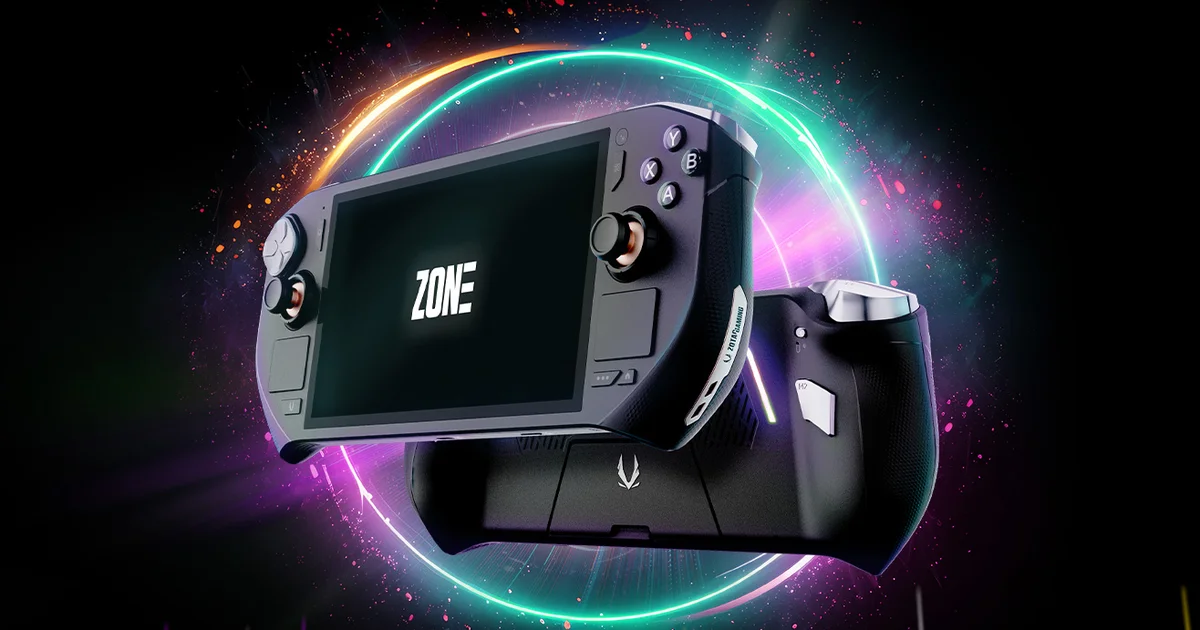
Zotac is moving into the growing PC handheld arena, taking on brands such as Asus, Lenovo, and MSI. Its Windows 11 handheld is called the Zone, and it pairs a Ryzen 8840U chip with a 1080p 120Hz OLED display (!). Pricing comes in at $799, putting it directly across from the (impressive) Asus ROG Ally X—and it’s hard to see what would convince buyers to choose the Zotac option instead.
On paper, though, the Zone is less capable than the ROG Ally X. It has a much smaller battery (49Wh versus 80Wh) and less memory (16GB versus 24GB), even if the rest of the hardware is largely similar. The OLED screen is its main selling point, and it’s true that it performed extremely well on the Steam Deck OLED. Still, the Zone may need to be priced below the updated Asus handheld to have a real shot at competing.
The software side is also somewhat of an open question. Asus’ Armory Crate software doesn’t match up to SteamOS, but it’s likely the most complete Windows handheld software package we’ve seen so far—even with experienced handheld makers like Ayaneo struggling to keep up. Zotac’s experience should improve thanks to updates to the Game Bar, which are meant to benefit all Windows 11 handhelds, although it may not feel as refined. There’s also the possibility that SteamOS could be a bit more awkward to run on the Zotac hardware, since Valve is concentrating on the Ally for porting its operating system.
Even so, first impressions of the Zotac Zone
Overall, the early feedback has been largely positive—especially when it comes to the quality of its controls—so we’ll need to wait a bit longer to see how the finished product holds up once it arrives, which is likely to be in September.
Asus
unveils its first dual-mode LCD display, shifting from 4K 160Hz to 1080p 320Hz
Image credit: Asus/Digital Foundry
CRT monitors have long been surprisingly flexible. With a bit of tweaking, people could often drive them to much faster refresh rates by lowering the resolution—and even this year, we’ve seen enthusiasts pushing 700Hz on older CRTs using this approach. LG was the first to apply a similar idea to modern displays, releasing a 32-inch OLED that can instantly switch between 4K 240Hz and 1080p 480Hz. Asus is now stepping into the same concept with a 27-inch ROG Strix XG27UCG LCD model, featuring a “dual-mode” setup that lets you choose between 4K 160Hz and 1080p 320Hz.
For buyers who want sharper detail for productivity or solo titles, while still needing a highly responsive option for esports, this seems like a strong mix—and it should cost less than the 32-inch LG alternative. Keep an eye out for a release by the end of the year, with pricing coming later.
WD reveals an 8TB SN850P PS5 SSD—though you should probably go for the far cheaper SN850X instead
Image credit: WD
The WD SN850P is one of the best SSD upgrades for PS5, and WD is now offering an eye-catching 8TB version at $999/£719. The issue is that this price is a steep jump compared with the similarly configured WD SN850X, which is listed for £654 with a heatsink or £600 without directly on WD’s own site. I recommend choosing the SN850X: its heatsink edition works just as well with PS5, and—naturally—both versions can be used in a PC too. The only thing you lose is one month of PS Plus Premium worth £13.49, which is hardly a deal-breaker!
Black Myth: Wukong and Warhammer 40K: Space Marine 2 Edition graphics cards are here—though you (probably) can’t buy them
Image credit: Asus via Videocardz Image credit: iGame
Both the striking Warhammer 40K: Space Marine 2 and the technically impressive Black Myth: Wukong have sparked special edition GPU launches at Gamescom. Asus has made a limited-run RX 7900 XTX for the former, while a host of Nvidia partners have produced RTX 4070 through RTX 4080 Super themed models for the latter. The Asus Warhammer artwork looks fantastic, but with just 20 units made, you’ll need to take part in a giveaway to get one.
Meanwhile, it looks like the Wukong cards are headed for wider availability, with product listings appearing on JD.com for the Chinese market. Top-tier choices include the Colorful RTX 4080 Super iGame Advanced and the Galax RTX 4070 Ti Super 20th Anniversary, plus six separate RTX 4070 Super special edition versions from MSI, Gigabyte, Zotac, Inno3D, Gainward, and Manli. The entry-level Wukong special edition GPU starts at 4949 RMB (~£530), while the priciest reaches 9199 RMB (~£990).
Nvidia moves the RTX 4070 to slower GDDR6 and drops the G-Sync module to cut costs
Finally, here’s an odd development: Nvidia has confirmed that its partners are now manufacturing RTX 4070 graphics cards with GDDR6 memory, rather than the faster GDDR6X used in the standard RTX 4070 and in all higher-end Nvidia RTX 40-series cards. Nvidia describes the change as a move “to enhance supply and availability to satisfy robust demand,” and it should also help lower material expenses by making it easier to source more plentiful GDDR6 modules.
I’m uneasy about this, because many buyers may not notice the switch and could reasonably assume they’ll get the same performance as the GDDR6X version. Nvidia says the updated cards provide “similar performance,” and with roughly a five percent reduction in memory bandwidth—from 21Gbps down to 20Gbps—we would expect results to land in that vicinity for most types of workloads. Even so, these models ought to be clearly labeled and priced appropriately, and we’ll have to wait to see whether that expectation holds.
Nvidia also stated that its G-Sync tech has been built into MediaTek scalers, replacing the separate Altera FPGAs that previously made full G-Sync monitors about $100 more expensive than their FreeSync and G-Sync Compatible alternatives. The new MediaTek scalers are set to appear in the AOC Agon Pro AG276QSG2, Acer Predator XB273U F5, and ASUS ROG Swift PG27AQNR—each a 1440p 360Hz model expected later this year. All three will support G-Sync Pulsar, combining variable frequency BFI and VRR, so it’ll be interesting to see how the technology performs in practice—especially if these models end up costing less than typical G-Sync monitors.
That pretty much covers it for the moment, though there’s plenty more I’d have liked to dig into. A few compelling items that didn’t make the final roundup include Crkd’s compact yet practical gamepads, the higher-spec and well-designed Philips Evnia 8000-series monitors, and HP Omen accessories featuring the good-looking HyperX Alloy Rise 75—a wireless gaming keyboard rated for 15,000 hours.
Good news, though: the helpful team at the Eurogamer news desk has also reported on a non-PC hardware announcement. The digital, white-chassis Series X is available to pre-order.
I’m sure there will be more Gamescom updates before the event wraps up, so stay with us—and if you’re going along, you can pick up a Digital Foundry or Eurogamer shirt from the IGN merchandise shop on the show floor.