AMD has already unveiled its newest Ryzen Z2 lineup for handheld PCs, yet its CES 2025 keynote (along with accompanying media briefings) went further by also revealing a brand-new class of graphics cards and a refreshed set of X3D chips for both desktops and laptops.
Let’s start with the graphics updates. In its briefing to the press, the American company detailed two GPUs built on the new RDNA 4 architecture: the RX 9070 XT and RX 9070, plus a highly anticipated upgrade to its FSR upscaling suite, FSR4.
The RX 9070 XT and RX 9070 are meant to take on Nvidia’s mid-range 40-series and 50-series cards. With RDNA 4, AMD is positioning stronger ray-tracing performance, enhanced AI capabilities, and a refreshed media encoder—areas where the company has struggled to keep pace with competitors like Nvidia and Intel. These models are produced on a 4nm manufacturing process and are scheduled to arrive this quarter. They’ll be sold through partner brands including Acer, Asus, Sapphire, XFX, ASRock, Gigabyte, and PowerColor.

FidelityFX Super Resolution 4 is AMD’s first move to use AI for upscaling, a technique Nvidia has been applying for quite some time. This capability is limited to RDNA 4 graphics cards, and it’s expected to be a meaningful step forward compared with earlier AMD efforts in a field where options from companies such as Sony, Intel, and Nvidia are already established. As with the past, frame generation and anti-lag are included. In a roundtable after the keynote, AMD also said that FSR4 won’t necessarily be restricted to specific models, as reported by More Than Moore. Still, RDNA 4 hardware will likely be the best fit for taking full advantage of these features.
AMD is likewise leaning into the AI strengths of its new cards, giving users the ability to generate images, summarize documents stored locally, and ask questions about AMD-related topics via a chatbot—so it won’t be long before amusing screenshots from oddball bot conversations start circulating online.
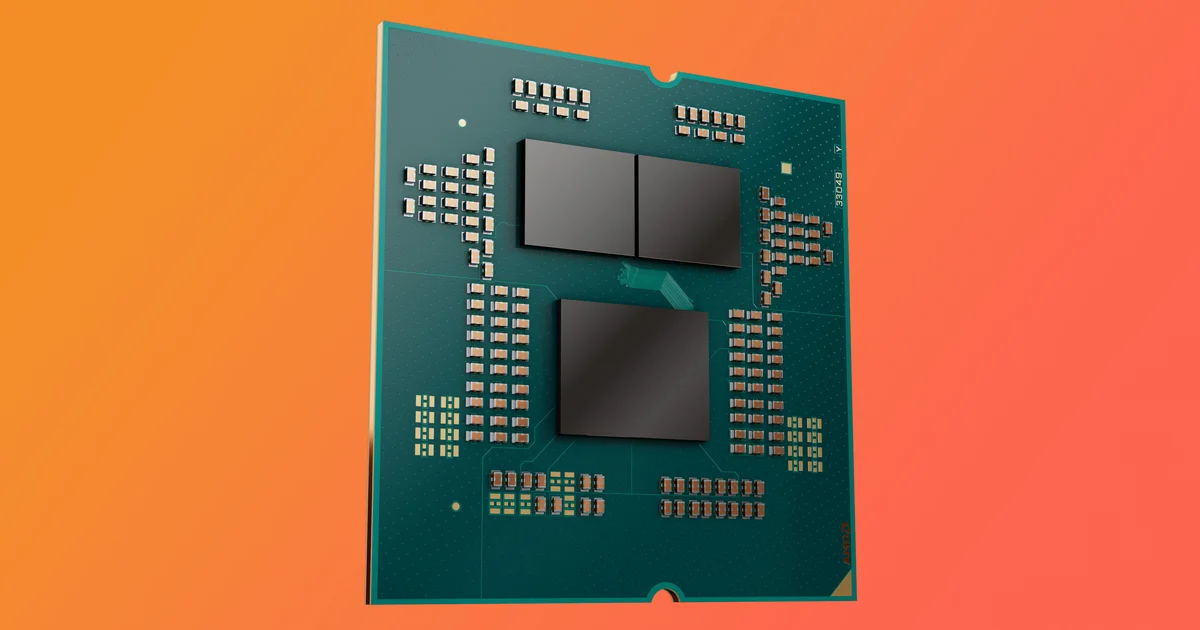
AMD’s CPU announcements are arguably more straightforward, and they were presented during the company’s public keynote. First came what many expected: two new desktop 9000 X3D processors, the 9950X3D and 9900X3D, both slated for release in the first half of 2025.
| Model | Cores/Threads | Max Boost/ Base | Total Cache | PCIe | TDP |
|---|---|---|---|---|---|
| AMD Ryzen 9950X3D | 16C/32T | 5.7GHz/ 4.3GHz | 144MB | Gen 5 | 170W |
| AMD Ryzen 9900X3D | 12C/24T | 5.5GHz/ 4.4GHz | 140MB | Gen 5 | 120W |
If you already know the 7950X3D and 7900X3D, this should feel familiar. Both chips follow a dual-CCD approach: the higher model number refers to a fully-enabled version, while the lower one indicates a trimmed variant. In practice, that means 16 cores on the 9950X3D and 12 on the 9900X3D, with the top model reaching a maximum boost of 5.7GHz and pairing that with 144MB of stacked v-cache. It’s a bit disappointing that the feature set doesn’t carry over completely across both chips.
AMD’s figures for the 9950X3D also look encouraging. The company claims an eight percent advantage over the 7950X3D when averaged across 40 titles. Some games show even clearer gains, including a 1.58x jump in Counter-Strike 2, 1.28x in Far Cry 6, and 1.16x in Starfield. When measured against the Core Ultra 9 285K, which AMD describes as a much less imposing competitor, AMD’s internal testing points to an average lead of 20 percent. In other words, results of 1.3x or better were seen in games such as Starfield, Cyberpunk 2077, Space Marine 2, Final Fantasy 16, Far Cry 6, and Watch Dogs: Legion.
Beyond the desktop lineup, AMD has introduced its first X3D processor for laptops: the 9955HX3D. This flagship is part of a broader family codenamed Fire Range, which also includes two non-X3D versions, the 9955HX and 9850HX. The leading X3D chip includes 144MB of cache, a 5.4GHz peak turbo, and a configuration built around 16 cores with 32 threads.
| Model | Cores / Threads | Max Boost / Base | Total Cache | GPU | cTDP |
|---|---|---|---|---|---|
| AMD Ryzen 9 9955HX3D | 16/32 | 5.4GHz/ 2.5 GHz | 144 MB | AMD Radeon 610M graphics | 55-75W |
| AMD Ryzen 9 9955HX | 16/32 | 5.4GHz/ 2.5 GHz | 80 MB | AMD Radeon 610M graphics | 55-75W |
| AMD Ryzen 9 9850HX | 12/24 | 5.2GHz/ 3.0 GHz | 76 MB | AMD Radeon 610M graphics | 45-75W |
This looks like a recipe for an extremely capable processor—one that could even outperform laptops that use full desktop-class chips. Still, we’ll need to wait until closer to the launch in the first half of this year to see the performance numbers.
Overall, AMD delivered a pretty impressive roster of announcements, though there could be some disappointment that the larger Ryzen 9000 X3D models won’t be available immediately.
Keep an eye out for more updates as they roll in—Nvidia is set to present its keynote shortly in the early morning UK time.