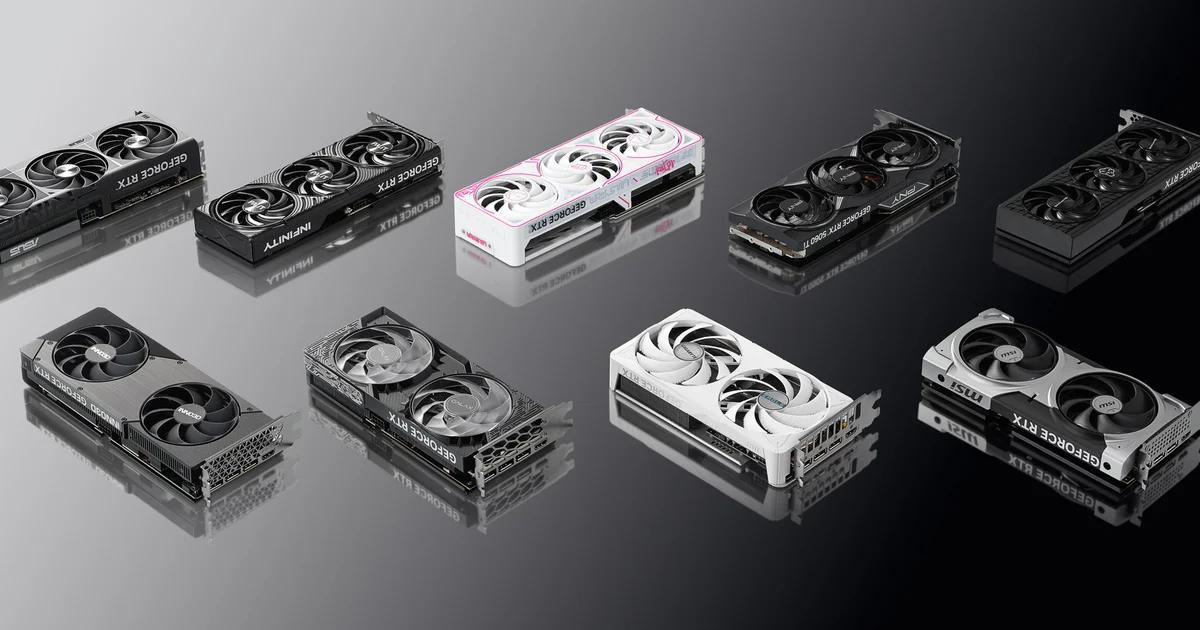
Several months after the debut of Nvidia’s flagship RTX 5090, the company has finally revealed its three mainstream RTX 50-series options: the RTX 5060 Ti 16GB, RTX 5060 Ti 8GB, and RTX 5060.
The two RTX 5060 Ti models are scheduled to launch on April 16th—tomorrow!—with a suggested retail price of $379/£349 for the 8GB variant and $429/£399 for the more in-demand 16GB version.
Given how uncommon recommended retail pricing is across the Blackwell lineup, it’s likely that multiple models will be offered above these figures—whether or not there are additional features such as factory overclocks, upgraded cooling setups, or compact SFF-friendly designs. Some of the partner cards are shown above, including offerings from Asus, Inno3D, Palit, Galax, Colorful, Gigabyte, MSI, and Gainward.
By comparison, the RTX 5060 is expected to arrive in May, priced at $299. Since the gap between the 5060 and the 5060 Ti 8GB is just $80—and then another $50 jump to the 16GB model—it should be fascinating to see how these three cards stack up against each other in practice.
Looking at the specifications, it’s hard not to notice the oddity of Nvidia putting out a $379 GPU with only 8GB of video memory in 2025. While many games can be tuned to run acceptably with that amount of VRAM, we still keep seeing fresh PC releases—particularly PS5 ports—launch with clearly weak results on 8GB cards. For example, the RTX 3060 originally shipped with 12GB of frame buffer, yet it can sometimes edge out the RTX 4060 8GB, and I’d rather not see a repeat of that situation with the RTX 5060.
Elsewhere, the technical details match what you’d expect. The 5060 Ti uses the GB206 GPU with 4,608 cores, and the 5060 cuts that down to 3,840 cores—about 80 percent of the full total. Boost speeds land around the 2.5GHz mark, which aligns with the rest of the cards in this lineup, and TGPs range from 180W on the Ti model down to 150W on the regular 5060, allowing it to run on a fairly modest 450W PSU. Also note that with the 128-bit memory bus, all three models share the same memory bandwidth rating of 448GB/s.
| RTX 5070 Ti | RTX 5070 | RTX 5060 Ti | RTX 5060 | |
|---|---|---|---|---|
| Processor | GB203 | GB205 | GB206 | GB206 |
| Cores | 8,960 | 6,144 | 4,608 | 3,840 |
| Boost Clock | 2.45GHz | 2.51GHz | 2.57GHz | 2.50GHz |
| Memory | 16GB GDDR7 | 12GB GDDR7 | 16GB GDDR7 8GB GDDR7 |
8GB GDDR7 |
| Memory Bus Width | 256-bit | 192-bit | 128-bit | 128-bit |
| Memory Bandwidth | 896GB/s | 672GB/s | 448GB/s | 448GB/s |
| Total Graphics Power | 300W | 250W | 180W | 150W |
| PSU Recommendation | 750W | 650W | 450W | 450W |
| Price | $749/£729 | $549/£539 | $429/£399 $379/£349 |
$299 |
| Release Date | February 20th | March 5th | April 16th | May |
Since the upside of DLSS 4 multi-frame generation doesn’t seem as striking at lower base frame rates—and because this generation’s improvements are relatively modest compared to the last cycle outside of the RTX 5090—it’ll be interesting to determine whether the new XX60 lineup can truly distinguish itself from the RTX 40-series cards it’s meant to replace. If the performance gap stays roughly in the 10–15 percent range, for instance, it’s easy to imagine discounted RTX 4060 or 4060 Ti models becoming an appealing option—especially alongside AMD’s RX 7700 XT or the upcoming RX 9060 XT.
Unfortunately, Nvidia’s promotional information doesn’t provide much clarity on expected real-world performance, leaning on 4x frame generation whenever possible. The only title shown without frame generation support, Delta Force, seems to indicate around 105fps for the 3060 Ti, about 110fps for the 4060 Ti, and roughly 130fps for the 5060 Ti at 1440p—equating to an 18 percentage point improvement generation-over-generation for the new card.
You can see a comparable pattern with the RTX 3060, 4060, and 5060. In Delta Force, the graph points to average 1080p frame rates of approximately ~120fps, ~140fps, and ~160fps, respectively—translating to about a 14 percent increase for the 5060 versus its closest predecessor.
We won’t have to wait much longer before the RTX 5060 Ti reaches buyers, so keep an eye out for upcoming reviews.