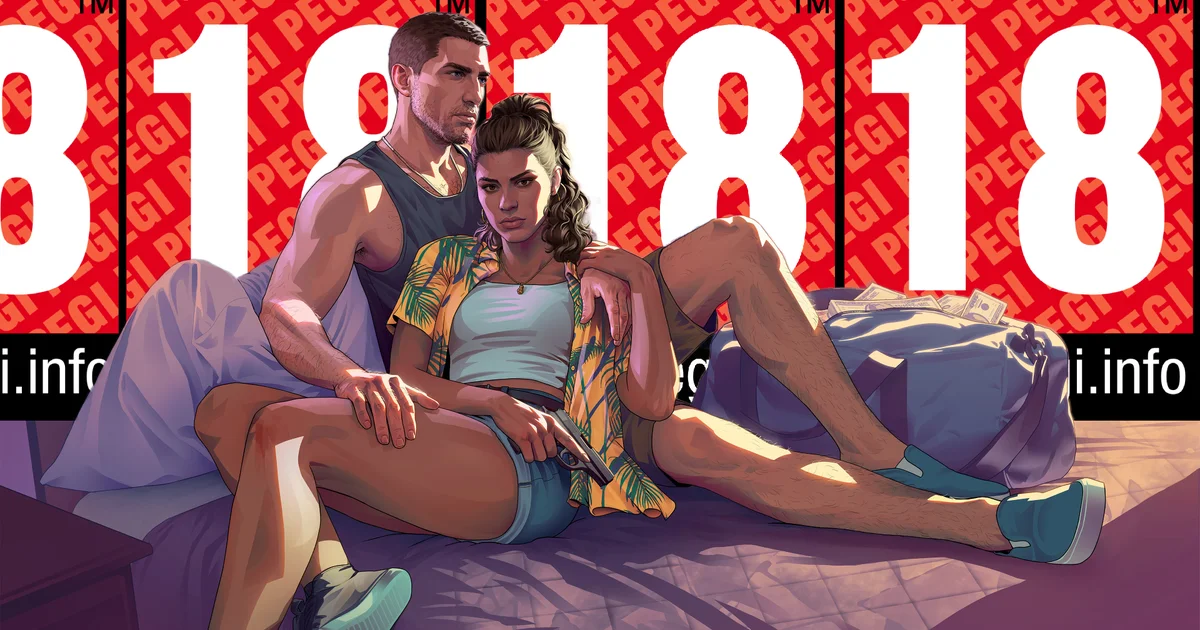
Ever since age limits started being applied to video games, few examples have been used as consistently as one franchise when people discuss the risks of underage play in society: the crime series Grand Theft Auto.
Even though every Grand Theft Auto title I can find is listed with a PEGI 18 rating in Europe (USK 18 in Germany)—meaning they’re intended only for adults of legal age—the games still draw a lot of attention from younger teens.
The pros and cons of this situation keep sparking debate, often resurfacing each time a new Grand Theft Auto release hits shelves. And naturally, there’s now another major entry on the way: Grand Theft Auto 6, scheduled to launch in November. The topic is, once again, front and center.
With that in mind—and remembering that PEGI director general Dirk Bosmans has a 15-year-old son during our conversation about upcoming changes to PEGI’s age-rating framework—I decided to put him on the spot. “Would you let your son play Grand Theft Auto 6 when it comes out?” I asked.
“I knew that question would show up!” Bosmans responded. “Listen, I’m the director of PEGI. My son told me, ‘Dad.’ And it was like he thought, ‘My father runs PEGI—so I’m basically finished.’” He laughed.
“He genuinely thinks it’s pretty neat that his dad has this job, but he also understands there could be boundaries. Still, what we’ve been able to demonstrate is that for every game he wants to play—because of peer pressure—there are 17, and sometimes even 170 or 1700 other games suitable for his age that are just as entertaining, if not more. That doesn’t solve everything, though, because peer pressure usually isn’t about choosing the best or most fun option. It’s more about one thing: other kids are playing it. So with GTA 6, that’s going to happen.”
When it comes to what PEGI is meant to do, Bosmans sees it as a tool to help parents make responsible, well-informed decisions about which games their children are engaging with. “If a parent checks the PEGI label and thinks, ‘This title carries a 16 rating, yet my 14-year-old is mature enough to play it,’ that’s a sensible decision,” he said. “In that case, we don’t see much danger. It’s different from a 14-year-old playing something while their parent doesn’t care either way. That’s why I pay attention.”
“If a parent looks at the PEGI rating and then says, ‘That game is a 16, but my 14-year-old is mature enough to play this game,’ that’s an informed decision” -Dirk Bosmans
I also have a 15-year-old, so I recognize his viewpoint: deciding is difficult, especially for someone in his situation and line of work. One thing that has helped, however, is the long wait for the release. “I’ll admit,” Bosmans said, “I was genuinely relieved by the delay of GTA 6.” He chuckled again. “But it may still end up arriving a little too quickly.”
He may hesitate to pick it up at first—something that seems to have worked before. “With GTA 6, though, it’s going to be such a huge moment that it will be tough to ignore,” he acknowledged. Even so, he still hasn’t played Hades 2, and he loves Hades 1; he even used it to introduce his son to Greek mythology, and that genuinely makes me smile. “I’ve got a PlayStation and an Xbox, and it feels unfair that I can’t play Hades 2,” he joked. “Since Hades was my all-time favorite, that might be a reason I can use to keep putting it off a bit longer.”
On the more serious side, Bosmans stressed: “Rather than simply following age labels, the most important thing is talking with the child. We always tell parents that if they can, they should play the games alongside their kids, because you’ll have the specialists right there and you’ll be surprised.”
“They’re not going to stop talking about Minecraft. They’ll keep going and going. You’ll end up receiving what are basically masterclasses on Minecraft, and it may actually show you why they’re so drawn to it—because it often goes much deeper than you might assume when it comes to video games. After that conversation, talking about screen time and when gaming should happen might get easier.”
Dirk Bosmans spoke with me this week about what could be the biggest updates PEGI has ever made to its age-rating system. From June onward, PEGI will start factoring in elements like in-game purchases when assigning a game’s age rating. For example, if a game includes paid random items such as loot boxes or card packs, it will automatically be given a PEGI 16 rating. Most titles are expected to be unchanged, but others—such as EA Sports FC, which currently has a PEGI 3 rating—are likely to see a major shift in how they’re categorized.