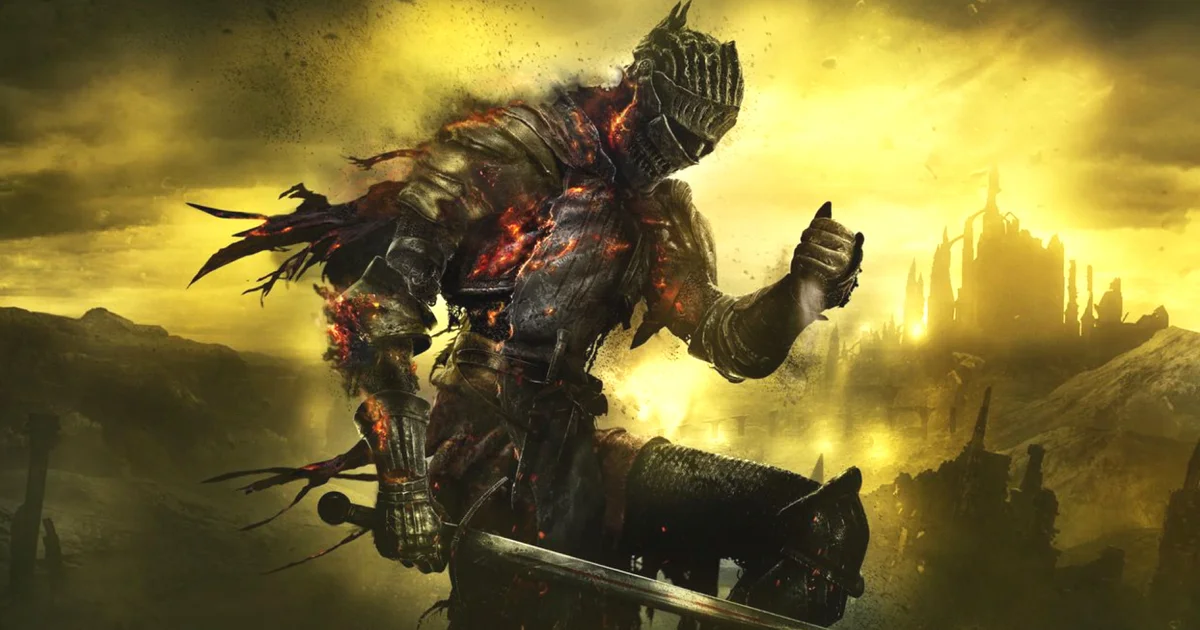
When I think about the prospect of the best Souls entry—one that keeps returning to my mind time and again—Dark Souls 2 is the one that most often wins out. I know that’s a contentious claim, but I genuinely have a soft spot for it, flaws included. I’m drawn to its wildly ambitious streak, even though a number of some of its most fascinating ideas—its focus on light, and the whole time-travel angle—ended up largely being dropped during a chaotic development stretch. Still, I can’t help but value those big concepts; just look at the Bonfire Ascetic system, or the cryptic alternative approaches you can sometimes use to make boss fights less brutal. Above all, I’m captivated by the unmistakably sorrowful mood that runs through it. Even so, it’s Dark Souls 3 from 2016 that I keep circling back to most often. So today, as it marks its 10th anniversary—and as we all slowly fade into dust—it feels right to send out sincere birthday wishes.
And because I can already feel the Dark Souls faithful sharpening their attention on me, I should quickly give credit to the original. Dark Souls 1 is absolutely a benchmark. It undoubtedly delivers the tightest, most harmonious world layout, the strongest body of lore, standout atmosphere, unforgettable bosses, a stack of legendary setpieces, and of course, the finest hat—but its rough spots are rough, to the point where after 15 years, I find it difficult to fully re-immerse myself. By contrast, Dark Souls 3, even with only a five-year gap, feels like it has barely aged at all.
That freshness is helped by the fact that the visuals still look incredible. FromSoftware’s move toward high fidelity (first shown off in Bloodborne) here pairs with the studio’s unmatched talent for detailed worldbuilding, resulting in an experience that’s consistently spellbinding. Every loose stone slab, every ruined skybox, and every carefully placed foe in Lothric adds up to a feeling of history and place so intense it almost seems to seep into you. That’s especially striking, because Lothric may be the most oddly arranged world in the series: for the most part, it’s a mostly linear chain of self-contained zones, then made coherent by the narrative’s talk of time and space breaking down together as the climax approaches. It’s also genuinely fun to dig into how some of Dark Souls 3’s late-development twists evolved—right down to an earlier version of Lothric that, at least geographically, appeared far more sensible.
Still, for all of that—and even if its scattered lore feels uneven—Dark Souls 3 manages to pull it off. Lothric’s distinct regions—its worn ramparts, its decaying villages and overgrown graveyards, its collapsing bridges and towering cathedrals—sit under the constant presence of Castle Lothric, while a sickly, dying sun hangs over everything. The result is beautifully made, repeatedly highlighting From’s strong sense of level design. Even if Lothric trends toward straight-line progression overall, these looping, connected spaces are a joy to navigate, and each one offers its own kinds of challenges.

Cathedral of the Deep could be viewed as the game’s first genuinely unforgettable area: a lavishly crafted, steadily narrowing spiral that mixes classic FromSoftware chaos—think precarious buttress skirmishes and cramped encounters with massive foes. In the toxic gloom of Farron Keep’s ruined woods, though, anxiety and confusion quickly take over. Later, Ithryll Dungeon leans into oppressive horror as it drags you further into the past, drawing you ever closer to the Profaned Capital far beneath. And then there’s the remarkable, intricately designed Grand Archive, which shepherds you through a highly tangled route that twists upward, loops around, and then goes out and back—where cavernous interiors abruptly shift into sweeping, apocalyptic vistas.
The DLC matches that level of pull (at least, if we set aside the outright nonsense of the Dreg Heap). It begins with the wide snowy reaches of Ariandel and ends with The Ringed City, one of the series’ most striking-looking destinations. It also serves as a fantastic wrap-up for the trilogy: after a run of Easter eggs during the descent, it ultimately revisits one of the franchise’s most intriguing (and most difficult to pin down) mysteries. And of course, Patches’ immortal nod is a charming burst of fan service as well.
It’s excellent work, and I’d argue that Dark Souls 3 contains the most enjoyable combat in the series. I’m not claiming to be a hitbox specialist or a calculator-level i-frame counter, but from a simple, personal perspective, fights feel quicker and smoother—while still keeping the series’ careful rhythm of stop, block, roll. It’s nowhere near the full-scale mayhem of Elden Ring. Nowhere is that excitement more obvious than in its outstanding boss matchups. Ignoring Crystal Sage, who can definitely be left behind, I honestly don’t see a true weak spot in this lineup. Even the divisive bosses appeal to me—like the Deacons of the Deep, whose more puzzle-like, gimmick-focused structure feels to me like a refreshing palate cleanser. Still, many of them are unmistakable standouts, and those peaks are high: impressive to watch and varied in how they test you, each offering clever new ways to measure your endurance.
There’s the oddly moving final stand of the Abyss Watchers, charging in from every direction and fighting amid the wreckage of their fallen comrades. Then come the last desperate struggles of the Twin Princes—protecting one another until death and beyond—which made me feel a little unhinged thanks to their teleportation tricks. Sister Friede delivers an eye-catching, tightly choreographed fight with twin weapons (and I’ll admit it nearly finished me). Pontiff Sulyvahn brings searing intensity, and The Nameless King ups the spectacle further, battling mounted on a dragon while swirling shadows gather beneath a storming sky. The ethereal Dancer of the Boreal Valley also has wonderfully strange rhythms, while Oceiros and his (apparently not always) invisible offspring add to the chaos. And Gael caps everything with brilliant end-of-the-world flair. Honestly, I even find that ridiculous tree oddly charming. Here’s to all of them—just not you, Crystal Sage.
When I last wrote about Dark Souls 3, just before Elden Ring launched, I called it an “exercise in refinement [that reveals] From at the pinnacle of its craft, pushing against the bounds of the [traditional] Soulsborne model… with breathtaking artistry and innovation,” and that impression still holds today. Admittedly, four years on, I suspect Shadow of the Erdtree likely edges out Dark Souls 3 when it comes to overall boss quality (and I still think the Land of Shadow stands as From’s best world design—though that’s the kind of hot take that’s bound to spark debate, so we’ll save it for another time). Even so, none of that has stopped me from returning again and again to Lothric, and to its beautifully doomed universe. Every so often, I catch myself wondering whether Dark Souls 3 might even be my favorite entry in the trilogy—until the next day when I hear Lordran, or Drangleic, calling me back once more.
So, as Dark Souls 3 reaches its 10th year, maybe the whole extraordinary series deserves the celebration. After all, when it comes to the flame, the beginning is the end is the beginning, once more. And honestly, it’s a never-ending cycle that I’m genuinely happy to get caught in.