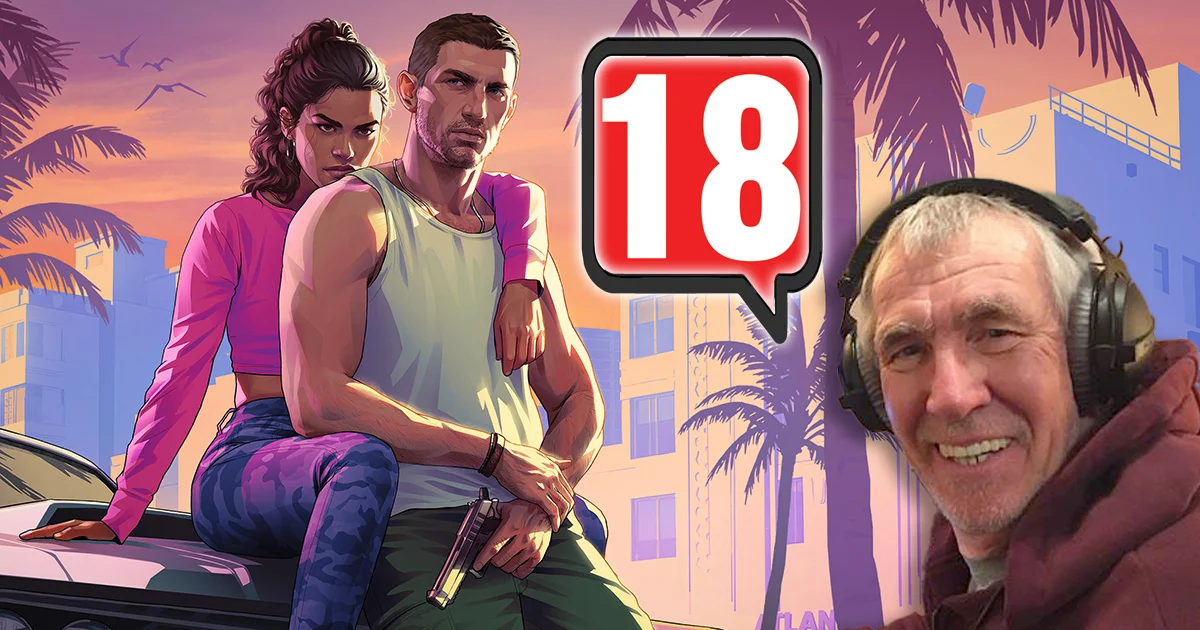
“I’m interested in what you think,” he begins, speaking in that unmistakably low, resonant voice of his — and that’s how our conversation kicks off like a math riddle. Let’s try this: for 16 years, a vocal track has opened many video game trailers, and several of those trailers have drawn millions of views. The details are a bit murky, but roughly, how many times do you think that recording has been played? Billions? “I was thinking about contacting the Guinness Book of Records and asking, ‘Are these the most widely heard recordings ever?'” my interviewee says.
Up until the start of 2024, hardly anyone knew who Richard Wells was. Then, all at once, he surfaced on TikTok. There he was: a more mature man with closely cut white hair and a well-kept white beard, looking warm and approachable, wearing a smile that put people at ease. At first glance, he seemed completely ordinary. But the moment he started talking, recognition sparked.
That voice… it’s familiar to a huge number of gamers across Europe, and possibly further afield. It’s deep, assured, and clearly enunciated — the kind of voice that doesn’t invite disagreement. It matches the audio it’s tied to: a kind of spoken benchmark. You’ve almost certainly come across it before. “PEGI 18.”
Wells introduced himself on TikTok as the voice behind PEGI, complete with a clip demonstrating “PEGI 18” and, to everyone’s delight, a grin (a somewhat comical contradiction). As the video started spreading, the response snowballed. It grew. And grew. Soon, a flood of nostalgia rolled in, dominating the comments. “Hearing ‘PEGI 18’ at age 12 was a rite of passage,” one skeptic wrote, and the comment racked up 156,900 likes — a clear sign that many felt the same. “NOT PEGI18 OMGGGGG !!! YOUR VOICE IS AMAZING 🥳,” another person added. In total, nearly 19,000 comments appeared, and the clip surpassed 20.4 million views.
Wells didn’t expect that kind of reaction. He only planned to check whether people would recognize his voice. He’d made the post on impulse. Still, the result was a loud, resounding “yes” — a big, happy confirmation that his “PEGI X” recordings have genuinely stuck with people. While he tried to settle himself amid all that attention, another idea quickly took center stage. If the recordings were so well known, why had he been paid only €200 for them?
During our video call, I also found it surprising to hear Wells talk about his background, because it wasn’t what I had imagined. He does match what I expected in one key way, though: he looks just like he does in his TikTok videos. He’s friendly, full of energy, and easy to engage with — and he has that enviably full, rich voice. He speaks from a home he owns in the south of France, where he and his wife spend time when they aren’t living in Brussels. I expected him to lay out a long theatrical career and a list of television and film credits — the usual markers of a life devoted to acting — but he doesn’t. He only moved into acting later in life.
At first, Wells worked in advertising. Somehow, he developed a real talent for languages. “I’ve got big ears and a decent ear for accents,” he jokes, playfully flicking his ears with his fingers. He found work with major advertising firms, including J. Walter Thompson and Leo Burnett, which took him around the world — from London to Brussels, and even farther east to Singapore, Hong Kong, and Bangkok. It was in Bangkok, about 15 years into his advertising career, that his plans changed. He’d become a manager and started wanting something different. “I thought, ‘I need to do something else.'”
“Back in the day, I’d be doing 200-250 jobs a year and earning a great living, enjoying life” -Richard Wells
Acting returned as a goal he’d carried for a long time. It felt like something that had always been there. There were moments when he recorded ads he’d written himself, simply because there wasn’t anyone else available to handle it. “I realized that I wasn’t bad at it,” he says. “And I thought, ‘I wonder if I could make a career out of voiceover?'” He presents it like it was a simple switch — but it wasn’t. This was the mid-80s, and Wells was in his mid-30s, with enough financial breathing room to chase that ambition. The only uncertainty was where to pursue the dream. “Should I go to Sydney? Los Angeles? London?” he wondered. Then an unconventional option surfaced: Brussels. Why? Because it’s where so many multinational companies are headquartered. The European Parliament, the European Commission, NATO, and more — all of them needed English voiceovers for the new Video Home System (VHS) tapes they were working to produce. “That seems like a good place to be,” he reflected — and, as it turned out, he was right.
Wells found a steady pool of work that he’s still relying on today. “Back in the day, I’d be doing 200-250 jobs a year and earning a really good living, having a great time,” he explains. He used to travel throughout Belgium to studios for recordings, and he occasionally made trips to France and the Netherlands. “It was fantastic,” he says. “I’m still doing it, still based in Brussels. I’ve been working full time since 1986.” Alongside the corporate sessions, there were occasional gigs in television and film, plus later recordings for e-learning courses — though, after a brief pause, he concludes that none of it would be recognizable to most people. “That’s pretty telling, isn’t it?” he laughs.
It was during one of those routine corporate jobs in 2009 that he got a question that sounded harmless. After wrapping up a task, more requests arrived unexpectedly through email. “Oh, could you just do this?” the studio contact asked. It was only a few lines, it wouldn’t take much time, and it would add another €200 to his earnings for the day. It would be quick. “Let’s be generous and say a minute,” he says. Why not? “I had to say, ‘This game is rated PEGI 7; this game is rated PEGI 12…'” he recalls. He didn’t really understand what it meant — “I’m not a gamer, obviously,” he adds, as if that should have been obvious — so he recorded the lines and left. “And I never heard anything more about it.”
Time passed — 15 years went by — and Wells kept moving forward. At the same time, though, something behind the scenes was changing. People were starting to notice that his recording had become hugely popular. In the years since, platforms such as YouTube had exploded in growth. Video became even more common on newer, video-first social channels, particularly TikTok. I can’t say what specifically made Wells decide to join TikTok, since he doesn’t spell it out, but in 2024 he downloaded the app to follow up on a hunch.

“What are you doing? Don’t be ridiculous,” his spouse said when she saw him filming the video—the one clip we’re watching today on TikTok. “I just wanted to see if anyone…” he replied as he posted it. “It shows how useless I was, because I honestly shared the same video twice,” he laughs. “That’s just me being a Boomer.” Even if it was duplicated, the video still found its way online, and, “Well, you know how it turned out,” he says. “It was absolutely astonishing.”
In truth, Wells wasn’t used to receiving that kind of direct attention. He’d spent his career lending his voice to corporate pieces or e-learning materials, often as an anonymous presence. Even with a solid professional path, he’d never been publicly acknowledged or celebrated for his contributions. Yet the response on TikTok was huge. Before long, he even received an invitation to a comic convention in Ghent called Facts, where admirers asked for his autograph and a photo. “I was totally shocked by it,” he recalls. “It felt great.” And while it was satisfying to watch his work bring up warm memories for other people, a new question started to grow in his mind—one we began with from the start: was €200 a fair amount to be paid?
“I checked the invoice and realized I’d been billed for recording a TV commercial,” Wells explains. “That was what we thought it was at the time. Then I thought, hang on—hundreds and hundreds of millions of views; usually, there’s some sort of arrangement.” But there wasn’t. He also couldn’t benefit from the popularity of his TikTok video, since the TikTok Creator Rewards Program isn’t available in Belgium, where he lives. His only option was to either let the idea go or try to contact the original source of the recording—PEGI.
We picked up the thread about how much Wells was compensated in early 2024—”The voice actor behind ‘PEGI 18’ says he received only €200,” as we reported—then later that summer I followed up with the Games Rating Authority, the body that manages PEGI age ratings in the UK. However, I was told it fell under PEGI’s responsibility. Hearing that, I assumed it was settled—like many times in my years at Eurogamer, when I don’t remember ever being offered an interview with PEGI. Recently, though, that changed. I spoke with director general Dirk Bosmans about upcoming adjustments to PEGI age-rating categories, and during that conversation, I asked about Wells. I wasn’t prepared for the answer.
“We were completely unaware of this. But there was no intention to pull a fast one for something free” -Dirk Bosmans, PEGI
“We didn’t have direct contact with Richard,” Bosmans began. “We worked through a voice agency, so we weren’t aware of what they were paid or what the agreement actually contained. Still, it’s clearly only about 20 seconds of work.” In his view, if we’re generous, “a minute.” “And this was set up in 2009,” he added. “Back then, we couldn’t predict how huge platforms like YouTube would become. Within just a few years, the voiceover was everywhere. Honestly, we didn’t foresee it—I swear. Our focus was on cinema ads and similar material. So we put in place an arrangement like, ‘How do we license this?’ And we discussed it with Richard because the goal wasn’t to underpay anyone.”
I paused. Bosmans had just mentioned that a new deal with Richard Wells had been agreed—or at least that’s what it sounded like. “Yes,” Bosmans clarified. “We discussed how multi-year licensing works. If he hadn’t gotten in touch… We were completely unaware of this. But there was no trick or scheme involved to get something for free.” He sounded genuinely convinced when he said it. “I hope we can protect his voice for a very long time.”
After that exchange, I contacted Wells to verify what Bosmans had told us—and the response came quickly by email. “What you heard from Dirk is correct,” Wells wrote back. “We had a brief negotiation and an amount was agreed as a buyout. A fairly modest sum, I admit, but it was a goodwill gesture on their side.” During our video call, though, he offered more nuance. “I think [Bosmans] pulled a number out of thin air,” he said. “I told them, ‘Well, I’d like a bit more than that.’ But we’re not talking about a huge figure in any case. I won’t share the exact amount. It wasn’t a large sum. It was simply a gesture, that’s all.”
With this buyout in place, PEGI now fully owns the rights to use Wells’ original recording—the one made in 2009, which, by the way, has never been re-recorded. That license covers them for the next fifty years. In return, Wells received a little more compensation. Not the big payday he might have imagined when the video took off on TikTok, but it still brings some measure of closure. As for TikTok, Wells has stepped back because he doubts anyone wants to hear more from him. “What else could I share?” he asks. “They’ll just see it as some old Boomer going on and on. Keep scrolling.”
And what about doing voice work for video games? I ask. He’s been building interest since he started his voice acting work—does he see himself trying something in that direction? “I’ve actually done one,” he says, though he doesn’t name the title. Wells’ page on the voice acting directory Bodalgo mentions a game called S Word of Prophecy and includes samples of his voice in it, but I’m not familiar with the game and I can’t locate any further information. Still, he does audition for game roles, he admits. “There’s a person in the States who keeps sending me auditions for wizards.” As he says this, he convincingly mimics Ian McKellen’s Gandalf from The Lord of the Rings films. “I send off these fantastic auditions and yet never get the part,” he tells me. “I try different characters and voice impressions, but no one has contacted me.” After a short pause, he adds with a smile: “Maybe you could reach out to people and tell them this guy is really talented?
“Anyway,” he wraps up. “I’ve had a really fulfilling 40-year career in voice work. I’ve loved every minute of it. I still care about it—I’ve got a job this afternoon. If you can follow your passion for 40 years and still earn a decent salary when you’re my age…” He stops there, but the point is unmistakable: Wells feels satisfied, appreciated in his own way, and content.
Still, there may be one final takeaway. “Looking back,” he says, returning to the start of the story, “I think the PEGI recordings—especially PEGI 18—are the most widely heard single recordings in history. I can’t think of any others that are listened to by millions of people every single day around the world.” Can I think of any? he prompts. I consider it, but I can’t—so it seems to support his claim. “It’s a bit egotistical on my part, I suppose,” he adds. “But I thought, ‘Well, why not also get a Guinness World Record from it?'”