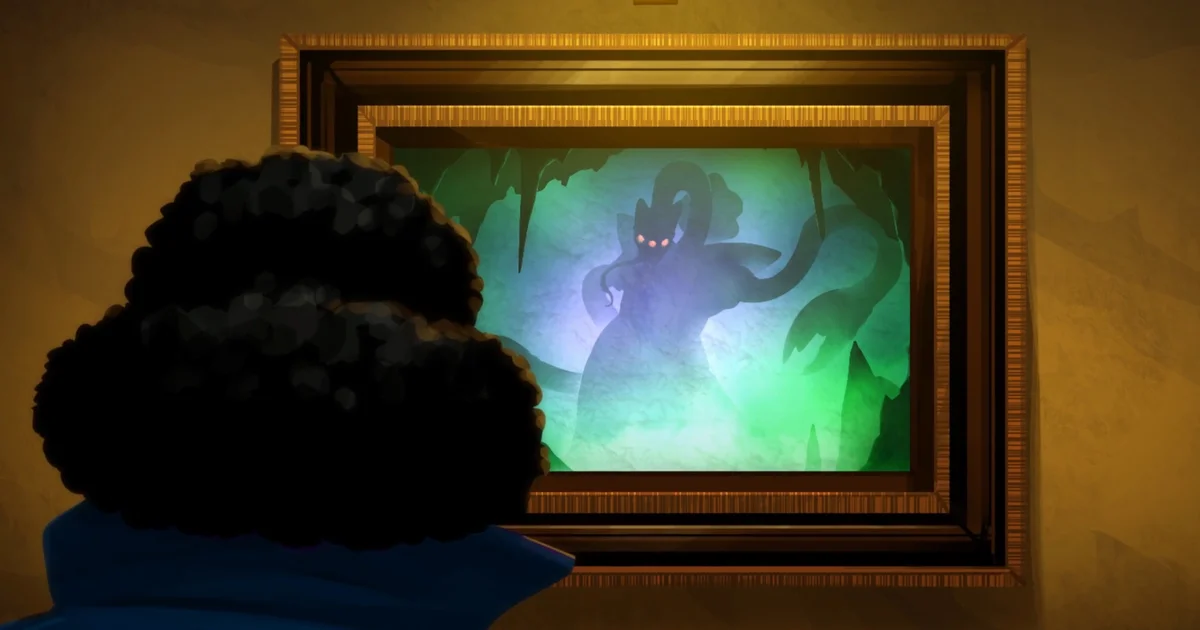
Despite the adrenaline-pumping Indiana Jones-style thrills, the lure of ancient civilizations, and the constant pressure of sensational supernatural danger, the real heart of Call of the Elder Gods may actually beat inside that battered, leather-covered notebook. This idea won’t come as a surprise to anyone who’s played Call of the Sea, its warmly received predecessor, but it’s still satisfying to see that—even with this sequel’s broader, bolder ambitions—the charm and sharp, detective-like logic of the original’s first-person adventure remain intact.
Developed by Out of the Blue as its third outing, and following the intriguing, Truman Show-inspired cinematic puzzle experience American Arcadia from 2023, this installment picks up a notable stretch of time after Call of the Sea. Instead of the tropical island escapades that starred Norah Everhart around 1934, you’re swept into a traveling adventure set in the 1950s, beginning in Arkham, Massachusetts. Yes, that Arkham.
Where Call of the Sea gradually leaned into the cosmic dread associated with H.P. Lovecraft, Call of the Elder Gods—as its title suggests—kicks into a higher gear right from the start. Still, anyone hunting for pure existential shock should be prepared: this sequel dips into the Cthulhu Mythos world, nodding to names like Miskatonic University and Dr. West. But Lovecraft here is treated more like a pulpy 1930s matinee adventure—more splashy and storybook than bleakly philosophical.
We begin with a new lead, Evangeline Drayton, a physics student at Miskatonic who’s been having unusually specific dreams about ancient cities and creatures best left unnamed. Not long after, we meet her future partner in exploration: Professor Harry Everhart—Dean of Archaeology at the university and, naturally, Norah’s grieving spouse. As for what exactly happened to Norah, players can steer that outcome through decisions made in the first game; either way, she’s gone. Or at least, that’s what it initially seems like. For reasons that aren’t made clear right away, she returns as the narrator for this new trip, offering sharp observations and dry humor that genuinely adds flavor to the proceedings. That likely helps, because Harry and Evangeline—despite their obvious eagerness—don’t quite land as fully compelling personalities.
That’s a little disappointing given how strong the character writing was in Out of the Blue’s earlier works, but Norah’s voice keeps things moving. Beyond that, there’s plenty to enjoy. For starters, Call of the Elder Gods looks gorgeous. With the tropical island setting of the prior game left behind, as our duo crosses paths with secret societies, ancient cultures, cosmic horrors, and even Nazis in a frantic, globe-spanning scramble, Out of the Blue leans hard into a wide range of fresh locations. The result is an immersive world saturated with bold, vivid color.

Ten minutes in, you’re headed to Boston for a moody detour through a grim estate—lightning tearing across dim staircases while rain pounds the library windows—before you step out into its sprawling grounds. And that’s only the start. As the pair investigates a mysterious statue said to hold the blood of an elder god, they’re pushed into crystalline caverns packed with long-hidden secrets, an over-the-top gold-and-black headquarters belonging to an Egypt-obsessed cult, and an abandoned Nazi bunker tucked away among Norway’s snow-lashed mountain peaks, among other stops.
It’s gorgeous throughout, sprinkled with appealing background touches—do we truly need to watch the gaslit street scene outside a heavily frosted office window? Probably not, yet Out of the Blue goes the extra mile. And yes, you can watch red lines twist across maps as the narrative progresses. Admittedly, the fixed 3D models don’t always blend smoothly with their surroundings, and the handful of basic 2D cutscenes can feel a bit abrupt against the lavish environments. Still, overall, Call of the Elder Gods does a solid job selling its pulp-style universe.
But if you’ve played Call of the Sea, you already know where our real attention goes: that journal. Sort of, anyway. Video games have introduced us to plenty of memorable notebooks over the years—we’ve lived through Max Caulfield’s teenage thoughts in Life is Strange, seen Nathan Drake’s sketches in Uncharted, and even witnessed Indiana Jones’ doodles in the Great Circle. Yet Call of the Elder Gods, just like its predecessor, turns the idea up another notch. Here, your journal (technically, Norah’s journal, since her disembodied spirit is the one keeping track “for clarity”) becomes the centerpiece of some surprisingly deep and intricate puzzles.
You know that advice people often give for tougher puzzle games—keep a pen and paper nearby? Call of the Elder Gods follows that instinct, but it folds the note-taking directly into the experience. Out of the Blue clearly understands you’ll want what you need from the outset, so it dares to widen the experience’s reach. Not necessarily to make things more difficult, but to make them feel larger and more immersive. Often, the puzzles spread across entire areas. Usually, you’ll run into an obstacle that appears right after entering a new area—maybe a room you can’t access yet, or a puzzling piece of equipment. That’s when Call of the Elder Gods shifts into investigation mode. You’ll comb through drawers for notes, study photos, flip through timetables that look tossed aside, and more. Promising leads are automatically added to your journal, delivered with Norah’s signature touch. Still, those fragments of information don’t do much on their own; that’s where careful cross-checking, inference, and deduction become essential—especially for the bigger puzzles.
A single note may refer to both earlier and later events, letting you piece together a mental timetable of key dates for use down the line. Or maybe you’re working to match names to specific roles—only to suddenly realize that the camera operator you need can’t be one of the people shown in the picture. Solutions like these often link back to other clues, widening the mystery even further. Every thread has a consistent rationale, and although bringing them together isn’t always simple, the organized structure in your journal—straightforward to picture and revisit—keeps everything under control. Still, it isn’t only about big-picture thinking; there are also plenty of easier tasks that keep the pace lively and stop your mind from getting overloaded. The wonderfully hands-on feel of Call of the Elder Gods’ many contraptions—complete with levers, buttons, and those satisfying, spiraling dials—offers a comforting physical counterpart to all that mental effort. It’s smart, and it does an excellent job of making you feel capable.
To be honest, I’m not sure I’m finding Call of the Elder Gods quite as enjoyable as the first entry. I definitely appreciate the range Out of the Blue brings to its expansive follow-up, and I also recognize the vivid attention to detail, but I struggle more to settle into its atmosphere than I did with the earlier game’s single-location focus—especially when the somewhat muted cutscenes and a story that hasn’t fully taken shape don’t provide enough connection. And thankfully, Norah helps. Two-thirds in, I still haven’t truly clicked with the new protagonists, so I’m less emotionally invested than I’d like to be.
That said, I think Call of the Elder Gods is a solid, worthwhile experience: thoughtful, atmospheric, often stunning, and genuinely rewarding. And in a time when side characters frequently spell out answers before you’ve even had a moment to blink, it’s a relief to spend time with a game that doesn’t act like you’re completely clueless. I’m planning to stay with it to see where the road goes next—just hoping that, wherever the murmurs of the cosmic elders steer me, it leads to something I’ll be glad to record in my journal.