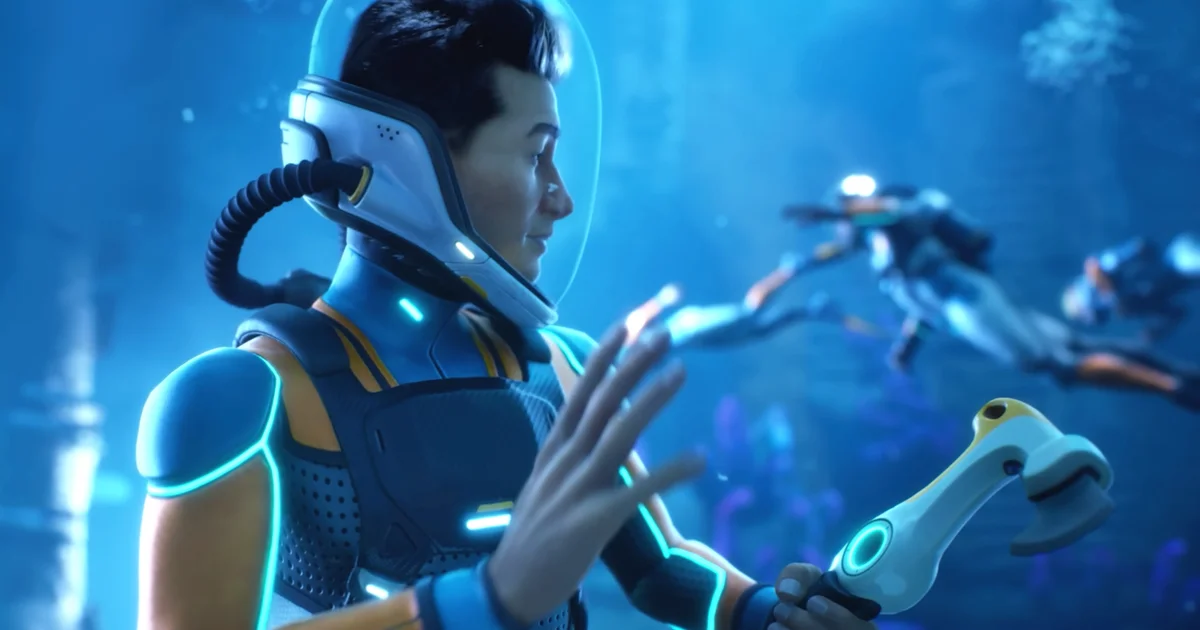
Time for a confession: I never truly finished the original Subnautica. It isn’t that I didn’t appreciate its smart mix of sandbox survival and a more guided narrative—it’s just that I’m a serious wimp when it comes to the ocean. Or, more specifically, what might be lurking below the surface. Subnautica’s sunlit Safe Shallows? Lovely, even. The Kelp Forest getting darker and more oppressive? That’s when my nerves start acting up. The huge, gaping drop where ocean terrors wait for you across the rest of the world? Absolutely not. I spent most of the original by staying near the top, carefully moving along while trying not to focus on what could be down there. Then, once I reached the moment where the only way forward was downward, I decided that was my limit. Put simply, I could immediately see the appeal of Subnautica 2’s cooperative play, the reassuring feeling that you’re not facing it alone, and the instant it was announced.
Subnautica 2, naturally, officially stepped into early access just last week—about four years after its original reveal. It also arrives while a widely covered legal dispute is unfolding between the removed leadership at developer Unknown Worlds and Krafton, the company that owns the studio. And while that whole mess is undeniably messy—court documents even reportedly included the frankly ridiculous allegation that Krafton’s CEO tried to dodge a promised $250 million payment to Unknown Worlds by using ChatGPT for advice—that tension doesn’t show up in the game itself. With its co-op features, Subnautica 2 begins with an unusually sure-footed confidence.
That probably shouldn’t be a big shock, though. After two earlier releases—Subnautica 1 and Below Zero—Unknown Worlds has refined its underwater survival formula into something sharp and polished. From the start, the game captures what made the series work: it fills the ocean-world of Proteus—or at least the slice that’s currently playable in early access—with striking alien scenery, arranged with care in a way that feels almost irresistible. Most of all, there’s that enormous fungal tree, bursting up from the water and throwing its shadow over everything beneath it. And no, I haven’t checked it out yet, largely due to the lingering dread from exploring the Aurora’s wreck in Subnautica 1. Still, the fascination is everywhere: strange spires peeking out on the distant horizon; abandoned bases stacked against steep ravine walls like an unfinished underwater settlement; thick tendrils draped around rocks like the veins of a hidden giant; and plenty more.
Right away, it feels like a persuasive and convincingly alien setting. Once again, Unknown Worlds uses story fragments to nudge you outward and softly encourage you to keep exploring. At intervals, your expedition’s questionable AI turns up fresh beacons, and as you make your way toward the next marker, you’ll encounter even more distractions that are deliberately enticing. It’s a smart approach: it keeps the adventure’s momentum intact without stealing that essential sense of sandbox openness. And the fundamentals around it—those familiar loops of scavenging, crafting, and building—remain just as compelling as before.

It’s also important to mention that Subnautica 2’s story comes across with real weight. Even with the horror already in your face, it leans into a creeping existential dread: ancient consciousnesses keep transferring into new bodies, and you start noticing details about Proteus’ genetic flexibility. The material is intriguing and delivered with real feeling, told through layer after layer of discarded PDAs—giving the game a surprisingly moving tone as you piece together the fates of Pioneers who once had real hope. Still, for all how strong the writing is, my biggest wow moments so far come from a simpler truth: Subnautica 2 is simply stunning.
Subnautica 1 had its standout moments, but some of its biomes felt a little too empty, and the constant haze didn’t help—Unknown Worlds used it to mask short draw distances and those frustrating loading pauses. The overall vision often felt slightly off. In contrast, Subnautica 2’s ocean world presents its breathtaking, intimidating scale almost instantly. Sure, it still leans on a similar look to the games before it—kind of a cartoony stylized world of huge bioluminescent wonders—but in this version, it feels genuinely vast.
In the opening shallows, sunlight ripples across carefully designed coral beds; those shallows then open into deep stretches of jagged rock pillars you can spot clearly from afar; and after that, it darkens into more threatening territory where dangerous creatures wait. And Proteus feels alive. Shark-like hunters circle with deliberate purpose, two-part fish hover ready to launch hammerhead attacks, unsettling horrors rest silently beneath the sand, and everywhere you turn: endearing scuttling shrimp-like creatures, strange “butthole” fish, and other fascinating lifeforms weaving through endlessly shifting, captivating patterns.
I could keep going. I really admire the player character’s physical presence, even though it’s first-person—you can see their legs and body shift as you turn, with their arms cutting forward while you swim. And the audio work is maybe even more unsettling than what you see. I’m almost constantly braced, ready to sprint away the moment I hear something, already aware that even the faintest motion can come right before those sudden, merciless jaws. I’m not exaggerating when I say my ocean anxiety (and yes, I think it traces back to Ecco the Dolphin on Dreamcast, though that’s a different tale) is running at full throttle.
So bringing it back to where it started, I’m genuinely glad co-op mode exists—the right way to share that nonstop underwater dread with a friend. Proteus might be a place where frightening moments jump out from every corner, but there’s real comfort in having someone alongside you: the crushing terrors of the tempting deep feel much more manageable when there’s conversation, a familiar profile
nearby, to lessen the pressure. And even if it’s mortifying to let out a full-throated scream of terror during a conversation (more than once), it’s noticeably less awkward when, just five minutes later, your partner ends up doing the very same thing.
That said, while the familiar social rhythm of cooperative sandbox survival is undeniably enjoyable, and even though I’ve appreciated having someone along, co-op—at least in my view—comes across as a rather weak way to experience Subnautica 2. Even in early access, this is a title built around a carefully constructed atmosphere: creeping dread and lingering sadness, close-up discovery and solitary survival. Pushing through it with a partner doesn’t quite feel right.
Co-op also feels a little clumsy from a design perspective. Since the breadcrumb storytelling is clearly meant to steer you toward the key moments, it stands to reason that you’d need to be pretty committed to sticking together, so you share the same feeling of exploration and don’t miss anything. Far too often, I’d spot something genuinely compelling—only to have to wait while my friend tracked it down, so we could both take in the narrative beats in the environment they’re meant to belong to. I believe this clashes with the game’s gentler, more open-ended exploratory mood.
So far, I’ve put roughly five hours into Subnautica 2’s early access, sometimes with a friend and sometimes on my own. Honestly, solo play feels like the best way to enjoy it: it lets you fully sink into Subnautica 2’s meticulous details, its melancholy tone, and its astonishingly alien world. But then, another message from my AI guide pops up—another callout demanding my attention. And as I carefully glide toward what I can’t yet see—watching the widening abyss below me, feeling the suffocating weight of darkness close in, while a fearsome roar from some concealed leviathan echoes through the emptiness—I can’t help asking myself: who am I trying to fool? Naturally, I’m not bloody doing all of this by myself.