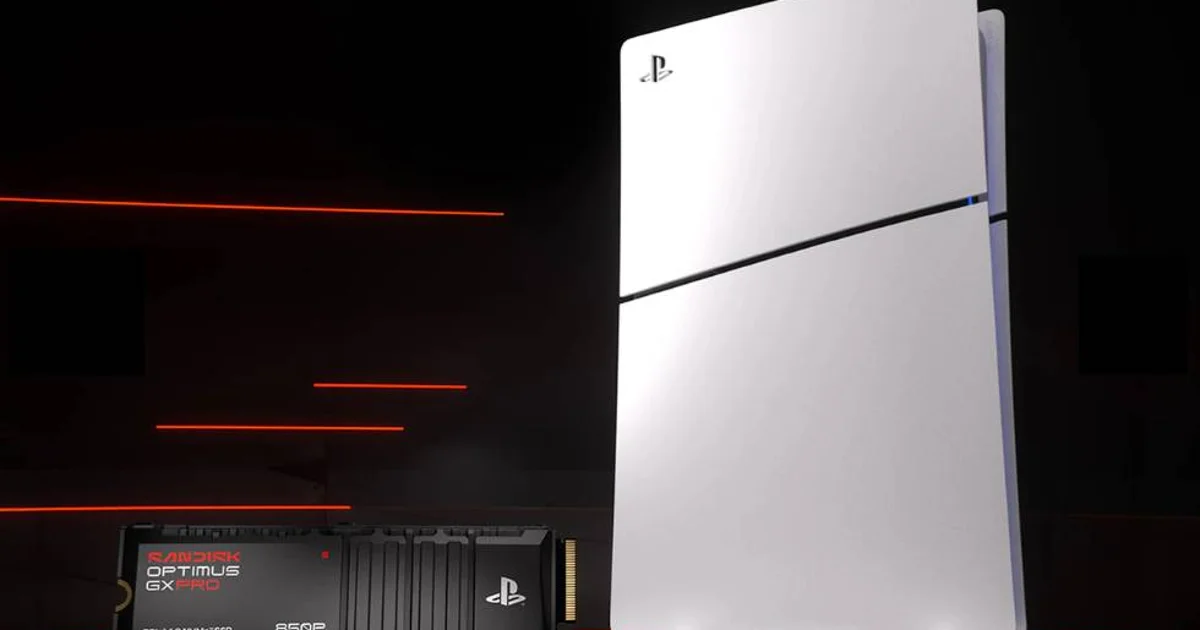
SanDisk has unveiled the Optimus GX PRO 850P, a lineup of officially authorized NVMe SSDs built for PlayStation 5 and PlayStation 5 Pro. By installing these drives in your console, you can expand its storage capacity, and they’re also set up to work with PCs.
There are four models in total, and each one comes with a different storage size. With the ongoing shortage of memory and storage, it likely won’t come as a surprise that these newly announced SSDs are priced at a premium.
Prices begin at £339/$380 for the 1TB version and climb to a steep £2639/$2960 for the 8TB model. These figures are based on discounts listed on SanDisk’s website, which, unusually, doesn’t show a purchase button at the moment.

The 2TB model costs £678/$760, while the 4TB option is listed at £1337/$1,500. As you may have already noticed, every drive except the smallest capacity is priced above the PS5 itself, and the biggest option is more than three times the cost of a PS5 Pro—using current PS5 pricing, which Sony raised in March.
These new drives use the PCIe 4.0 standard, with performance figures up to 7300MB/s for sequential reads and 6600MB/s for sequential writes. They also include a built-in heatsink featuring the PlayStation logo.
This appears to be the latest example of how AI-fuelled demand for additional data centers has pushed up global memory and storage costs. Console makers, like nearly every other consumer electronics company, have had to raise prices repeatedly over the past 14 months. Sony, Microsoft, and Nintendo have all been part of this shift, which keeps the door open for additional price increases as expenses continue to grow.
In practice, this situation has made affordable computing out of reach for many people across PCs, consoles, and even enthusiast projects such as the Raspberry Pi. At the moment, there’s no obvious path to a fix. It will be interesting to see how Valve’s Steam Machine tackles the pricing problem.
For most observers, it seems likely that we’ll be dealing with this issue for a few more years—especially when you consider how much uncertainty platform holders have around when the next wave of consoles will arrive, with estimates often pointing to 2028 or 2029. For now, the smartest option is to make the most of the consoles and PCs you already own.