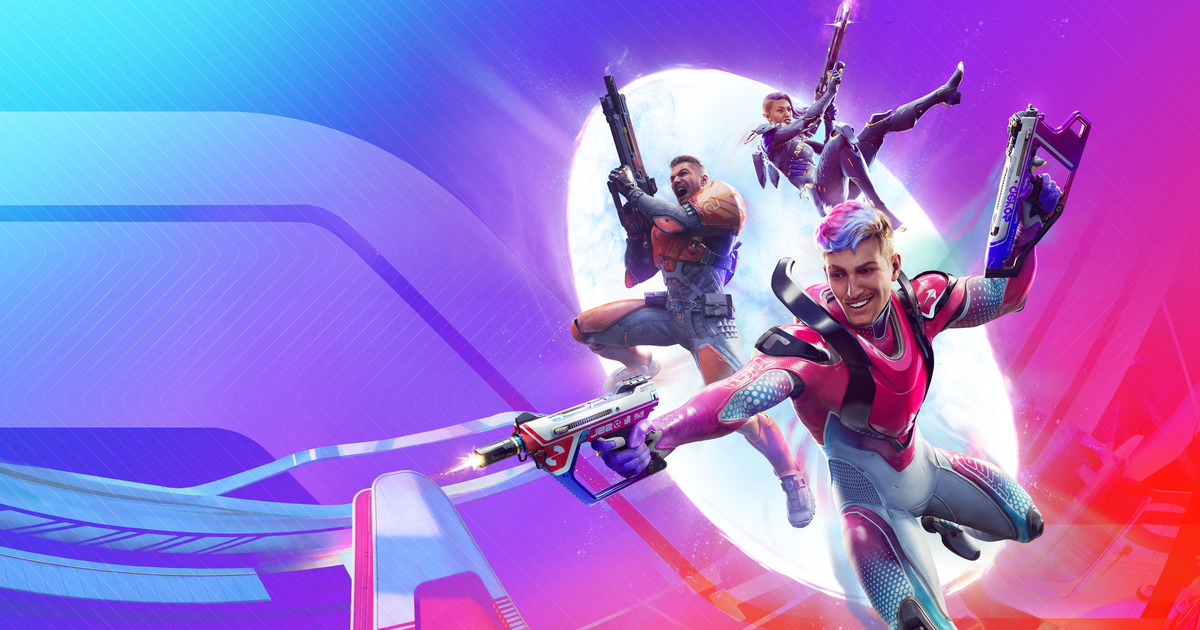
One thing I loved most about the original Splitgate was how it brought me right back to those early Halo days—kicking back with friends during LAN weekends in the early 2000s. On top of that, it delivered all the familiar comforts of today’s gaming scene, with a wide range of tweakable lobbies and crossplay multiplayer that made setting up our best matches feel surprisingly effortless.
Even with plenty of modes to choose from, my friends and I usually gravitated toward the no-frills Deathmatch playlists, though we’d swap things up with Gun Game from time to time. We enjoyed zipping around in these free-for-all matches, picking up weapons off the floor as we came across them, or playing Gun Game with a more careful, step-by-step approach to taking opponents down.
The mix of Halo-like nostalgia and the strategic possibilities of portal-based flanking really landed in my friend group. It felt like it outshone Halo Infinite’s multiplayer, while also offering a much broader lineup of maps and choices—so Splitgate ended up naturally taking over as our go-to FPS for casual online sessions.
That’s exactly why, when I heard Splitgate 2 would be centered on 4v4, objective-driven matches with a small hero-shooter twist, I felt a letdown hit me. To me, the original Splitgate wasn’t about stepping into an esports spotlight or hunting for the perfect balance between each player’s skill set. Instead, it was all about pure, chaotic, brain-off entertainment—very much like the kind of multiplayer fun people were having in the early Xbox era.
So I approached yesterday’s Splitgate 2 Alpha reveal with a bit of caution. Of course, it’s exciting to see the next entry in the series, but I couldn’t help wondering whether it would come at the cost of what I valued in the first game. I still had doubts, but I was willing to let the actual gameplay change my mind.
The Alpha, which you can register for on Splitgate 2’s Steam page and is set to launch for the public on August 21st, offers two modes—Hotzone and Team Deathmatch. Hotzone is basically King of the Hill with a twist: both teams share the capture progress, which lets one side sit back and do most of the work later on, then swoop in at the end. Team Deathmatch is the familiar scramble to rack up the most kills, but with a round-based spin. In this setup, the first team to hit fifteen kills wins a round, and the team that takes three rounds wins the overall match.

Both modes were fun to jump into, but as with many team-based shooters, how well you do depends more on team coordination than on individual skill alone. That’s why my enjoyment shifted a lot from one match to the next, based largely on who I got matched with. I can see how players with a dedicated squad would enjoy these 4v4 modes a great deal, but for someone like me who doesn’t mind playing solo now and then, pairing up with unpredictable random teammates can get exhausting fast.
One major reason random matchmaking can put you at a disadvantage versus organized groups is Splitgate 2’s introduction of factions. There are three factions to choose from, and each one comes with distinct abilities and a particular style of play, so a well-coordinated team can take advantage of those differences. Still, what happens when everyone in a mixed lobby chooses the same character? That doesn’t work out nearly as well. The Areos faction is tailored for players who mastered portal play in Splitgate, offering a speed-boosting ability along with health injectors. I usually leaned toward the tanky Sabrask faction since I prefer gunfights over portal setups, though Meridian is also there for players who gravitate toward support, thanks to its wallhack-style ability.
Overall, I didn’t feel these abilities were overly disruptive or especially hard to deal with—and I even started to like Sabrask’s portable shield ability, which came in handy when defending Hotzones. What bothered me a bit, though, was that each faction is limited to three distinctive weapons. Every class gets its own take on the carbine, assault rifle, and SMG. Even if there are plenty of customization options for magazines and barrels, I still missed the original game’s straightforward approach, where you could freely roam and pick up weapons from the ground.
On the maps we played, I also noticed power weapons with the same kind of spawn points: a rocket launcher that includes an alternate firing mode to launch three rockets at once for big splash damage, and an assault rifle that can split into two, enabling some truly satisfying Halo-style dual-wielding. These pickups provide a small edge, but with Splitgate 2’s quick pace of engagements, going after them instead of focusing on the objective often felt like a waste of time.
Another addition I was glad to see was sliding. Movement in Splitgate has always felt smooth—particularly with the jet-pack double jump—and this new ability to slide along the ground while shooting fits in naturally with everything else going on.
There have also been tweaks to the portal system, mainly that you can now slightly redirect nearby players’ portals when you fire your portal adjacent to theirs. That means you’re no longer blocked from placing a portal on a wall just because a teammate accidentally got in the way. Likewise, you can now take out enemy portals by shooting your portal directly over them, instead of relying on EMP throwables, which have been replaced with optional gear such as grenades or health bombs. After placing a portal, each one gets a short window of invincibility, so you can’t immediately shut down an opponent’s portal—but overall, this feels like a sensible upgrade from Splitgate’s EMP approach, which I often forgot to use.
If you catch the embedded live stream, you’ll see I genuinely had a good time with Splitgate 2’s alpha. It looks and plays like Splitgate, and the updates to portal interactions and movement are definitely welcome—plus, wow, that shotgun is still a blast to fire. That said, I’m less drawn to the focus on objective-heavy 4v4 team battles.
I’m sure a lot of players will welcome this direction, especially those who care most about competitive play, but I’m hoping the final release brings back the kind of flexible, customizable lobbies and options that made the original shine. That way, players like me can set up enjoyable classic Halo-esque lobbies where everyone is on equal footing, without worrying about getting stuck with unreliable teammates. If those options are there, Splitgate 2 should be an excellent game and a regular part of my rotation. If not, I can easily see myself moving on sooner rather than later.