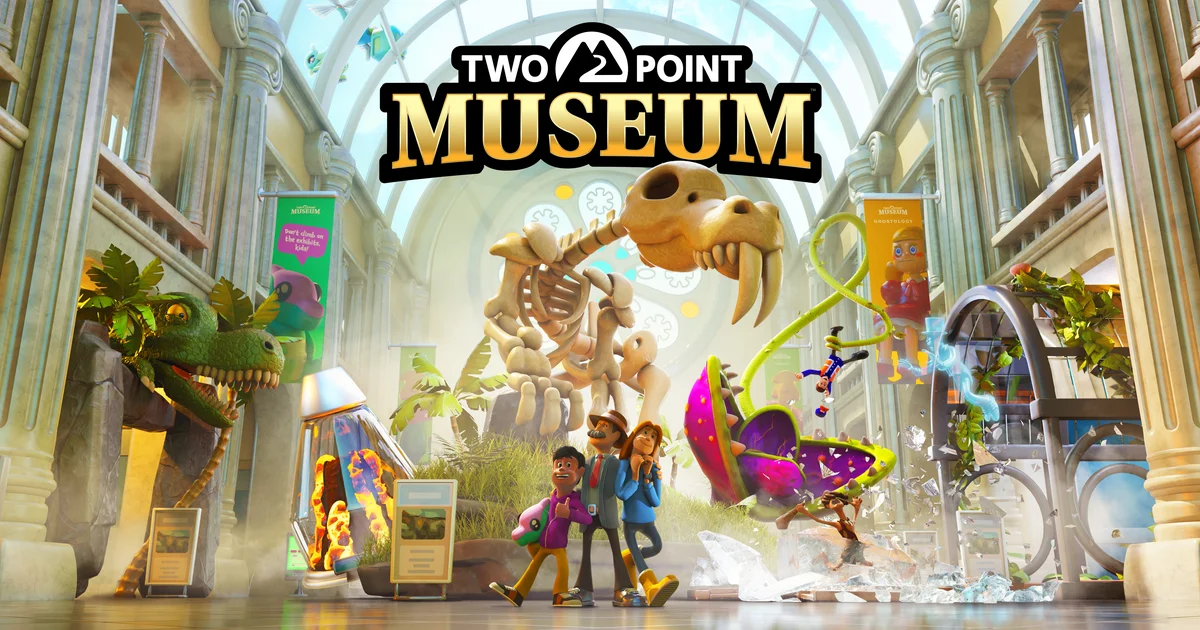
What struck me most about Two Point Studios’ earlier games was how powerfully they expanded around a single core idea. Starting with a hospital setup, then moving into a campus, each concept delivered impressive depth in its systems and a wide variety of ways to play — along with, of course, plenty of laugh-out-loud moments.
That same approach applies to the recently unveiled Two Point Museum. As you might expect from the title, players take charge of building and running a museum packed with historical exhibits. Still, because this is a Two Point release, things never stay as simple as they sound. Picture Night At The Museum, then tilt it toward oddball, sharp-edged British comedy.
The process includes assembling a museum, designing displays, setting up gift shops stocked with quirky items, adding places to eat, and requesting donations. All the familiar pieces are there, but handled alone they wouldn’t be very exciting. In Two Point County, exhibits aren’t just collections of relics — they’re starting points for discovery and, potentially, chaos.
So with so many kinds of simulation management gameplay available in the quirky world of Two Point County, why a museum?
“We maintain a list of various concepts we consider for future titles,” says design director Ben Huskins, after I get to try a short demo of Two Point Museum. “What really grabbed us about Museum when we first started talking about it was the opportunity to curate collections of amazing artifacts… How do I track down these fantastic things and put them on display in my museum? That immediately set off a wave of ideas for us.”
“Each exhibit has a lot of meaning and comes with plenty of gameplay elements, which gives us a great deal of flexibility,” adds executive producer Jo Koehler. “We’re seeing that, unlike earlier entries, players’ museums are developing their own personality — because once we moved past simply having gameplay, we put a major focus on making these museums feel remarkable and look truly impressive.”
Two Point Museum begins with basics like placing items and setting up decorations, alongside recruiting staff, but it doesn’t stop there. At first, building isn’t limited to rooms the way it has been in previous games. This time, partition walls can shape the space, opening the door to a more flexible design workflow, with fresh floor and wall options, archways, extra decorative details, and visuals that help light up every area.

On top of that, Two Point is widening its approach with expeditions. Exhibits aren’t just selected from a menu the way you might order hospital or school supplies; instead, they need to be discovered while travelling through an expanding world map, then brought back to each museum’s helipad. You’ll hire specialists not only to keep exhibits in top shape, but also to head out on adventures at the players’ request, returning with interesting items to display. And then there’s the big crate that floats into view and opens to reveal your newest find — it looks a lot like a fossil gacha machine.
Of course, this can lead to both trouble and delight. One specialist came back from an expedition with an illness, leaving muddy footprints across the spotless floors of my museum. Two Point suggested that even worse situations could happen, too. In fact, experts may not always return safely while they’re out.
Expeditions are a key way the studio is pushing gameplay further than its earlier titles, blending exploration and uncovering in a way that’s rarely seen in the simulation genre. Huskins explains that it adds another layer of adventure and storytelling, while also demanding careful strategy — players must decide which experts to send on trips and which ones to keep back at the museum.
The demo I played focused only on prehistoric exhibits (the “starter pack,” as Huskins put it), which meant travelling to the Bone Belt to dig for them. Even so, you might find these displays don’t match expectations. Sure, there are dinosaurs — including Sharpontops and the Tugowaurus — but there’s also a caveman trapped in ice, seemingly ready to thaw and wake up, a fossilized future adventurer (thanks to time travel, naturally), and a massive stone prehistoric computer. Even a fossilized floppy disk makes an appearance, because apparently our childhoods deserve a spot in a museum. Specifically, dinosaurs are collected in pieces, so you’ll need multiple fossils to finish a full set. It feels a bit like Animal Crossing, especially the collection approach where you’re working toward completing every item in each exhibit. I’m not sure the café will include a pigeon taking orders, though.
What other themes could come next? Two Point is, understandably, keeping tight control over the details, though I did spot some aquarium areas in the game’s trailer.
“We have some concepts that are based in reality,” Huskins notes, “so we’re obviously thinking about the kinds of things you’d expect to locate in a museum, and we want that to be the foundation. But we also include those more unusual, offbeat elements that fit right alongside the spirit of Two Point County.”
He referencesprevious titles and lore clues that may point to what’s coming next. “This is about delivering that kind of variety—both in the look of these intriguing displays and in the way they function, as well as how players interact with them.”
Personally, I’d love to see an art gallery where you have to stop soup-throwing vandals and deal with thefts. “Keep watching,” Huskins hints.
Even so, Two Point Museum brings something far more challenging than dinosaurs: kids. Visitors will arrive in groups, including those pesky youngsters who will stir up trouble unless there’s enough to keep them busy. I saw one clambering all over a fossil I’d been particularly fond of, unable—tragically—to scare it away. After that, the game will roll out school trips, giving players a way to set up tours that highlight their favorite pieces.
belongings.
The participation of children is another path the studio is using to push the genre forward, alongside a range of new visitor types. At the heart of its “edutainment” philosophy is the workshop, where players can build engaging exhibits—whether that means a climbing setup inspired by a dinosaur or something similar—while making sure nothing turns into a disruption. School excursions will be part of the plan as well.
A major goal within the game, naturally, is earning income. Every exhibit is given a Buzz score that reflects how exciting it feels and how appealing it looks; that, in turn, draws in admiration from guests, making them more likely to drop something into a donation box nearby. Just be sure you’ve got enough security staff on hand to prevent any stealing.
Still, education is also a core focus, as Huskins explains: players know some facts about exhibits and artifacts, but not everything. “A few of them are a little more mysterious once you first uncover them,” he says, “so there’s this part of the game where, as a museum manager, you’re working to learn more about these displays. Later on, you’ll be able to review your exhibits, which deepens your understanding—so you can create better, clearer writing for the information placards. That helps visitors learn more, and ultimately, it leads to stronger reviews for you.”
The experience starts with familiar controls, a recognizable user interface, visuals, and humor for anyone who’s played a previous Two Point title. “Dinosaur bones used to be surrounded by dinosaurs,” a message delivered to guests at one stage made me smile. There’s plenty of small stuff to catch too: friendly animations of tourists in floral shirts as they pose for photos, donate, and learn, along with parents offering snacks to their kids.
“We always try to build on what we learned from our earlier games,” Koehler says. “We spent a lot of time testing and polishing, working with our players so the controls feel right to them. We didn’t want to throw away what already functions well… but I think that helped us get to the mechanics and key systems faster. The last thing we want is for anything to feel off for our players.”
Two Point Museum will bring upgraded customization tools and more room for creativity, mainly because room layout limits are no longer a sticking point. There will also be extra objectives once you hit a three-star rating on any level, giving players more things to pursue and encouraging them to return to stages they’ve already finished.
It becomes clear that Two Point Museum is just as careful about its craft as it is delightfully funny. Even after a brief demonstration, I found myself impressed—eager to see what comes next. And isn’t that exactly what makes museums so enjoyable, along with the thrill of discovering something new?
In the end, it really comes back to the depth of the studio’s creativity. “It’s genuinely an open process,” Huskins remarks. “Everyone on the team is excited to contribute ideas. You’ve got artists, designers, coders, producers—everyone’s throwing ideas into the mix.
“That’s how you build that variety of different elements, along with some of the slightly quirky humor. We each bring our own sense of humor to the table, and then we combine it into one big melting pot.”
He also talks about how the different systems fit together: “We spend a great deal of time discussing these pieces, and we try to apply a bit of Occam’s razor—asking, ‘Do we really need this feature? Will it make the game more complicated than necessary? Could we combine these two ideas to form a simpler system that still gives us the depth we’re after?'” From there, the team rolls out the experience step by step with tutorials, making sure systems work smoothly right from the beginning and continue to do so for hours afterward.
“Some of our players are very casual, more cozy management gamers, but we also support dedicated simulation fans who love to min-max their play and use specific strategies,” Koehler adds. “We want to tick every box for everyone; it takes a long testing cycle. And while we don’t always nail it on the first try, we keep adjusting until it feels just right.”
Indeed, just like Two Point Campus grew out of Two Point Hospital, Two Point Museum seems to be taking the same direction. Longtime fans of the studio’s earlier games shouldn’t expect to feel let down.