Put simply, Cronos: The New Dawn is a survival horror title built around revisiting the past—sending you back in time to grab items from earlier eras. That context matters, because Bloober Team, its development studio, seems to have returned to older creative territory, drawing on nearly every aspect of Cronos’ gameplay systems from earlier survival horror experiences and even beyond.
That approach isn’t automatically a drawback, though. When there’s just one standout spark of originality (and it really is notable), it can leave you with a lingering sense of “I’ve already done this” during a recent run through the game’s opening stretch.
Still, familiarity can be a mixed blessing rather than a pure negative. Cronos leans into a dark, tense atmosphere, supported by an ambiance that’s oddly hard to look away from. Visually and tonally, it brings to mind Returnal—especially through the Traveller, whose space suit dampens their voice, creating a resemblance to Selene’s delivery in Returnal during moments when she reflects on her predicament.
The audio work stands out too. You get a constant stream of sci-fi beeps, boops, and whirrs from strange, otherworldly systems; plus metallic creaks and crunches as you move through each area. Meanwhile, the grotesque squelches and roars that come from the merging mutants sit beneath a tension-building, heartbeat-like pulse that keeps time in the background.
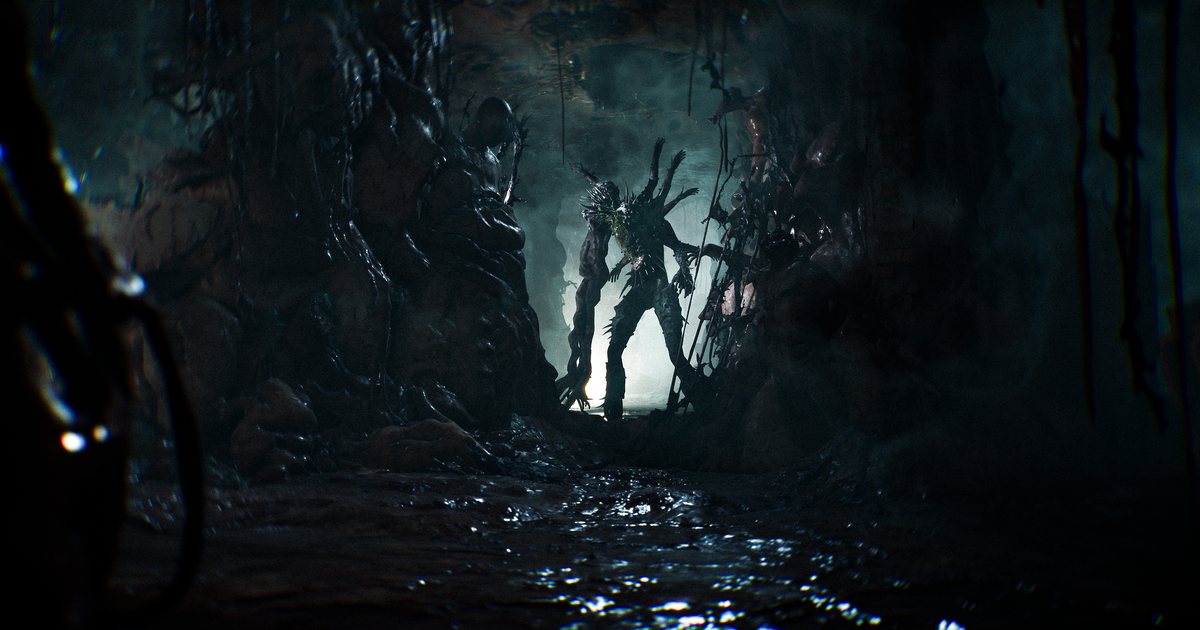
Pair that with some hauntingly beautiful locations—everything from ruined, crumbling apartment blocks and dusty shop interiors stranded in an apocalyptic state, to unsettling caverns and canyons carved from grotesque piles of human flesh—and the overall mood becomes almost as recognizable as the Traveller’s helmet, which has a distinctly phallic look.
In terms of color, it favors a fairly muted, subdued palette, matching the mood of despair and echoing the feeling of lost humanity. My main complaint with the visuals was that quite a few props can’t be broken. Bottles, glass, boxes—unless something is clearly designed to shatter for gameplay purposes—remain perfectly fixed in place. That said, this may just be a personal preference; I tend to enjoy smashing things.
Returning to the comparisons with Returnal, one element that immediately pulled me in was the mystery at the heart of the narrative. Where is Selene? Why is she there? What is she supposed to be doing? And why is her childhood home sitting on a foreign world? The story drew me in, and Cronos feels ready to offer a similar kind of mystery—one that could be just as compelling to uncover.

Early on, the Traveller wakes up inside what the game calls a sarcophagus. A computer aboard the unit presents the player with a Rorschach test, and you have to respond—do you see a dog, or a demon? But why is this test happening in the first place? Do your answers affect what you experience later? The opening couple of hours don’t shed much light on any of those questions. Instead, nearly everything is wrapped in uncertainty.
You’re told you’re searching for something called a Predecessor, but you’re left wondering why. What is their purpose, and who are they, exactly? Eventually, you come face-to-face with them, and they turn out to be another Traveller—someone just like you. The difference is that they’re already dead. So who was this Predecessor? Could they be a Returnal-style, time-traveling doppelgänger? If that’s the case, does it mean you’re essentially the final surviving remnant of humanity—tasked with rebuilding the human race by succeeding where your earlier versions failed?
This Traveller also wears a different number on their suit than yours: 3500, compared with your 3576. Maybe the suits simply get different labels, with more people lined up to take on the Traveller role somewhere in the far-off dystopia. Or perhaps Travellers aren’t really people at all, but rather a kind of mass-produced humanoid device. Either way, it raises another question—why is Traveller 3500 bleeding? At the very least, Cronos is excellent at setting up mysteries I genuinely want answers to. Figuring out who’s behind that helmet will likely become the main drive that carries me through to the end.
Combat in Cronos can feel especially demanding, largely because ammunition is scarce and it takes quite a lot to bring enemies down. You do get the familiar trade-off: a slower, Dead Space-inspired heavy melee swing with your fists—useful if you’re running low on bullets. But the catch is that you’re more likely to eat significant damage, so it’s best kept for urgent situations. Often, you’ll be forced to balance how much ammo you have against how many creatures are nearby. I fell back on experience from other survival horror games, using the tried-and-true habit of “running past enemies to save ammunition,” which worked well—because outside of any set-piece arena fight, you can frequently reach areas where the monsters stop chasing you.
I remember thinking, “Nice.” Clever work, Ian—you made your escape while still conserving ammo. But what I hadn’t prepared for was the Merging mechanic, which is arguably Cronos’s only genuinely original idea. It’s an engaging feature, and it finally put real fear into me: I wasn’t just leaning on survival horror instincts anymore, but actually confronting something I didn’t know how to predict.
In Cronos, after you bring down a monster, the remains will sit on the ground until you burn them away (yes, this incineration detail is something I’ve run into before—first in The Evil Within—though the rest of the system is different enough to feel its own). You can take care of the bodies using nearby explosive barrels or by firing a flame effect from your suit. At the start, that flame ability is limited to a single blast, and then you’ll need to recharge it.
If you don’t manage to incinerate the corpses, there’s a strong chance another creature will stumble in and fuse with the dead flesh—turning into a larger, spikier, and far nastier threat than what you originally faced. I learned that firsthand when I returned to an area I’d already cleared, only to find that many of the monsters I had previously avoided had combined with the ones I’d eliminated. The end result was a noticeable rise in difficulty. Once that fusing system clicked, it changed the way I handled fights: suddenly, running wasn’t automatically the safest move, and that realization was honestly pretty unsettling.
As you may have guessed, Cronos openly pulls from a good deal of gameplay mechanics found in other, already established survival horror games. Most of the time, that wouldn’t be an issue if it were done with care—after all, what game doesn’t borrow a few proven ideas? Still, in Cronos, it felt like I’d already seen almost everything it had to offer. You’ll run into time-manipulation puzzles, fuse-based puzzles, and doors that stay shut until you track down a three-digit code written on a note somewhere, among other examples.
The influence of Dead Space is also hard to ignore. The impact of those massive boot stomps, along with the grotesque, formerly human enemies, brings a clear Necromorph-style feeling. That’s paired with wall-mounted lockers that hold health, ammunition, and crafting supplies. There’s even a gravity-boot jumping maneuver highlighted in recent gameplay trailers, though it didn’t show up as part of what we got to test during our hands-on time.
There are also similarities to the Resident Evil franchise. For example, Cronos’ Resi-like safe rooms include those familiar item lockers where you can stow away gear you don’t want to carry. And the worn-down apartment interiors we explored toward the end of the demo looked like they were lifted straight from Bloober Team’s latest Silent Hill 2 remake.
On top of that, it’s not just visual echoes. I could tell pretty well when enemy encounters and jump scares were coming. It was obvious when I’d entered an area designed for a fight against multiple foes, and it was equally clear when I was moving through sections where monsters probably wouldn’t show up. That predictability undercut the suspense and pressure in Cronos, leaving my exploration with a more muted, almost indifferent tone—until the merging behavior started to happen.
Some horror moments don’t stay scary once you’ve survived the first handful of encounters. The upside for Cronos: The New Dawn is that, if you haven’t played horror games before, it may end up being among the most terrifying experiences you’ll ever have. But if you’re a longtime fan of the genre—or even a casual player looking for something standout—then based on what I’ve seen so far, it may not be the best investment of your time without a few more genuinely fresh ideas.
This preview is based on a press trip to Poland. Bloober Team provided travel and accommodation.