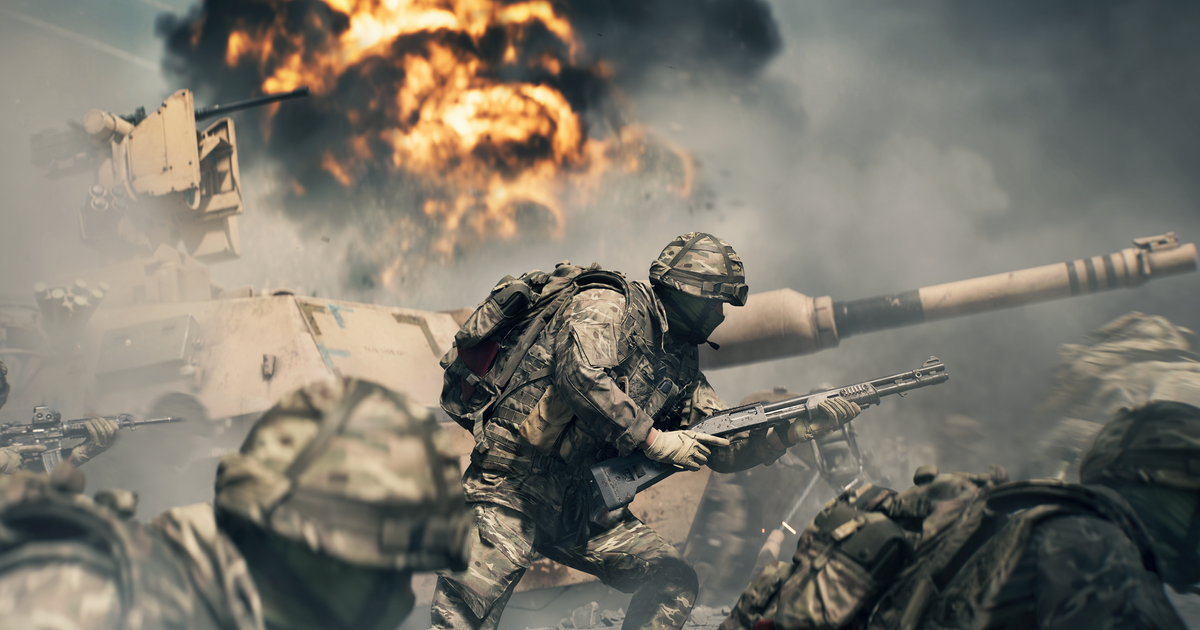
After all the talk about bringing Battlefield back to what it originally felt like, Battlefield 6’s multiplayer is surprisingly bold. Usually, the template is instantly familiar to FPS fans: big set-piece firefights, large teams, and a blended approach that mixes infantry, ground vehicles, and aircraft. Yet while the moment-to-moment play is still as satisfying as ever—maybe even pushing the series to fresh levels—some of the new ideas introduced by Battlefield Studios (a joint effort from multiple EA teams, including DICE, Ripple Effect, Criterion, and Motive, who all now work on this franchise) have me wary.
During a lengthy preview event, I got to test a range of maps and modes, and, as you’d expect, everything delivers a chaotic blend of crumbling architecture and teammates unloading at full volume. Take Cairo, for example: the streets are packed with cramped buildings and tight passages, ideal for plenty of ambushes. Empire State swings the mood the other way, with a multi-level firefight inside a building under construction—squads firing down from scaffolding while one player sprints upward from the rear, shotgun in hand.
Classic options like Conquest return, while familiar staples such as Team Deathmatch and Dominion drop you into these updated battlefields either by carving out a smaller slice of the map or by letting you play without restrictions. Everything is, as usual, driven by a nonstop energy you rarely find in other shooters—at least not unless you head toward the more unforgiving end of the genre. And the intensity often smashes straight through those limits.
These smaller map variations aren’t chosen at random. Instead, the more condensed modes highlight the tighter infantry brawls, while the bigger layouts are reserved for the broader, high-pressure confrontations involving vehicles. Each approach has its own pull. Pushing door to door toward a capture point feels tense and immediate, especially with a rapid time-to-kill that keeps infantry fights brisk and fun. Wider areas create memorable “Battlefield moments”: a tank can blow up just ahead of you as you dash between rocks and small shacks to evade a barrage of missile fire. No matter which map or mode I tried, they all turned into powerful arenas for destruction.
On top of that, yes—destruction physics are back in Battlefield 6, though handled in a more focused way. It looks like Levolution—still not a widely understood term!—the system that featured massive destruction events capable of completely remolding a map mid-match, has been taken out. What remains is “tactical destruction,” letting you, for instance, bring down a floor beneath a group of players to set up surprise attacks. Debris still scatters and rubble keeps falling everywhere—still the same frantic, audio-visual storm of action—but compared with earlier entries, Battlefield Studios has leaned into precision rather than raw spectacle.

That shift may reduce some of the huge “wow” moments from the matches I played, but it also brings a steadier feel—something that would otherwise disappear when a devastating event wipes out your carefully established defensive position. You could make the case that in Battlefield 4, having a pack of snipers perched on the skyscraper during Siege of Shanghai was annoying, and watching that skyscraper collapse felt like a satisfying answer to elevated marksmen. Battlefield 6 seems to treat the situation differently.
This approach, which allows snipers to stay up high in an unexpected way, leads to a more grounded Battlefield experience—less centered on dramatic acts of destruction and more oriented toward classic military-simulation style shooting and tactics. That could be a real advantage for players who prefer Battlefield’s gunplay over extra flourishes.
You may have noticed that I used the word snipers rather than Recon players. That difference matters, because Battlefield 6—despite the developer openly acknowledging the mistakes made in the full overhaul of Battlefield 2042—still brought a major change to the traditional class structure. The four core Battlefield classes are back: Assault, Engineer, Support, and Recon. Each class keeps the expected gadgets, like a respawn beacon for Recon and an RPG for Engineer, but—importantly—weapon-type limitations tied to classes have been removed. A sniper doesn’t have to be a Recon anymore. Any class can hang back at the far end of the map, miss shots, and still smile through it.
This has sparked debate among Battlefield regulars—so much so that Battlefield Studios says it plans to add classic locked weapon playlists when the game launches. Even so, the goal is still to keep this more flexible way of equipping class loadouts. In the Battlefield team’s view, gadgets determine what a class really is. They might be right. Still, I can’t shake the sense that this will meaningfully reshape the familiar Battlefield flow. Let’s go back to that sniper example from earlier.
If players couldn’t level the whole building, Battlefield fans have long used helicopters or jets to hunt down clusters of Recon enemies. That frequently left Recon players on rooftops in a dangerous position, armed only with anti-infantry gear that wasn’t effective enough to deal with those aircraft. They’d get taken out, the respawn beacon would be destroyed, and the pilot would complete the mission. No complaints, all around.
Recons can’t reliably take on vehicles, and that creates a cycle of rock-paper-scissors strategy and counterplay. From a basic gameplay perspective, it’s
It sets Battlefield apart from its main rival, Call of Duty. But imagine letting an Engineer handle a sniper rifle—sure, they might not gain benefits from…
The passive perks a Recon can pick up for sniper rifles—made possible by a new system that grants small advantages to players who stick to more traditional playstyles—don’t add up to enough to make Recon overwhelmingly dominant at long-range sniping. If they did, the open weapon approach would essentially undermine itself.
Instead, it suggests that a 38-year-old known as SKYxDUI will rush into what they think is an all-you-can-kill gathering of snipers—an idea that’s been woven into Battlefield for years—only to discover that one of those snipers is armed with a surface-to-air missile launcher. Suddenly, the usual rock-paper-scissors balance doesn’t hold anymore. The changes have been reshaped in a way that leaves me unsure whether the outcome will actually help the game.
And what about objective-focused modes—how will they be affected when Recon players can sprint in with an assault rifle and then drop a respawn beacon? This plan used to be difficult because using a sniper and pistol against mid-range or close-range loadouts came with a clear downside. How will tanks and other ground vehicles fare when more people than before can carry a rocket? You can probably already guess where that leads.
Still, I get the counterargument as well. I’m a big fan of LMGs. The issue is that I don’t enjoy spending a large part of a match either reviving squadmates or restocking ammunition. Being able to carry an LMG on another class gives me more options and fewer barriers to play Battlefield the way I like. My worry is that this kind of freedom may come with too high a cost. I wouldn’t be shocked if, months after launch, most “hardcore” Battlefield fans end up choosing weapon-locked servers as the default.
I’m caught between two opposing reactions. On one side, purely from a sensory standpoint, this is the most engaging Battlefield has ever felt. It runs smoothly, delivers an adrenaline rush, stays packed with action, and is genuinely a lot of fun. Leaning more into localized, tactical destruction means that if you want to jump in and place some C4 with precision, it’s an especially satisfying feature.
On the other hand, the changes to one of Battlefield’s core pillars—something the dev team keeps weighing and reworking through the years—seem to chip away at part of the game’s identity while chasing a more open-ended experience. In the end, it’s a shift that could make Battlefield feel more similar to other big games in the same genre.
That’s why I’m left with cautious optimism. I think Battlefield 6 already has the building blocks of a truly outstanding entry—possibly even a classic—but I still need to see and play more to judge how things shake out. I’m looking forward to learning whether these ambitious gameplay adjustments land well, or if they just blur an otherwise excellent foundation.
This preview is based on a trip to Los Angeles. EA provided flights and accommodation.