When I previously put together a detailed review of a Dawn of War entry, I started tossing around lines like “a prima facie truth.” To be clear, I was aiming for a tongue-in-cheek tone—after all, it was all about the sheer satisfaction of smashing giant mechs into one another! Still, I have to admit there’s something in this franchise that leaves me a little too fired up. The first Dawn of War—where you pulled small villagers in from the cold and reshaped resource gathering into a capture-and-hold style affair—stands out as one of the crown jewels of the wider RTS genre, and it has a real, personal place in my development as a player.
That context makes it especially surprising that, even two decades later, we still haven’t gotten a straightforward follow-up in the traditional sense. DoW 2 shifted the whole experience toward a tighter, more tactical pace—commendable on its own—but it didn’t quite deliver the kind of payoff many RTS fans were looking for. DoW 3, meanwhile, was famously polarizing: Relic made a bold, ambitious effort to fuse real-time strategy with touches of light MOBA gameplay, and the reaction was anything but warm (I still think it was brave to try something new, and I would’ve welcomed a more classic RTS alongside all the impressive work the studio did with those huge Titan animations and the visual effects.)
Which leads us to DoW 4, unveiled during Gamescom’s Opening Night Live—somehow both startlingly unexpected and, at the same time, oddly inevitable. It felt surprising because, after the third game, it seemed reasonable to assume the series would sit on the shelf for a while. Relic had every reason to step back and regroup after separating from Sega, even if you might’ve expected them to press on with a fourth try. Yet in the grand scheme of things, inevitability is what you see across games and pop culture alike: first you get the original, a true classic built around a clear idea and executed so well you feel it on the first run. Then follow the waves of sequels, reboots, tougher-to-follow remakes, and more—because the fashions of the moment are hard to ignore. And at last, once everyone’s thoroughly tired of the cycle, you get the big return: a triumphant comeback that brings back the qualities that made the first game great (with mixed outcomes, depending on the effort).
Still, Dawn of War 4 takes that premise and somehow keeps it from turning into a rote formula. I’ve only played one mission, but, reader, I’ve already gone through that same mission around six times because it’s that good. Picture the next Dawn of War game you’d make if you were handed the keys. Would you build a classic RTS focused on bases, growth, and commanding large armies? Yes. Would you lean into a dark, grimy tone and drown the battlefield in gloriously over-the-top gore? Absolutely. Would you bring back those large special units? And would it include customizable skirmishes, co-op play, throwback online multiplayer, and an army painter? With stand-out visual flair? With colossal weapons roaring like thunder? And does it feature Gorgutz? Most importantly: yes.

As the team behind Dawn of War 4 explained to me during our conversation, putting these ideas into practice turns out to be far more complicated than it might look at first glance. Even so, based on the single mission I’ve had the chance to experience, my early takeaway is that their work is set up to be a genuinely impressive achievement. Dawn of War 4 truly feels like “real” Dawn of War—whatever that definition ends up meaning in practice.
The mission I played was a skirmish, though it carries a small story beat. The Imperial Guard—while not a faction you can control here, even though it’s surprisingly developed and run by the CPU—needed help pushing back some Orks (as you can probably guess, that’s what they’re dealing with), and you swoop in with the Space Marines to turn the tide, represented by the returning Blood Ravens and – splat. Drop pods are part of the package, dealing wonderfully messy giblet-producing damage, plus a mounted gun that functions as a modest defensive turret once it lands.
A clear departure from the original Dawn of War, highlighted right from this intro, is how tough the Space Marines are relative to the Orks and the Imperial forces. Two basic squads and your commander, Cyrus, are enough to wipe out roughly six squads of low-tier Orks. Just as notable is the set of upgrades and active skills you can use from the start. This isn’t the heavy bustle you see in DoW 3, so there’s no need to stress—it’s closer to an evolution of DoW 1, where grenades and similar tools feel a bit more within easy reach. Cyrus is also slightly different: he comes with a small mini skill tree where you can pick two or three upgrades. A remote-detonation bomb is brutally effective, or you can instead steer him toward a stealthy sniper role or a passive support build, including the ability to cloak his attached squad as well.
Zooming out to the squad level, this ends up feeling like a mix of the original DoW and another Relic standout—Company of Heroes. Units now include a retreat option that works much like it did in CoH: they dash back toward base, and it pairs nicely with the reinforce button (there’s also a built-in healing option for your vehicles using the corresponding button). Space Marines don’t have builder units at all. Instead, buildings are placed using a button found in the universal menu along the bottom of your screen. For the Marines, that retreat behavior feels especially important, since their whole approach is about being powerful but costly—meaning you can’t afford to ignore their upkeep,
to reduce the risk of losing individual soldiers—and definitely entire units—so the higher-level gameplay stays smooth.
Once you’ve established a base nearby, it’s time to jump into classic DoW-style play: push out to break down enemy strongpoints and forward bases, grabbing requisition points—static zones you can capture.
on the battlefield that unlock one of two essential resources, along with power nodes as well. This tweaks the approach a bit: power is now generated from the power-specific points you seize, similarly to requisition points, rather than from generators you build back at your base. It’s another nod to Company of Heroes—since power is crucial for vehicles and stronger late-game units, it mirrors how CoH separates manpower from fuel.
Beyond that, other resources depend on your faction. The Orks keep their Waaagh, just like always. The Space Marines earn one primarily through essentially performing well, feeding stratagems—high-impact abilities such as the familiar Orbital Bombardment, which feels incredibly satisfying but also slightly out of balance in this setting, or a mechanic that grants your squads a burst of XP. (The Space Marines now gain XP too! Highly leveled units, which reflects another CoH influence from veteran status, adds a smart layer by making them stronger—while also increasing the importance of keeping them alive, often with steep costs.) Meanwhile, the Necrons rely on a power matrix they spread out to grant their units buffs, and the Adeptus Mechanicus make use of entities called “cogitator relays” to strengthen their network—we didn’t see much of that here.
It’s worth digging a little deeper into the playstyle differences you can expect here. Even though I only played as the classic Space Marines, KING Art says the Orks will focus on cheap, mass-produced units and buildings, moving across the map at a fast pace—exactly as you’d anticipate. The Adeptus Mechanicus, meanwhile, lean into tools like tracking enemy movement on the minimap through fog of war, paired with network-style buffs. A few light spoilers for this particular skirmish: at one point, they bring out a Knight Castellan walker to deal with a (surprise!) Necron Monolith incursion, giving a memorable matchup that spotlights both factions’ most imposing “super heavy” units.
Back with the Marines and the rest of the mission: after you handle an Ork forward base as a minor objective, it’s revealed that the Orks are building three Gorkanauts at three separate spots across the map. That means you’ll need to move out and destroy them before they finish (in one of my runs, I let a single one complete just to see what would happen—it was entertaining, but it was also quickly shut down by that Orbital Bombardment. I’m guessing getting and using it in a regular playthrough will be harder than in this demo, which seems intentionally built to show off everything KING Art can pack into one mission.)
Next comes the fun appearance of the Necrons, starting with a creepy cameo from an unidentified Adeptus Mechanicus figure who comes in to do some “scans,” followed by a quick fight and then a push toward the Ork base. As all of this unfolds, one of the most obvious takeaways is the map design, which feels like yet another refreshing update to the classic DoW feel. The layout is deliberately asymmetrical: the Orks reach the flanks more quickly and get sturdier terrain in the middle, while from the South you have an easier time taking control of the map’s core. The real decision, then, is whether to concentrate your advance on a single flank or spread your forces more evenly—something that also fits neatly with another Space Marine perk: the ability to place units into “reserve” earlier than before, at a cost, and then drop them into the fight anywhere with a satisfying impact.
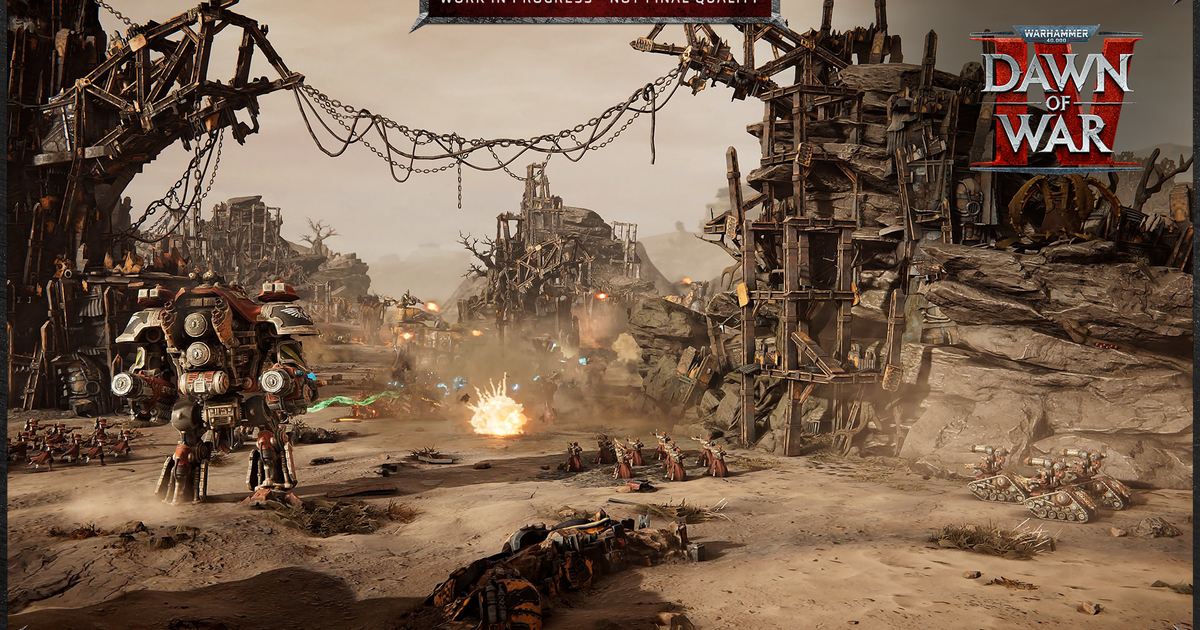
Once the battle hits the ground, it feels great. In DoW 4, the weapons sound absolutely incredible—like the noises you used to make as a kid while messing around. Brrrrrr, Pfffff, Dug-dug-dug-dug—okay, I’ll stop there. The guns deliver heavy, satisfying sound design, and it’s simply fun. There’s also more going on under the hood: you can count on a smooth blend of micromanagement at the infantry tier, from upgrading weapons and triggering auto-reinforcement to throwing grenades, using one of your Dreadnought’s two standout ranged abilities, unleashing fire with those impressive missile arrays, and then switching to melee to get units up close. Zooming in so you can guide squads into pieces of cover (which somehow brings back a little of DoW 2), or watching that exciting new animation feature—the “combat director,” which effectively runs a fully staged system where all melee animations are synchronized—then zooming back out again to consider the bigger plan and repositioning.
That combat director, by the way, could turn out to be a big deal. The key question is still how “sticky” your units feel, since that’s a major factor. This build is quite early, too—while the environments looked visually stunning in their gothic bleakness, the Space Marine base structures were still placeholder assets. It’s that early stage, and it’s also the one area where the presentation felt a bit rough. I found it hard to tell whether a unit had been locked in combat for too long versus when things were simply lagging. Still, purely as a visual spectacle: wow. I can’t think of another RTS that has tackled anything quite like this. If KING Art pulls it off—and it’s still an if at the moment—I’m not sure I’ll be able to view other games in quite the same way again.
There’s even more tactical depth to the combat when you look even closer
For example, the Space Marines use three color-coded segments to keep track of each unit. The usual health meter counts as one, XP takes up another, and then there’s a third bar—oddly enough—that fills, then steadily drains away. In practice, that functions like short-lived bonus protection granted when squad members fall and when foes are removed as well. It’s a kind of intense combat spirit meant to push you into sustained, aggressive engagements, encouraging you to stay in the fight because if you manage to hold them back—or keep your units alive—for just a little longer, they’ll build enough momentum to swing the battle.
Plus, the game pairs that pacing with some extremely satisfying late-game options—Terminator units and beyond—making the whole experience feel genuinely engaging.
them feel remarkably strong. I expect others will notice the same once human players take the controls or if you crank the difficulty up further. The Orks had plenty of numbers here, but the AI never actually gathered them into one place to launch an assault; instead, it hung back in that familiar RTS style of waiting for the right trigger. If they’d grouped up as a single force, I likely would have been overrun from the very beginning.
What ties everything together is sheer spectacle. Dawn of War 4 comes across as a full-course feast of detailed animations, flashy weapon effects, and memorable sound design. The army scale can feel enormous, the base buildings are playfully exaggerated, and the turrets look intimidating the moment you notice them. The Necrons fire off energy blasts with a chilling menace, the Ad-Mechs trudge ahead with showy, metallic intimidation, and the Orks press forward in a turbulent tide, almost like one continuous, wave-like mass. The Space Marines capture the feeling of a ruthless purge, all of it framed by bleak architecture and slick, grotesque gore. To me, it absolutely reads as 40K—across different styles and, at minimum, within a single mission—and it’s hard not to call it pure delight.
If there’s a weak point in this early look, it’s the amount of campiness carried over from the original. Saying that might sound heretical to some, but I’d encourage those folks to go back to the source material with a sharper eye. Camp is baked into Warhammer—and even 40K. In more recent years, as the emphasis on darkness and weight has grown, it can become easier to miss that even something that brands itself as “grimdark” still has a built-in streak of goofiness, at least in certain ways.
The one thing I truly hope to see here is a nod to the original’s wildly expressive, over-the-top dialogue—the kind that made it so easy to quote endlessly. Still, Gorgutz is in the picture, and the Gretchins too. So there’s reason for hope. And for me, optimism is the main takeaway. After a long run of false starts over the years—not just for Dawn of War, but for the genre more broadly—I’m genuinely eager to see this take shape. Dawn of War is returning; it just needs to land with the full-bodied, punchy impact you’d expect from its anticipated launch.