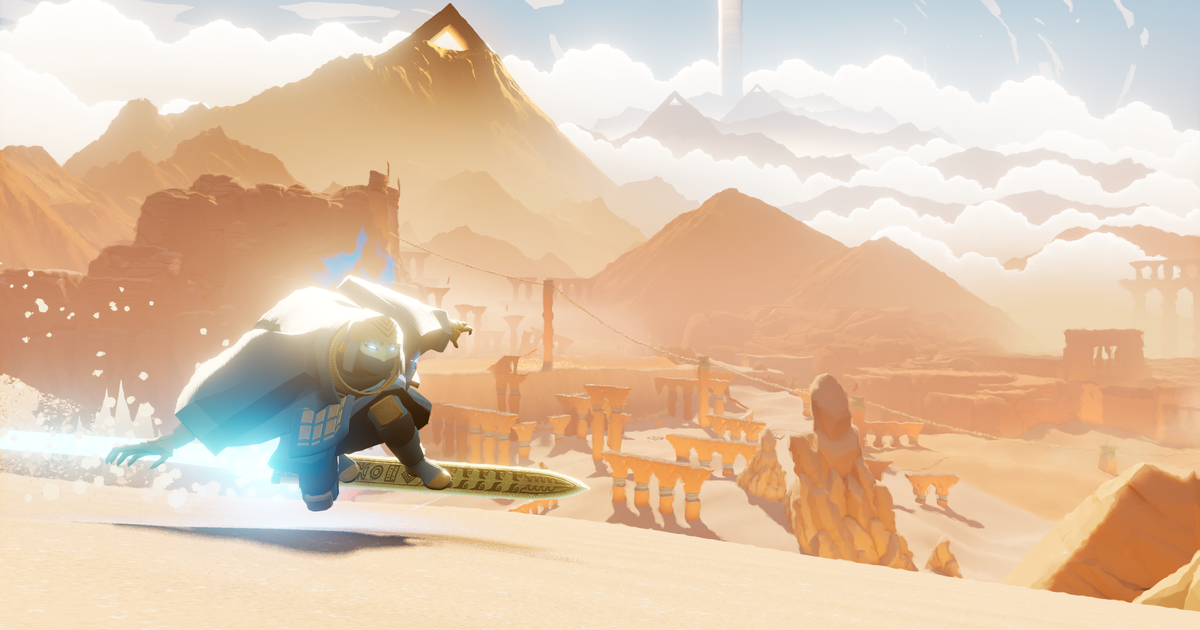
“To start with, it’s just wonderfully satisfying in a video game to move around and explore,” Matt Nava says with the calm certainty of someone stating the obvious. And honestly, he’s not wrong.
“Whole game categories revolve around motion—think racing games or snowboarding—but once you get down to it, the play tends to collapse into either a race or a points-driven challenge. Exploration games are far less common.” That brings us to Sword of the Sea, the newest work from Giant Squid. It comes after the quietly reflective The Pathless and Abzû: “What if we made a game where you could enjoy that kind of movement, but in an exploration setting?”
I met Nava for the first time, when I spoke with the creative director at Giant Squid during Summer Game Fest in June. Still, the experience of the game—and our conversation—stays with me easily. Even with the hectic energy of a press event show floor, Sword of the Sea felt like a peaceful, comfortable breather.
After about half an hour in the game, I can say this with confidence: it delivers an exceptional feeling of flow, though it’s a very particular kind. In most flow-focused games, that state is sparked by pressure, producing a laser-like attention that hits like a polished, diamond-hard focus. Here, the flow in Sword of the Sea mirrors water’s own motion. And with confirmation that it’s heading to PS Plus at launch next week, there’s a strong reason to champion it now—because if you do have the subscription, trust me, you’re in for something special.
Step out of your cozy cave hibernation spot, take up your enchanted blade tied to some kind of silent, fated purpose—and you’re moving right away. You’ll immediately spot a lot of Zelda-inspired touches, including the joy of smashing pots—and then it’s off to the races. Your sword acts like a surfboard, a skateboard, a snowboard, or whatever you need it to be. The dunes turn into your waves. Then go looking for what they uncover.
“In this game, what matters most is how movement links you to the world,” Nava explains. He draws a comparison to snowboarding, one of several “extreme sport” references you’ll notice throughout. “When you’re charging down the mountain, you get to experience the whole environment quickly. It can make you feel like you’re almost everywhere at once. It’s the closest you can get to truly understanding the space. And that kind of movement unlocks a different way of perceiving the world.”
That extreme sports angle is a key piece for Nava and Giant Squid, because it blends mindfulness with motion. “It’s kind of like Abzû,” he adds. “I went scuba diving, and whenever you see diving in a video game, there’s usually an air gauge. There’s this constant tension. The sharks are about to attack—you’re at the edge of death! And the Sonic soundtrack is playing dee-doo-dee-doo-dee-doo,” he laughs.

“In real scuba diving, you drop into the water, and you actually have far more air than you’d expect to need. You’re in shallower areas. It’s bright with sunlight, and there are beautiful fish. You’re just floating along. The only sound you really hear is your own breathing. It feels like meditation. You naturally end up relaxing—you feel pulled to it. It’s such a soothing, beautiful experience, and it has nothing to do with what you see in video games. I kept thinking, where is that coming from? And the same idea shows up with extreme sports like snowboarding and surfing—I simply wasn’t finding that feeling elsewhere. That’s what makes it especially meaningful to me.”
As you ride the desert “waves” in Sword of the Sea, you’ll collect a handful of sparkling prisms of currency—sometimes by smashing those pots, sure, but more often just by exploring. In a way, the game nudges you along, much like other truly magical titles tend to do. There’s a button to jump and a double-jump—probably included because it feels great, from what I can tell—and another for releasing a small pulse that you can hold down to expand the effect. Then there’s the one you use with the left bumper, which lets you combine the other inputs to pull off a few maneuvers while you’re in the air. Even with these limited moves, that’s really all you need: pulse near some shiny object that reads like universal game language—a treasure chest, a glowing pad, an odd little character, or a group of pots made to shatter—and you’ll get results. Cause and effect, right there in real time.
After a gentle, rhythmic platforming stretch—maybe you followed a cave you stumbled into, or crossed crumbling bridges and toppled statues—Sword of the Sea explains why it’s called that. Suddenly, the desert gives way to the sea. Lifeless stretches and towering skeleton-like structures turn into flying fish and drifting whales. And then comes your real payoff: a sweeping, gorgeous slide that lets you zip through the space at breakneck speed, collecting those golden “not-coins.” Gather enough, trade them with the quirky character, and you earn a small upgrade. Repair enough water and life across the world, and fresh zones will open up. New dunes to skim over, walls you can grind on, and ancient ruins that—what’s this?—turn out to include a charming little half-pipe just waiting for you.
“When teams make games, developers often concentrate on imitation—either recreating a subject’s surface traits or simulating its appearance,” Nava points out. “But if you look one step deeper at why people connect with it, you try to capture that underlying essence, which is usually a much tougher job. Still, I think it leads to a more satisfying experience…because it lets players engage in a different way, and on a deeper level.”
Nava’s body of work—ranging from his art director role on Journey to Giant Squid’s broader catalogue, including Abzû and The Pathless—often carries a subtle spiritual tone. Naturally, the conversation drifts that direction. We’re seated on a couch in a roomy hall, staring at a large display while the pause menu hangs on screen, surrounded by laughter, chatter, and the sound of virtual fighting. “When people talk about the games that really land with them, they often mention transformative, high-impact moments. Players end up forming spiritual ties to those experiences—even the more combative ones,” Nava says, chuckling while gesturing toward a roaring machine gun on a nearby screen.
“I think spirituality is a strange subject in the world we live in today,” he continues, bringing up the “open questions” found in ancient philosophy alongside the established side of modern science. “The human mind still looks for some kind of spiritual connection to the world, along with drive and optimism.” Based on what I’ve seen so far, Sword of the Sea seems to set out its own small open questions—steering ideas of myth and religion through clear references and quiet symbolic moments. The goal is to offer a similar spiritual connection you might feel when you race downhill over a mountain, or across the sea: a sense of togetherness with the world you’re moving through, and an invitation to forge your own way ahead.