Looking back on Pokémon Legends: Arceus before checking this preview for its quasi-sequel, Pokémon Legends: Z-A, I couldn’t stop noticing just how unsettling it felt right from the start. Legends: Arceus sits in a notably hushed space—partly because there’s no voice work at all, continuing a long-standing Pokémon tradition that also carries over into Z-A, even during the extended cutscene that opens the preview. But the atmosphere is eerie for a more deliberate reason too: the setting. Legends: Arceus takes place in the chilling, unwelcoming wilderness of Hisui, a frequently cold and sometimes ghostly vision of the Japanese region. It felt natural to lean into the audio details—the rustle of grass, the wail of wind, Ponyta’s cries, and the heavy steps of people pushing through untamed ground. Honestly, what an odd game, with such a distinctive mood. I ended up valuing that experience more than I expected.
Then, in Pokémon Legends: Z-A, that same whispery feeling gets completely turned on its head. It’s total chaos—at least during the hour I spent with it—rolling out across four separate micro-demos set in Lumiose City, a place that’s clearly modeled with heavy inspiration from Paris. Z-A takes a bold, and possibly questionable, move by moving its battles into full real-time action. Combined with its modern way of having Pokémon roaming in the overworld, you’ll often feel like you’re stepping straight into the middle of mayhem, with attacks streaking everywhere and wild Pokémon surrounding you from every direction. And if you’re like me, you might find yourself asking: does this actually add to the fun, or is it simply overwhelming?
I bring that up, but it’s important to note a few major caveats right away. This is only a preview, and one that’s both short and missing a lot of context. A big part of what makes Pokémon feel special doesn’t come strictly from its mechanics—it’s also about how everything connects, and that’s exactly the piece I haven’t been able to experience yet. What I saw boiled down to four small demos bundled together. The first one was called a Wild Zone.
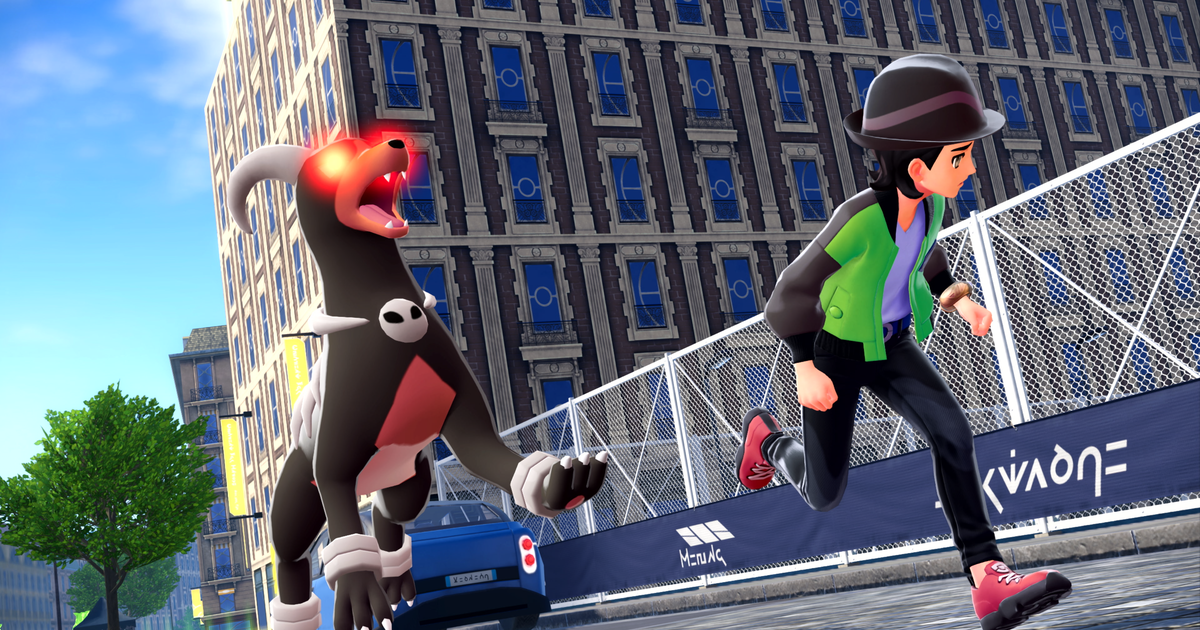
Wild Zones were first introduced in Pokémon Sword and Shield (even though they do connect back to the Safari Zone from Pokémon Red and Blue). In Z-A, they’re spread across the city and packed with Pokémon that are surprisingly aggressive. I jumped into Wild Zone 6, where the preview’s first stretch takes place, and I was quickly swamped by a Lv.33 Alpha Houndoom—those red-eyed Alphas with boosted stats from Legends: Arceus making a return—along with a group of Houndours. The team we were given was notably lower, roughly Lv.25, which made things tougher, especially because my starter for this demo was Chikorita. There’s also a twist on evolution: it’s now something you choose to trigger rather than something that happens automatically. Once your Pokémon is ready, you open the party menu and select the option to evolve. Like in Legends: Arceus, you can swap moves around as well, as long as you’re not currently in a fight.
Adjusting in the menus definitely made a difference, but the Wild Zone’s difficulty still struck me as oddly inconsistent. Smaller, lower-level Pokémon such as the Houndour would fall in a single blow, while their “parent” Alpha forms often took several tries to fully clear before you could actually catch them. On top of that, catching has been tweaked too. You can still toss Pokéballs during combat as normal, but lowering a wild Pokémon to 0 HP creates a brief moment where stars swirl around its head and it stays dazed—giving you a better chance to capture it. Still, there’s no guarantee: if the attempt doesn’t work, the Pokémon disappears like it had been KO’d in the usual way.
Moving through the Wild Zone also turned up a few extra discoveries. Item behavior, for instance, has been updated again: stepping over a shiny “hidden” item now collects it automatically, while items that are placed in the world still show up inside red Pokéballs that you pick up yourself. You’ll also notice a strange, pink rocky material scattered around, and it’s often up on rooftops. When you hit it with a Pokémon’s attack, it breaks apart and leaves behind a handful of Mega Shards. They weren’t used during the demo, but as the official Pokémon website explains, you can trade them in-game with another player or character for Mega Stones of your choice, once you’ve gathered enough.

The big headline feature here, of course, is the battle system. Along with letting you use moves while you travel through Wild Zones, Pokémon battles themselves have shifted to full real-time. Rather than PP—what used to limit how often a Pokémon could use a move before you had to replenish it with an item or visit a Pokémon Center—moves now rely on a cooldown timer. Based on what I saw, that cooldown typically falls somewhere between about two and ten seconds. Moves can also fail, especially since your Pokémon doesn’t behave like a locked-on fighter; it loosely follows you while you run around during the fight. There’s no dedicated “dodge” option for Pokémon, though you do have one as the trainer. And moves can be shut down with a perfectly timed Protect, which now feels more essential than ever. Otherwise, it’s pretty simple in practice: use your strongest options the moment they’re available again, and fill the gaps between cooldowns with your other moves.
Strategy is still very much part of the equation, largely depending on the moves you bring. My Gyarados, for example, had Whirlpool, which delivered damage over time to any Pokémon caught within its area. Waterfall let it rush toward an opposing Pokémon in an aggressive burst, and it may even help it slip past some incoming attacks. Other moves, like the familiar Growl, keep their original purpose of boosting or reducing specific stats, while status effects have also been adjusted. My Vivillon’s sleep-inducing ability ended up being a key tool for stalling while cooldowns played out, and Paralysis appeared to effectively stop a Pokémon in its tracks. In my hands it wasn’t incredibly helpful, but it’s possible that as you progress, it may help you avoid enemy hits more effectively. If I’d been more confident at swapping Pokémon quickly, it could have paired nicely with Whirlpool’s area-of-effect damage.
I’m
Ambivalent about how it all plays out in practice. On the one hand, it’s always a relief to see Game Freak—so deeply rooted in its
Sure! Here’s the rewritten content with the requested adjustments:
For such an extended stretch, the series continues to polish its nearly three-decade-old battle system. On the flip side, that turn-based approach was extremely effective, especially thanks to the craftsmanship of talented developers like Shigeki Morimoto across those thirty-plus years. Compared with the almost over-precise feel of the previous setup, this latest version marks a clear break. Fights are hectic, a bit dependent on rapid button pressing, and usually don’t leave much room for planning—though with more time, it may get easier to handle the finer details and build a team around movesets that actually work well together.
I also spent a lot of time scrambling between Pokémon—leaning on weaker moves while I waited for the stronger options to recharge—and I burned through a large stack of Revives. Much like Legends: Arceus, that becomes a tough hurdle, and it often feels as though many of the battles end with your entire team, even when the matchups seem evenly matched, getting knocked out before you manage to catch or defeat your opponent. By the end, only a single Pokémon remains to earn the experience. At that rate, leveling up will likely rely on going back to lower-level Pokémon on the fly, again and again.
I then ran into a particularly frustrating mistake. After several painfully long minutes battling an Alpha Binacle I found near not-Paris’ waterfront, I finally got its health down to a tiny strip of red. A short cutscene followed to confirm that day had officially shifted into night, which in turn opened the Z-A Royale for participants. How did that derail my big showdown with Binacle? If you already guessed what happened from the annoyance, you’re right: its health was restored to full, while my battered team at the end of the encounter was left as it was—worn down. Not great—especially because this cutscene played twice during my limited time in Pokémon Legends: Z-A’s Wild Zones, and that’s a bit concerning. If I have to walk into every encounter with a tougher Alpha Pokémon, knowing there’s a chance my opponent could randomly reset to full HP at any moment, I’m probably going to avoid those fights. Another reporter at the event shared that their opponent’s HP reset in the same way if you wander just a little too far, which they only learned after trying to regroup and plan something more carefully.
As for the Z-A Royale, it was the next demo stretch I sampled, and I was hoping it would feel a little less irritating. Each night, it kicks off with your main goal: climb from rank Z to rank A (I get the nod!) by progressing over time. First, you earn enough tickets by completing activities during the royales, then you advance through rank-up matches between each letter. Those ticket-granting challenges are interesting, though they start to feel a bit repetitive early on. Most commonly, they ask you to sneak up on your opponent for the opening hit, or knock them out with a surprise strike using a move of a specific Type, and so on. One example was: “Sneak up and initiate battles using Normal-Type moves!” It even includes counters for how often you’ve done it, with later objectives requiring you to repeat it a set number of times—along with a reward of 20 medals and 200 points. The idea is straightforward: you approach a trainer’s Pokémon without the trainer noticing, which leads to a pretty amusing sequence where you quietly make your way through the streets of Lumiose City, catch the kids’ pet birds by surprise, and come away with a medal.
That covered the full Z-A Royale experience for the early portion I played, so I moved on to the next assignment: a rank-up battle against another competitor, Rintaro, in his restaurant.
Rintaro relied on the trio of “simi” Pokémon here—Simipour, Simisage, and Simisear—and, as you’d expect, he got swept by the tournament’s eventual winner. Again, this fight didn’t demand much strategy beyond noticing that some moves hit harder than others, so I focused on using those as soon as their cooldowns finished. I also leaned on the occasional Revive when needed. If nothing else, it’s comforting to know that trainer battles still feel familiar in the ways you’d expect.
Next up was the fourth section of the demo: a raid-style boss encounter featuring a rogue mega-evolved Victreebel. The structure plays out much like the real-time raid battles from Sword and Shield or Scarlet and Violet. There’s a huge, stationary Pokémon in the center of a circular arena, complete with a big health bar, but this time you can move around the space with your allies and direct your Pokémon to attack it.
In this round, I mega-evolved my Gardevoir so I could land some Psychic-type hits against Victreebel’s Poison, with Houndoom acting as support. The central feature is, naturally, mega evolution. You have a mega ring that fills when you land attacks, and then it gradually drains after you’ve mega-evolved a specific Pokémon. There’s also a twist: from time to time, small orbs appear from the raid boss Pokémon, and picking them up refills the mega ring. One more twist comes in through moves, introduced here as Plus Attacks.
These are triggered—yes, seriously—by pressing the plus button on the Switch before you choose a move. Only some moves are labeled to show that a Plus version is available, and unlike Z-Moves, which they resemble in spirit, you can use them multiple times, with each use simply consuming your mega ring as the resource. Mega-evolved Pokémon handle Plus Attacks automatically, so it’s worth waiting to mega-evolve
…at least not unless a single use can tilt the result. As for that boss encounter, it was fairly uncomplicated again: steer clear of the area-of-effect moves Victreebel keeps launching—and, on top of that, somehow manage your hard-to-control Pokémon so they also don’t walk straight into those strikes—while continuing to deal as much damage as you can, using revives between KOs.
One more twist is tucked into all of this, mind you: those items come with cooldown timers as well, even if…
Interestingly, during my short stint with the game, I couldn’t spot any clear sign of how that timer works. Across the Wild Zone and the tougher confrontations, including this one against Mega Victreebel—where I was noticeably under-leveled both times—I kept relying on Revives and Potions until, at some point, I couldn’t use them anymore. I then had to track down a nearby PR rep to confirm why they were suddenly unavailable. The good news is that in Wild Zones, there are cafes where you can take a brief break over coffee to fully restore your Pokémon—very French, indeed. Still, if you want to fight opponents above your level or try to catch anything especially difficult, it looks like you’ll need a well-stocked inventory as you head out.
Overall, it made for an intriguing mix. This is Pokémon leaning into full real-time action, where your character is constantly dodging around the Wild Zone or ducking behind vehicles in the Z-A Royales as Pokémon attacks streak past. I don’t mind the idea on principle, even though I genuinely love Pokémon’s classic, highly strategic turn-based battles. The snag is in how it’s been put together: at first, it can feel like a system that’s awkwardly bolted onto a franchise with a long history, rather than a sincere reinvention of what Pokémon-on-Pokémon fighting could look like.
As a result, it comes off a bit clunky. Do we really need your character risking a hit from attacks—say, for instance? Shouldn’t the pressure be about your Pokémon team getting taken down, not you getting clipped by a stray Iron Tail? Shouldn’t we be calling for our Pokémon to dodge—like Ash and Pikachu do—rather than having you personally avoid the blows? And is repeatedly firing off your quick-cooldown skills while waiting for the bigger move to come back truly the best way to handle all of this?
Hopefully, with time and a fully realized release, those concerns will iron themselves out. After all, Game Freak’s battle designers are still in the picture, and they’ve shown on several occasions that they can add smart little details to systems that might seem overly straightforward at first glance. There’s also the wider city that hasn’t fully opened up yet, the ways these different pieces of the game connect, and that key atmosphere of a smaller—yet likely much busier—world (and importantly, after the issues seen in Pokémon Scarlet and Violet, it does appear to run smoothly on Switch 2). I’m looking forward to seeing more of it—following what will likely be another quirky but meaningful story, and digging into the complexity of its battles to uncover any hidden tactics. For now, though, I remain a little doubtful that Pokémon’s real-time shift is genuinely moving in the right direction.
This preview is based on a trip to Paris. Nintendo / The Pokémon Company provided travel and accommodation.