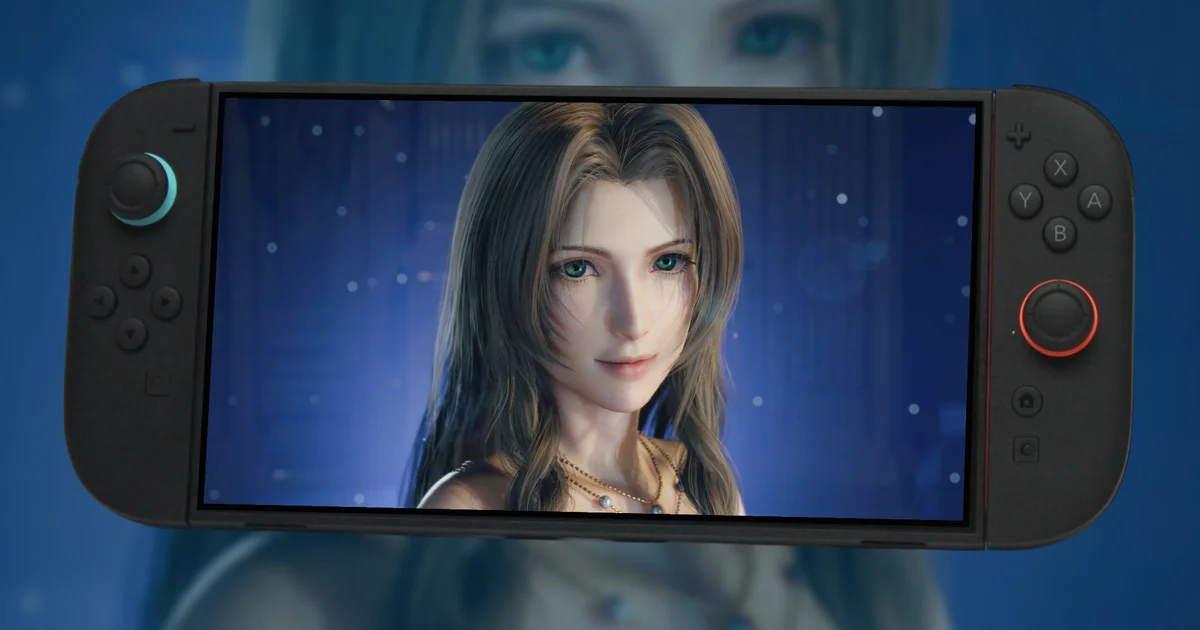
Let’s be honest: supporting Square Enix right now is genuinely difficult. Between job cuts, unexpected restructuring moves, and a habit of jumping onto the newest controversial ideas, it’s easy to feel skeptical about one of Japan’s best-known publishers heading into 2026. Still, among the many questionable corporate choices and the ongoing noise around NFTs, there’s a studio delivering something that brings back the Square Enix we grew up admiring—one that pushed past technical limits, experimented within the RPG space of video games, and tried to stay ahead in our slightly odd industry.
When I look at the Final Fantasy 7 Remake series, I can still spot familiar traces of the Square Enix style I remember—especially in how these games are brought to Switch 2. Earlier this year, Alex on our team was impressed by the first release, Remake, and how smoothly it runs on the newest Nintendo hardware. With the sequel, I’m once again struck by Square Enix’s technical skill—maybe even more than it demonstrated with Remake.
I only had around thirty minutes to sample the Switch 2 version, but the confidence Square Enix shows in the port is hard to miss. For the demo, the publisher put us in Kalm (close to the start, of course, but also among the most crowded and richly detailed zones in Rebirth). From the moment you begin, it feels like the game is walking you through a quick introduction to how the console—when played in handheld mode—handles the varied features you’ll encounter across Rebirth. The first point where I paused to appreciate the adaptation was when we climbed the clocktower with Aerith to take in Midgar stretched out in the distance. It’s a moving scene in Rebirth, and it’s also a real showcase of the engine and the underlying tech. In the cutscene, as Cloud and Aerith talk about the hero’s disagreement with Tifa, you might spot a couple of slightly soft, low-detail strands of Aerith’s hair—but overall, the result is clearly well finished. And honestly, it doesn’t feel wildly different from what you’d get on the base PS5.
The follow-up dash through Kalm’s stalls and narrow, cobbled streets turns the spotlight toward a more urgent pace: HDR-enhanced lighting reflects across the ground, looking crisp beside the darker areas created by structures above. In the version we tested, the graphics options come down to Brightness and HDR Luminance, matching what Remake offered. Still, that’s fine, because the real story in these ports is that DLSS is doing much of the heavy lifting. The game is produced at a reduced resolution and then AI-enhanced with an upscaling pass (no, it’s not quite the same as Nvidia’s heavily criticized “yassification” filter).
That approach can lead to a little haze, and some textures—especially those further back in the scene—may look less refined than what the game otherwise strives for. But with character models this convincing, and with facial capture and performance that sit comfortably between lifelike presentation and stylized flair, I’m not overly bothered by where the eye is guided. You may catch a bit of pop-in during certain cutscenes, but really, who cares? If this is what you get in return for a game that looks and plays this wonderfully in your hands, then it’s a compromise I’m happy to accept. I’m fully on board.

Going into the demo with an eye on performance and the technical side helped me appreciate Rebirth even more. I still get a surge of excitement whenever Aerith’s Theme plays, and when she comes up from the air-raid shelter to see the “living, breathing planet, despite everything,” her joy feels like it matches my own. Right there, Aerith is struck by how the planet can look and feel this way despite Shinra’s relentless efforts to weaken and sacrifice that beauty for its own gain. Likewise, I’m amazed that a handheld system can deliver something that feels this strong in visuals, audio, and gameplay—especially as we shift from the carefully constructed city scenes into the open, airy stretches of the wider Gaia region.
You might notice tiny clumps of grass and wildflowers fading in and out when you cross invisible borders, but it’s a small hiccup compared with the overall experience. This game feels bigger, more ambitious, and more certain of itself than Remake ever managed, and it does so smoothly on the palm of your hand. I got to play through a complete battle in the more open Grasslands before a Square Enix representative took the Switch 2 back from my hands. Even then, everything still seemed to run flawlessly. The particle effects, the magic visuals, the 30fps frame rate (which is absolutely appropriate for a game like this—thank you very much). Every bit of it feels just as comfortable on Switch 2 as it did on PS5. Somehow.