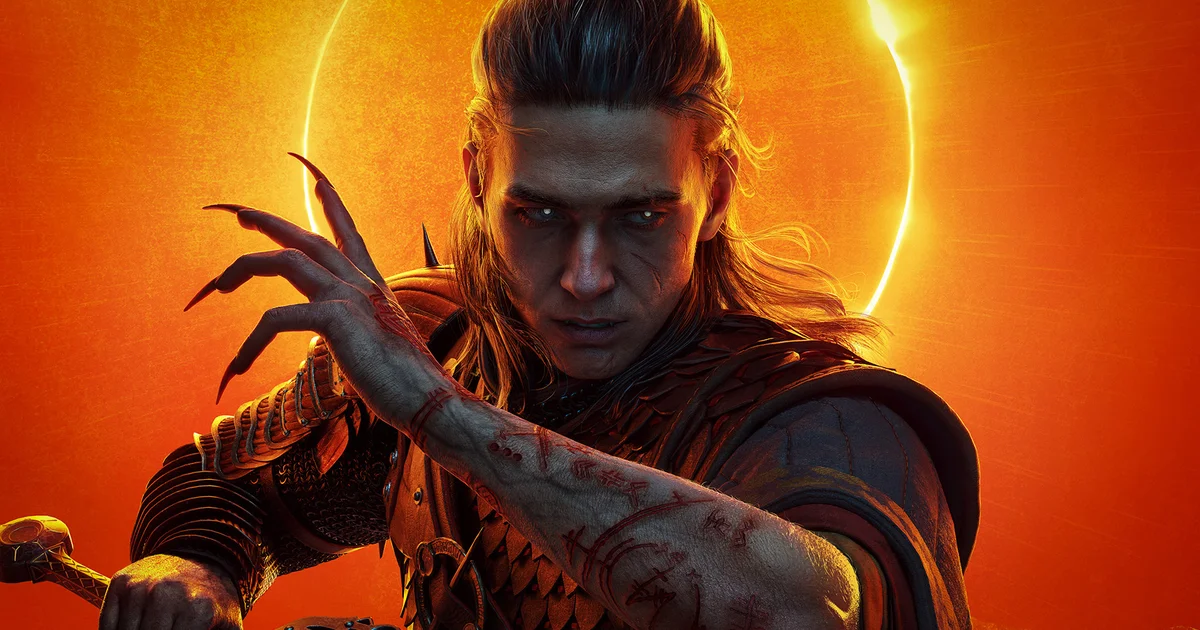
What struck me most during the 90-minute showing of The Blood of Dawnwalker that I recently watched at developer Rebel Wolves’ studio in Poland was the assurance with which this dark fantasy role-playing game leans into its own character. That impression feels even stronger for a first release, especially given how boldly it embraces what makes it different and how polished the presentation is.
One moment keeps coming back to me as a strong example of that identity: a highly unsettling scene near the end of the game’s Prologue — an area we don’t see directly — where we witness a form of Unholy Communion inside a local church. It isn’t carried out with reverence for the Christian deity above; instead, it’s a tribute to the blood-sucking vampires controlling this stretch of the Carpathian Mountains, Vale Sangora. They spared the region from the worst of the Black Death, and now they’re demanding repayment in the form of atonement.
The entire ceremony is thrown into darkness by a figure suspended from the rafters, presented to the villagers as a lesson in what follows when tainted blood is uncovered — a skill the vampires possess. The pressure mounts as a fragile character, someone closely tied to you, Coen, the player character, steps toward the priest’s bloodstained chalice. Will they be exposed?
The result lands hard and fast once the deception is revealed: the character is grabbed and punished. They’re thrown down onto a stone slab as though they’re being delivered to wolves; immediately after, the lead vampire’s retinue surges in with the same predatory intent, barbed teeth flashing as claws tear through and bite into flesh. And then, just as suddenly as it begins, it stops—cries fade, fangs retract, and the threatening group resets itself like it’s preparing for a grim snapshot.

What I value most about this sequence is that the game moves on without dwelling on it. A less experienced, or less disciplined, studio might lean into the gore—pushing players to stare it down, with lines like, ‘Look what we’ve created! Recognize how mature we are!’—and usually earning the opposite reaction. Dawnwalker, instead, does exactly what’s required: it drives home that these vampires aren’t meant to be underestimated, and then continues forward. Even though the moment looks brutal at first glance, it’s presented with restraint, and that kind of care shows up repeatedly across multiple parts of the game.
Let’s step back for a second. The Blood of Dawnwalker is Rebel Wolves’ first game, yet it doesn’t feel like something built from inexperience. On the contrary. The team is led by Konrad Tomaszkiewicz, who directed The Witcher 3 and its expansions (including a vampire-focused one, which feels especially fitting), and also played a major role in Cyberpunk 2077. There are also plenty of other former CD Projekt Red developers working alongside veterans from different backgrounds. Given how much The Blood of Dawnwalker echoes The Witcher 3, some overlap is to be expected—but the sheer degree of similarity is genuinely surprising. From the menus and the soundtrack to the general feel of the action and the supernatural folklore atmosphere, comparisons come up almost instantly. There’s even a mechanic that lets you turn on a detective vision mode, along with brawling to get involved in. One quick look is enough to trigger the comparison.
“It’s quite challenging to steer clear of the comparisons to The Witcher 3,” Konrad Tomaszkiewicz says in a group interview, “because many of us on the team were instrumental in creating those games. It’s tough to alter one’s style, as it inherently shows up in our work. That’s why you see it in this game.”
He draws an analogy to film directors as a starting point. “Don’t misunderstand me; I still have much to demonstrate — but take, for instance, Tarantino movies. There’s a plethora of them, yet upon starting to watch, you immediately sense it’s a Tarantino film. There exists a distinct quality that, when you have your own style, resonates throughout the artwork these individuals produce.”
The Blood of Dawnwalker developer Rebel Wolves’ studio.
That said, The Blood of Dawnwalker gets even more interesting once you focus on what sets it apart. The clearest difference is that you step into the role of a vampire—specifically a Dawnwalker—who disguises themselves as human during the day and becomes a vampire at night, naturally opening the door to different gameplay approaches. Still, the biggest variation may be how the game is structured. You’re not led through the world by a single main quest.
Instead, you’re invited into a “narrative sandbox”—a phrase that came up repeatedly during my time at Rebel Wolves—where you can shape your own story as you move through the open world. There’s a bigger goal to rescue your family from the vampires within 30 days and nights, but it’s not set in stone: I’m told it’s fully possible to fail. At the core of that system is how the game intentionally tracks time. Every quest (except for certain bandit camp activities) takes time, shown with an hourglass icon. You’re in charge of time here—it won’t just disappear without notice—and managing it matters for everything you do.
This has understandably made some players uneasy. They’re concerned they won’t be able to comb through the map thoroughly or finish quests the way they can in other RPGs. While it is true
That The Blood of Dawnwalker is designed to nudge you toward making choices—and, in doing so, shaping a story that feels distinctly your own rather than like everyone else’s—is still only part of the picture; there’s a great deal you can still accomplish.
“It would be far too severe to end up missing out on something like 70 percent of the experience,” creative director Mateusz Tomaszkiewicz tells me. He’s Konrad’s brother. “I imagine players would have every reason to feel annoyed. But the reality is the opposite: we built it to be quite flexible, so in a typical playthrough,
if you take part in most activities and don’t lock yourself into a single approach, you can reach roughly 80 percent of the content before the clock runs out.
I’ve seen longer gameplay demos of these systems earlier in the form of previous The Blood of Dawnwalker videos, yet last year they didn’t include the narrative backdrop that clarifies what’s happening. That’s exactly what I get from watching the game’s opening stretch. We see how Coen becomes a vampire, and we meet the family he’s meant to save.
Much like The Witcher 3, the experience begins with a smaller open-world prologue area, giving players a chance to ease in. The atmosphere is tense right away: through a cinematic sequence, vampires suddenly break into the region. Despite their cruelty, they also provide the steadiness and safety the plague has been eroding. They leave an impression on our family, even if—somehow—it’s still not on Coen himself.
Jump ahead a few years, and we’re placed in a charming mountain farming community. The chaos far away feels like it’s been pushed into the background—though only briefly, because Coen’s day soon spirals into a nightmare. A sequence of foreboding imagery, with blood-red skies and horrifying metamorphoses, hits him like a chilling warning. It also gives a quick introduction to gameplay systems and even vampiric powers, before we abruptly rouse again. We’re still human, but the dread of what’s coming hangs in the air.
Step outside and 14th-century village life pulls us in. As we wander the settlement—past chickens, pigs, and fields—our attention is drawn to different villagers and the tasks they offer. Most of the game, as a rule, is built around quests: they’re what carries us through the Vale. But they’re also quests with strong narrative structure, intentionally designed to loop back to the larger story. For instance, we speak with a villager searching for his pig, and we help a man working a field who asks for assistance finding his missing brother. On the surface, both situations look like straightforward errands, but they branch into multi-part events with different results. Tracking the pig’s trail also introduces the hourglass symbol that alters time, letting us follow the footprints and push the timeline forward by one step.
Before I watched this segment, one worry I had about Dawnwalker was the risk of visual repetition. Since so much takes place in a single valley of the Carpathian Mountains, even if the air is crisp and the landscapes are vividly green—and they truly are—that alone doesn’t automatically guarantee a wide range of biomes. Still, in the 90 minutes of gameplay we see, there’s enough fluctuation to stand out, including dim swamps and old underground ruins, where several of the game’s biggest secrets are said to be found. While there are clear influences from real life, there’s also creative bending of the facts. It’s less a direct, one-to-one recreation and more like a “best of” package from the Eastern European mountain region—right up to the detail that this landscape runs through Dracula’s homeland, Romania. I’m also told that the castle where the main vampire Brencis resides is nearly an exact stand-in for the place where Vladimir Țepeș lived—the historical figure better known as Vlad the Impaler, or Vlad Dracula.
The hunt for the missing brother ends with an underground boss confrontation involving an ancient zombie skeleton. Meanwhile, the pig quest finishes with you bringing it back to the villager—only for him to invite you to help butcher it, a choice I’m glad our demo guide refuses. Even so, it underlines the game’s odd, offbeat humor and the sudden, warm charm of rural medieval life—an element the Witcher series managed to capture effectively.
It seems The Blood of Dawnwalker takes that angle seriously too. As we get closer to the Unholy Communion scene near the end of the prologue, the open-ended questing starts to connect in meaningful ways. The brother we rescued? He wouldn’t have been in the church if we hadn’t saved him. And what about the person who’s about to be dragged onto the stage against their will? We could have altered their outcome by finding herbs to hide their condition, but we didn’t—so they’ll face a grim end. The Blood of Dawnwalker isn’t afraid to let you fail.
These events bring the prologue to its peak and eventually lead to your transformation into a vampire. This change sets the direction for the rest of the game and, from a mechanical standpoint, hands you a broad set of usable abilities. It’s in the way the game is built and the way it asks you to operate that you can feel another level of polish—especially in combat—where the effort goes beyond simple attacks and dodges.
Your results depend on how you carry yourself.
As a human, you fight with a longsword and make use of blood magic abilities you learn later on. Your main task is landing directional strikes—up, down, left, and right—along with blocks, in a way that feels a bit like the Kingdom Come: Deliverance games. Hit an exposed area to connect, and then meet an approaching swing with a parry that redirects it: that’s essentially the rhythm. As you advance and level up, you gain several distinct attacks, while enemies bring their own unblockable moves that you’ll need to dodge. Getting the hang of everything can sound complicated. In my time with the demo, the presenter activated certain icons to show strike and block directions, and I wouldn’t want to play without that guidance.
When you shift into a vampire, you won’t have to worry as much about those directional strikes and blocks, because you’re far sturdier in that form, and your claws seem less demanding in terms of precision. Even so, stamina still matters. You can dodge with a shadow-based teleport, and—of course—you can drink from enemies to restore health. Taken together, the human and vampire systems feel like they naturally support each other, adding meaningful and enjoyable variety.
You’ll also find deeper skill trees, which I’m hoping will let us shape our characters in a more personalized way. The vampire state even improves exploration: using Shadow Step—much like Blink from Dishonored—you can reach platforms you wouldn’t be able to access otherwise, giving the movement a real sense of speed. You can also adjust gravity to travel up walls with Plane Shift (think Batman and Robin from the classic TV series, minus the rope), then Claw Ride back down the other side to return to the ground.
Still, the most captivating part of playing as a vampire is the danger of accidentally feeding on people. As your health runs low, Blood Hunger takes over. If you start a conversation with an NPC while you’re in that condition, there’s a very real chance your hunger will overrule your intentions—pushing Coen to drink and kill the person he’s talking to. I saw it happen for myself. During the dialogue, the option text stretches and sways until the presenter loses control and Coen finally quenches his thirst.
In line with the game’s emphasis on role-playing freedom, it looks like every NPC can be killed, including those who hand out quests. That means you could end up drinking from someone you really shouldn’t (Bertie, you absolutely shouldn’t drink and drain at all). This also hints that darker playthroughs may be possible. I’ve heard whispers that you could even rise to become the new sinister ruler of the realm. And yes, there are romantic options for Coen as well, should that be on your mind.
To me, it’s all wonderfully thrilling. Konrad Tomaszkiewicz has talked about how RPGs need to bring something new and distinct, pointing to examples like Clair Obscur as proof of how innovation can look. There are echoes of that here, too: while the team isn’t tiny—160 isn’t small, just not huge for triple-A—it is still relatively lean, and the overall design takes a somewhat unusual, alternative angle. Could The Blood of Dawnwalker turn into this year’s breakout RPG hit? It’s been a strong stretch for them.
That said, there’s still a lot of The Blood of Dawnwalker we haven’t been able to explore. It was frustrating to travel that far without actually getting to play, even with the generous hands-off demonstration, and what we saw was only the Prologue. It felt focused and tense, but we had to jump through it by save-game rather than experience it in full. What will actual gameplay feel like? How will the wider world come across? Will quests be engaging enough to keep pace across the roughly 50 hours it should take to finish? Will the combat deliver a satisfying experience? Those are still plenty of questions I’m left thinking about. But I’m genuinely excited. This could be something special, and with a newly announced release date later this year, it won’t be long before we can find out for ourselves.
This preview is based on a visit to Rebel Wolves’ studio in Poland. Bandai Namco provided travel and accommodation.