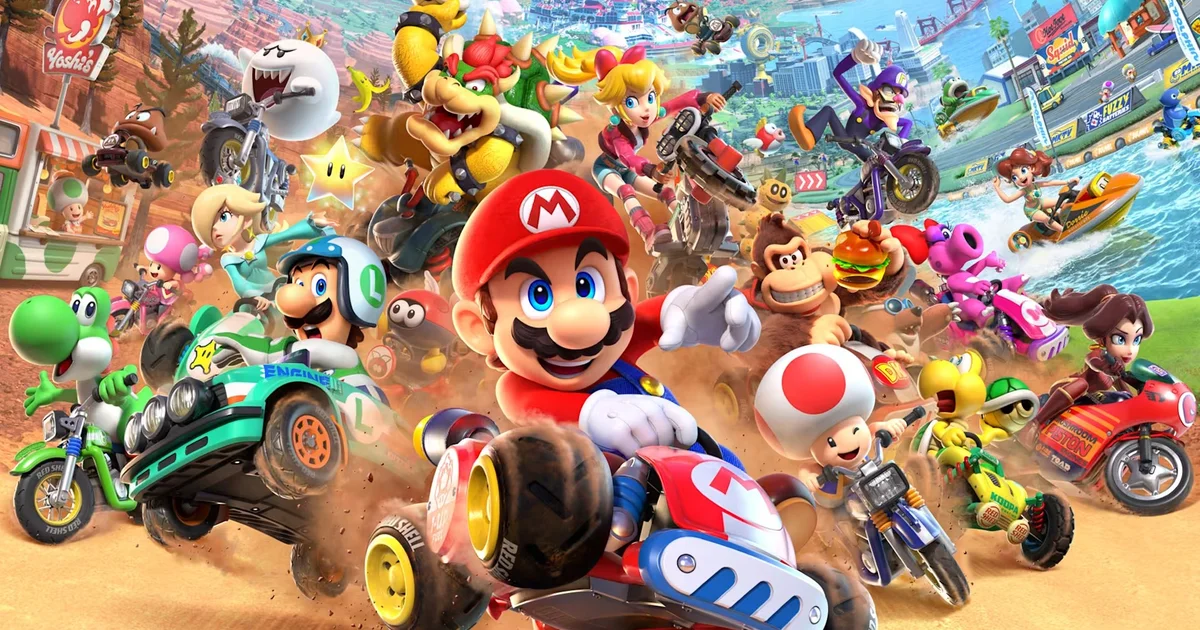
Mario Kart World brings up compelling twists on the usual Mario Kart formula, though its hopes for a true open-world experience are somewhat softened by familiar Nintendo quirks.
To be honest, it feels a bit odd to imagine a fresh Mario Kart being positioned as the headline release for a console launch. I’m not dismissing it—I’m a longtime fan, and I’ve poured thousands of hours into the series over the years (save for Double Dash – spit.emoji). Still, I’ve always viewed Mario Kart as the kind of game you fire up with friends or use for quick time-trial sessions when you’ve got some downtime. It’s the sort of experience everyone can jump into together, which is exactly why it has such lasting pull. Yet for me, it isn’t the system-launch moment unless it comes with something more substantial. On Switch 2, Mario Kart World has to be both the starter and the main event.
When you first boot up Mario Kart World, it’s easy to assume that things haven’t moved much beyond Mario Kart 8 Deluxe. You’re greeted with a familiar lineup of choices—scratch the surface, and more starts to appear, but there’s still no obvious cue that points to the open world teased in trailers and baked into the game’s name. There are multiple ways to jump into the wide-ranging Free Roam space, including pressing the + (plus) button from the main menu. Still, it’s not highlighted the way I expected it would be, especially since it’s what truly ties Mario Kart World together.
Before I get into my tangled impressions of the Free Roam mode, it’s worth looking at the more traditional Mario Kart offering in World—presented here in a noticeably fresh way. For ages (or roughly 33 years, if you’d rather keep things less dramatic), Mario Kart has had Grand Prix as a staple. In most entries, this means a set of tracks where you race against AI drivers, and the top performer—earned through your placements across the races—takes home the trophy and wins the cup. Pretty simple. Mario Kart World keeps that idea… but it doesn’t stop there.
In Mario Kart World, Grand Prix could just as easily be called Road Trip. Each cup is split into four ‘tracks’, but the real shift comes from how one track flows straight into the next. The opening track plays out as you’d expect: it begins on the starting grid and then runs through a set number of laps. After that, the ‘world’ of Mario Kart World takes over. Your second race starts exactly where the first one leaves off, and part of it means driving through the game’s open map to get to the next track. Some members of the Mario Kart community have been divided by this change, but I actually like it. You reach the second track for real, accelerate through it, and then move on to the third track in the same fashion.
There’s no escaping the fact that the tracks look sharper and more carefully crafted than the roads scattered across the map, but that doesn’t mean the in-between stretches lack appeal. Jump into an online match and you’ll quickly spot a clear gap in skill—both in knowing the best lines and in figuring out how to move around them. Mario Kart often seems simple at first glance, but experienced players know there’s an entirely different layer here (this time, quite literally) that opens up abilities you may not have realized were possible.

A big reason for this is that Mario Kart World gives you very little hand-holding. Sure, there’s an option in the menu for assistance, with explanations covering the mechanics of nearly everything—but realistically, how many people are going to take the time to read through that? If you’re not the type who checks the instructions, you’ll mostly learn by doing, including rail grinding, wall riding, and a whole set of brand-new power-ups. Timing matters a lot here. Consider the feather: it lifts you so you can pull off an extra high jump that hasn’t been in the series since Battle Mode on the SNES. At first, I assumed it was mostly pointless, but I later understood how it can help you reach portions of tracks that a normal jump can’t access. It’s saved me more than once when obstacles suddenly blocked my usual route.
Only time will tell which tracks in Mario Kart World end up as the true standouts, but I already have a handful of picks I’m still getting comfortable with. Dino Dino Jungle is a blast, Airship Fortress keeps delivering, and Great ? Block Ruins is a great place to show off your drifting. I won’t spoil Rainbow Road, but it’s a treat—and fans will definitely have plenty to love. If there’s a minor gripe, it’s that you don’t get much time on these courses in Grand Prix mode. Gliding also returns from earlier Mario Karts (though this time your kart sprouts actual wings), and instead of racing over water as if it’s beneath you—like in Mario Kart 7 and 8—you ride above it thanks to a jet ski transformation, which is a really fun surprise the first time you drop into a pool. As with Mario Kart (and many Nintendo releases in general), there’s more going on than it looks at first.
That idea is even more true in Free Roam. With the full map open to explore, it’s almost like you’re blindfolded, then dropped somewhere far away and simply let out of a van (though in an adorable way—possibly from the kind of people who hand out cold drinks and wear cravats). Don’t head into Mario Kart World’s Free Roam mode expecting anything close to Forza Horizon, or any modern open-world game. What you get is a map that lays out the different areas, along with how many P-Switch missions you’ve completed, how many Peach Coins you’ve collected, and how many Question Mark Panels are still out there. You can even sort all of that by track if you spend a bit of time digging. That’s essentially it. To be blunt, I don’t find the way the game tracks these things particularly useful.
How you approach Free Roam is the main factor shaping the overall experience. I’ve had a great time playing it with my son, using a wireless connection across two separate consoles, and the relaxed energy of this world fits our usual way of gaming. We whip around, grab items to collect and missions to finish, and then we call it—repeat as needed. It’s genuinely charming, almost picture-perfect, yet it isn’t my first choice for solo play. I’d prefer more concrete stats, and I want the P-Switches I’ve found—or missions I’ve completed—to be clearly indicated on the map. To make things even better, the top open-world racing games fold everything right into the setting, whether you’re dealing with races, missions, challenges, or collectibles. In Mario Kart World, the lively racing and events are here, but they don’t really mesh with the surrounding world; they’re handled through separate menus. To me, that makes it feel more like bite-sized content than a fully immersive experience.
There’s still plenty to dig into. Knockout Tour, an elimination-style racing event, is one of Mario Kart World’s standout attractions. Just know that you’ll likely run into some exasperating AI behavior as you try to complete every Rally on the toughest settings. Even so, running the races at 100 cc or below against bots— or, even better, real players online—makes this mode hugely satisfying. There’s real excitement in seeing the field shrink, as racers who cross checkpoints under the required limit get cut, while the rest push on. This mode captures the spirit of the world well, with each rally stretching across big sections of the map.
If you tend to get irritated easily, it could be smart to rethink your strategy in Knockout Tour, since it’s packed with the franchise’s infamous moments of chaos—unlike anything I’ve experienced before. In Mario Kart, you never get the comfort of feeling “safe” on the way to a win, because at any time you can be hit by shells or other attacks that instantly wreck your plans. Knockout Tour cranks up that tension with regular eliminations during each rally, but the satisfaction of taking first place balances out the pain of a split-second triple-shell storm that can yank you from first all the way down to eighth. It’s worth remembering that when you’re close to despair, someone else is probably celebrating instead. As always, Mario Kart World works the give-and-take.
Other multiplayer-heavy modes include classic Balloon Battle (where you knock out opponents by popping their balloons) and Coin Runners (focused on collecting as many coins as you can). Over the long haul, I can see myself sticking with Mario Kart World—aside from wandering around in Free Roam—primarily for Time Trial. This has always appealed to me, all the way back to my Mario Kart 64 days, when I submitted my best times to gaming magazines. These days, online ghosts make it easier to learn strong techniques, but posting outstanding times still demands serious effort. If you think you’re particularly good at Mario Kart World, checking out Time Trials may quickly bring you back to reality.
I jumped at every chance to play Mario Kart World after Switch 2 released. It’s an outstanding multiplayer experience and a real staple for late-night sessions full of laughs—where did the time go? Still, I’m a little uneasy that it’s positioned as the main launch title. Free Roam promised (and may yet, depending on Nintendo’s updates) to hold my attention more deeply, but with a few familiar Nintendo quirks, it seems to shine most when you drop in casually rather than fully commit to it.
A copy of the game and a Switch 2 was provided for review by Nintendo.