A more energetic, lively, and emotionally layered take on this distinctive hiking-style simulation.
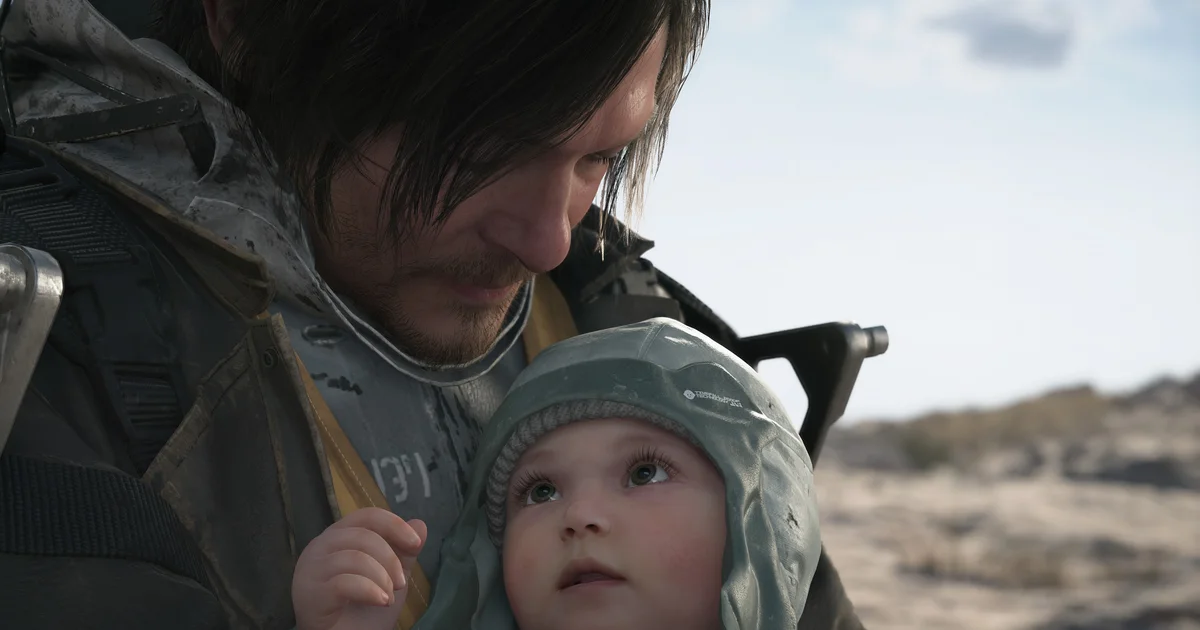
It all starts with a deeply personal father–child moment. Sam Porter Bridges sits on a mountainside in northern Mexico with an infant held against his chest. The baby is Lou (BB from the original Death Stranding), no longer sealed inside an odd container, but carried in a standard baby harness. Their hands meet—one big, one small—framed by a wide powder-blue sky and a sweeping vista carved by jagged, deep rocky ravines. Sam straightens up and seems to glide, stepping down narrow, photorealistic ridges with a light, dance-like motion. As he runs—sometimes even springing forward—Lou laughs with pure delight.
So it begins: Death Stranding 2: On The Beach, the next chapter in writer-director Hideo Kojima’s divisive sci-fi saga that launched in 2019. Every element of the already intricate original felt loaded with meaning. It took aim at the gig economy, skewered social media, and offered a moving meditation on environmental collapse. The sequel is simultaneously bolder and more restrained. Kojima cranks up the metaphysical weirdness, yet—surprisingly—he also leans more into familiar, traditional aspects of his work, including the stealth and combat beats that made up the Metal Gear legacy. (Shh, but there are moments when Death Stranding 2 feels like the spiritual follow-up to 2015’s Metal Gear Solid V: Phantom Pain.)
Still, don’t worry. This game clearly embraces the fact that it’s a sequel. It’s bigger, brighter, and easier to approach. And Kojima—now in his sixties—has stepped into a fresh position. He isn’t only the postmodern creative force behind today’s gaming; he’s also come across as its leading champion of tenderness.
The more openly emotional tone shows up right away. Sam lives with Lou—now 11 months old—in the remote, off-grid wilderness of Mexico. Their home is a cutting-edge bunker, but it’s filled with the everyday tools of raising a child: a high chair, a crib, stuffed toys, and building blocks. Sweet father-and-child snapshots decorate the walls and even the refrigerator. Yet within moments, that picture-perfect sense of family life is shattered when Léa Seydoux returns as the enigmatic Fragile. She has a job lined up for Sam: he has to connect Mexico to the strange, intensified chiral network.
Even so, Mexico is just the opening act. Sam quickly goes back and discovers that his home routine has been completely undone. For a while, the porter slips into emotional numbness until Fragile tries to bring him back with yet another task. This time, she wants him to build connections across all of Australia.
The story moves at a breakneck pace. Before you know it, you’re picking up dense background details and puzzling acronyms: Plate Gates, Beach Water, APAS 4000. Still, don’t stress over the exact meanings too much—just like Final Fantasy XVI, there’s an in-game lore log called the Corpus.

Death Stranding 2: On the Beach.
In short, the private corporation APAC (or the Automated Public Assistance Company) is responsible for setting up the connection in Australia. Fragile’s own group, Drawbridge, is assigned to carry out the job. New faces arrive too—film director George Miller as the friendly, grandfatherly Tarman, Elle Fanning as the displaced youngster Tomorrow, and Turkish-German director Fatih Akin, whose appearance is used for the kind, encouraging stop-motion puppet Dollman. There’s also a kind of central base: the submarine-like DHV Magellan (named after the Portuguese navigator who mapped an eastern route). Your team slowly grows, too. This isn’t the lone trek of the first Death Stranding, but a journey built on gentle companionship. Over time, these people become a second family for Sam.
As you get to know the key characters, you’ll also have to master new gameplay additions. The game asks you to build a Watchtower—a tall structure that lets Sam look over the area from above. Place one near an enemy outpost, and you can start marking targets. What happens from there is up to you. You can eliminate foes at range, push in with weapons in hand, or move quietly through tall grass and crumbling buildings. Combat across the board is fast and forceful: each takedown (or disabling, since Sam’s gear is non-lethal) triggers a Matrix-like slow-down effect; stealth attacks, much like in the previous game, have the same anime-style burst of rope-tying precision.
The stronger emphasis on confrontations with enemies feels like an adjustment for players who—fairly, in some ways—may have felt that fighting took a back seat in the original. The sequel doesn’t follow that pattern. Kojima has even described it as being like James Cameron’s 1986 blockbuster Aliens. Now you can find sword-swinging robotic samurai as well. However, in trying to offer players more options—more tools, more weapons, more opponents, and, at its core, more ways to be aggressive—Death Stranding’s previously radical, deliberately slow, radically non-violent design spirit has been watered down somewhat.
This idea can be argued from either direction. Has Kojima trimmed his ambition—or expanded it—so the game can satisfy players who struggled with the uncompromising mechanics of the first installment? That concern hangs in the air, particularly with the elevated importance placed on driving. More than before, you’ll be racing across the continent, covering long stretches of dryoutback on a state-of-the-art three-wheeler (or a sturdy pickup truck).
The music player feels like yet another feature aimed at players who want tighter command over how they experience the game. You can pick any song you’ve unlocked, or even assemble playlists for Sam. In the first installment, tracks such as the understated folk-pop of Low Roar were only added at pivotal moments—usually when you were closing in on a settlement, the camera…
pulling away with cinematic confidence to highlight how small Sam is against the sprawling, moss-covered landscape. Now, you can hear rustic Americana and icy synth-pop pretty much whenever you like.
Even so, for all the upgrades that make Death Stranding 2 feel more approachable—and, in terms of design, arguably less daring—it still comes across as wonderfully odd when judged against triple-A standards. Consider the stark, untamed sweep of Australia, which seems just as old-world as the moss-drenched U.S. backdrop from the original. In several ways, it’s an even better setting for investigating the time-bending mayhem triggered by the series’ central Death Stranding (the catastrophic event that opened a gateway between the world of the living and the dead).
One moment keeps resurfacing. You’re crouched amid a swarm of BTs—the shimmering, otherworldly beings anchored to another realm through faint umbilical cords. Surrounded by Australia’s ancient red stone, you rely on high-tech tools to slip past these deadly threats (and, in yet another nod to player options, Sam can now carry out stealth takedowns on BTs after unlocking—yes, a blood-powered boomerang). The feeling of time being out of joint—captured in these images of spectres, landscape, and avant-garde equipment—is genuinely unsettling. The game stretches backward toward a distant past and forward into a sci-fi future, yet it stays unmistakably rooted in the here and now, as Sam fights to breathe and scrambles to avoid being spotted.
The world doesn’t just deliver stunning scenery and lyrical sadness—it directly shapes how you play. The game regularly unleashes enormous earthquakes, flash floods, raging wildfires, and sandstorms that scramble your vision. You’ll have to weave around massive boulders.
Amid all this unrest in the environment—along with extreme weather—Death Stranding 2 still manages, although perhaps a bit less frequently than the first, to pause for gentler beats that hit you in the mind. At one point, crossing a vast desert the color of Mars and packed with massive dunes, I spotted a lone kangaroo. I stopped, and it stopped too. As it stared back at me, lit by my vehicle’s headlights, it felt as if time itself had frozen. Its arrival felt almost miraculous in a place where nearly all life has vanished (a consequence of timefall, the rain that speeds up aging for whatever it touches). You’ll also encounter other animals, like emus and echidnas, but the open world isn’t crowded in the way many post-apocalyptic games tend to be. The emptiness is deliberate—it invites you to mourn the loss of nature.
Still, Death Stranding 2 isn’t only about grief and awe. Kojima’s knack for playful, unexpectedly timed jokes keeps popping up. Near the end of the game, I set off on an especially punishing climb over the Himalaya-sized peaks that have inexplicably grown in the center of Australia. I planned my path carefully, following the rocky ridges along the mountain range’s spine. I was being cautious—so cautiously!—until I misjudged a single step. Sam slipped, and the shift of momentum sent him and his entire cargo tumbling awkwardly. Before I could recover, both the human load and the supplies dropped down an almost vertical stretch of snow, hundreds of meters lost in a single disastrous fall.
Connection was, of course, the guiding idea of the first game. This time around, Kojima makes things more complicated without fundamentally changing how you interact with other players (you’re still sharing infrastructure and filling the world with tinkling holographic emojis). It’s no longer a government-run body responsible for building the internet—now it’s a private company. Sam initially treats them with skepticism, raising issues that feel more at home on a leftist tech podcast than in a blockbuster. Is expanding the chiral network across Australia just meant to grow the organization’s influence? Is the chiral network a cover for digital— and by extension, real—colonialism?
Kojima keeps returning to these questions, then ultimately folds them into a story that squarely focuses on the emotional core of the experience: Sam’s radically transformed reality. How does he cope? By staying busy. The porter throws himself into his work, taking one step after another to carry out deliveries—sure, it’s a distraction, but honestly, who could really blame him? Just like the first, Death Stranding 2’s central struggle eventually balloons into something far grander. Troy Baker again leans hard into the role as Higgs,
brandishing a flame-thrower electric guitar that screams while he inflicts maximum torment. Bare chests crop up frequently; the image of a lone traveler crossing the wilderness fades as the drama ramps up. The final stretch is explosive and, to be candid, a touch disorderly. Surprisingly, the most satisfying story takeaways don’t revolve around the fate of the planet—they land on Sam himself. The impact is as solid as a heavyweight knockout.
If there were standout frames from the original Death Stranding (apart from, naturally, the baby in its glass container), it was the raw, taut, sinewy build of Sam. We saw flashes of it in every shower, each time he had to strain to lift his cargo, and in every punishing step.
Those kinds of visuals are still plentiful in the sequel, but their place of prominence has been overtaken—at least in terms of importance, if not sheer volume—by another kind of physical imagery: human closeness, involving not only Sam but also the supporting cast. Lips meeting, the hands mentioned earlier pressing into contact, all choreographed and motion-captured with the same careful attention to detail reserved for the game’s main character. In one especially notable kiss, the pair’s noses squish together; it’s awkward and a little clumsy, yet undeniably beautiful in its imperfections.
Fragile sums it up best: “Chiralgrams [the game’s term for holograms] are wonderful, but nothing compares to a hug.” That sentiment feels unmistakably Kojima—clunky in its sincerity, plainly stated, and yet somehow kind of brilliant. Seydoux, to her great credit, delivers it with the effortless feel of something natural. Fragile is right, and it’s that intensely warm, affectionate spirit that seems like the biggest step forward here, even if the overall game—while unmistakably larger—is also a bit safer than the original.
For anyone who rolled their eyes at much of the first installment, Death Stranding 2 will likely spark a similar reaction. Still, there’s no question that Kojima is approaching it with the same wide-eyed fascination. This huge, bizarre project, in a lot of ways, represents the writer-director’s quirks and obsessions converging at their most extreme, while also offering—within all that chaos—perhaps his clearest message yet. The world might be falling apart, but you can’t solve it just by talking your way through online spaces—certainly not by hiding there. Step outside. Don’t merely touch grass; connect with another person.
Code for Death Stranding 2: On the Beach was supplied for review by Sony Computer Entertainment.