It’s still a classic, though some of that vital oddity has slipped away.
Revisiting System Shock 2 for its 25th anniversary remaster review was, on paper, the easiest assignment I could’ve been given. A beloved cornerstone, lovingly brought back by a team that exists because of System Shock 2? Naturally, I figured I’d just give it five stars at a glance—at least if that’s all it took to settle things.
Still, after I made my way through the Von Braun spaceship corridors for the umpteenth time, a troubling thought surfaced. Maybe I’m being dramatic—call it blasphemy, sacrilege, or the sway of The Many’s never-ending spinning peanut troupe—but I couldn’t help wondering whether System Shock 2 truly holds up in 2025.
I’m stressing the word truly for a reason. I still have a real soft spot for System Shock 2. I’m drawn to how unsettled it makes you feel about its setting. I value its disjointed horror storytelling—centered on a spaceship caught in a struggle between two hostile superintelligences. I’m also especially fond of its level design, which stays a pleasure to move through no matter how often I replay it. And, for the most part, I’ve been impressed with Nightdive’s updates too, because they meaningfully strengthen the game in ways I wasn’t sure would land as well as they do.
That said, admiration without candor doesn’t get you very far. The simple truth is that System Shock 2 has been worn down by the passage of time, and a straightforward remaster can’t fully undo that. Some issues and annoyances need a more sweeping overhaul to fix properly. Many of these problems date back to the game’s original release, but the immersive sim landscape has evolved a lot since then—and Irrational’s once-legendary follow-up has, fittingly, been surpassed by what came after.
None of this is meant to take away from the remaster itself, though—it does a solid job nudging the experience forward by a few years. Alongside additions such as controller support, ultra-wide display options, and an updated approach to cooperative multiplayer, the remaster also refreshes models and animations across much of the game. You’ll see it in everything from weapons and enemies to environmental objects, including the Alien-like egg sacs where The Many’s wormy minions burst forth.

System Shock 2: 25th Anniversary Remaster.
The payoff is a version that looks a bit more streamlined and a bit more polished than before. I was skeptical about a number of these tweaks at first. There’s a particular eeriness in the telepathic monkeys and cyborg attendants’ clunky, hammer-like design—and it matches System Shock 2 extremely well. Replacing them with busier, more detailed models could easily have dulled the game’s inherent weirdness.
Fortunately, the remaster largely preserves the game’s signature atmosphere, with its uneasy mix of high-stakes survival action and understated dread. System Shock 2 doesn’t rely on forcing scares. Instead, it lets the tension inside the Von Braun gradually build in your head, until you finally need to stop playing after encountering one too many gruesome corpses—or after hearing one too many audio logs of your crewmates laughing and gasping as they transform into monsters.
System Shock 2: 25th Anniversary Remaster.
A few elements also benefit clearly from the changes. The wide-eyed look of the midwives grows even more intense as it stares out through their bloodied skeletal jawline, while protocol droids now twist and contort as you shoot them. Their otherwise polite offers of help become even more disturbing when they’re trying to blast you apart. I also appreciated how the pipe-wielding hybrids’ attacks have been adjusted to land with more force—now you can really feel it when they crack you across the skull while offering their apologies.
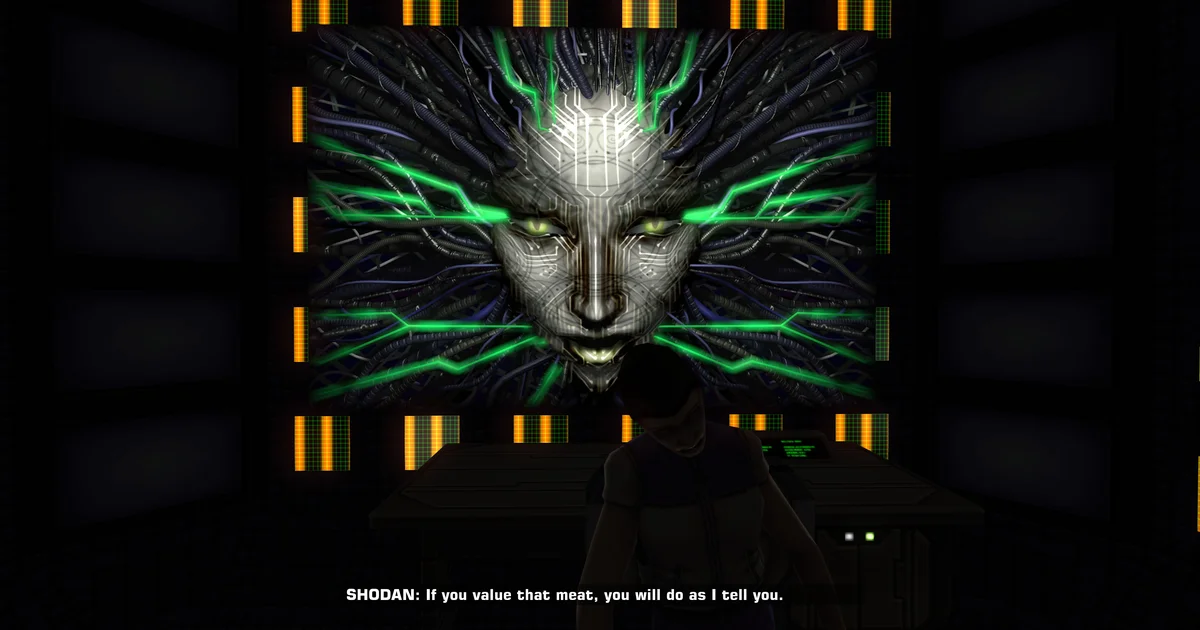
The one modification I’m not quite as keen on is the introduction of lip-synced mouths for many characters, including the hybrids. It’s a minor change, but it subtly alters how the game comes across, reducing the sense of unreality I mentioned—almost like every spoken line is ringing inside your own mind. That’s especially noticeable in System Shock 2’s most iconic moment, where it strikes me as a bit silly and weakens the tension.
Beyond that, Nightdive’s decisions are largely sensible. As for the game itself, so much of its foundation still shines. Like other titles in the genre, System Shock 2’s level design works like a textbook for spatial puzzles. The Von Braun’s five decks (plus the later sections that take place on the Rickenbacker and beyond) feel designed to slip out of your memory. You’re constantly picking up and re-picking up its layout—overlapping corridors that keep demanding you check the map for the closest security station or chemical storage space. Working out its nested objectives remains incredibly rewarding. System Shock 2 is the most relieved you’ll ever feel when you finally get an elevator working—short of being
System Shock 2: 25th Anniversary Remaster.
I also like that the game means for its character growth to feel truly punishing. During at least the first stretch, System Shock 2 pushes you into an uneasy sprint: you feel pressured to grab everything, yet it seems like you can’t really afford much. Sure, you can improve your weapon skills to make use of the shotgun you’ve just obtained, but repairing it once it’s damaged won’t be an option for at least another hour. That pressure becomes even sharper if you start as a Psi character—because while transformative abilities are waiting for you, you also begin with the steepest climb.
No matter which approach you favor, you’ll still find yourself craving the slow trickle of cyber-modules that your lone ship companion, Dr. Janice Polito, delivers so you can complete your objectives. Still, SS2’s most memorable touch is how it weaves that longing into the narrative itself. System Shock 2 revisits comparable themes of player agency seen in its younger sibling, Bioshock. Yet where Bioshock spends most of its story power on a single standout twist, System Shock 2 lands its ending more gradually and with a darker edge—giving you time to reflect on what it means to serve as a compliant soldier.
All of it remains as thrilling and intelligently shaped as it ever was. Even so, a few elements of System Shock 2 could use a fuller modernization today. For a large part of the game, the Psi abilities you can access simply don’t feel worth the effort involved in trying to pick the right one. Moving through the Psi power levels and then drilling down to the specific ability you need is almost unworkable, particularly when you’re dealing with enemies at the same time. Nightdive does a solid job attempting to translate this awkward system for controllers, but the way the game lays everything out makes the whole process feel like triggering Helldivers 2 tactics—except instead of calling down a devastating aerial blast, you’re either releasing a fairly unimpressive ice shot or launching an entirely invisible sheet of flame.
That brings me to a bigger point: System Shock 2’s combat hasn’t really aged all that gracefully. It still works as problem-solving gameplay—you can have fun figuring out the best way to use the weapons and gear you have against what you’re up against. But in terms of feel, the way it encourages cautious corner peeking and careless wrench-wrecking reads as dated, even when you have the more detailed weapon models. If this were Thief or Deus Ex, the issue wouldn’t be nearly as serious, since combat matters far less in those games. The difference is that SS2 plays much more like a shooter than those titles do—it simply gives you the freedom to decide what flavor of shooter you want it to be.
Thief and Deus Ex are relevant here in another way too. In my opinion, both still represent the high point of their respective genres. No one, after all, has produced a better pure stealth experience than Thief. With System Shock 2, though, I don’t think that claim holds. I’m not going to start a debate by insisting that Bioshock is the better game (something I don’t actually believe, even if it does shine in some areas). Still, coming back to System Shock 2 made me realize just how strongly Prey improves on its core ideas.
Arkane’s version of the immersive sim formula takes the same basic concept and stretches it with fresh mechanics, more open-ended options, and tightly linked systems—so it truly feels like a spiritual successor to the MIT-inspired thinking behind both System Shock games. It also surpasses the work of Looking Glass and Irrational in a way that deserves to be recognized more and more over time.
To wrap things up, System Shock 2 is still an excellent game, though its popularity has faded a bit during the last twenty-five years, especially as other bright stars have risen. Even so, if you like your shooters to be mentally engaging, your levels to be richly layered, and your nightmares pleasantly strange, System Shock 2 remains a more approachable experience than ever thanks to Nightdive’s impressive work.
System Shock 2 code was provided by the publisher.