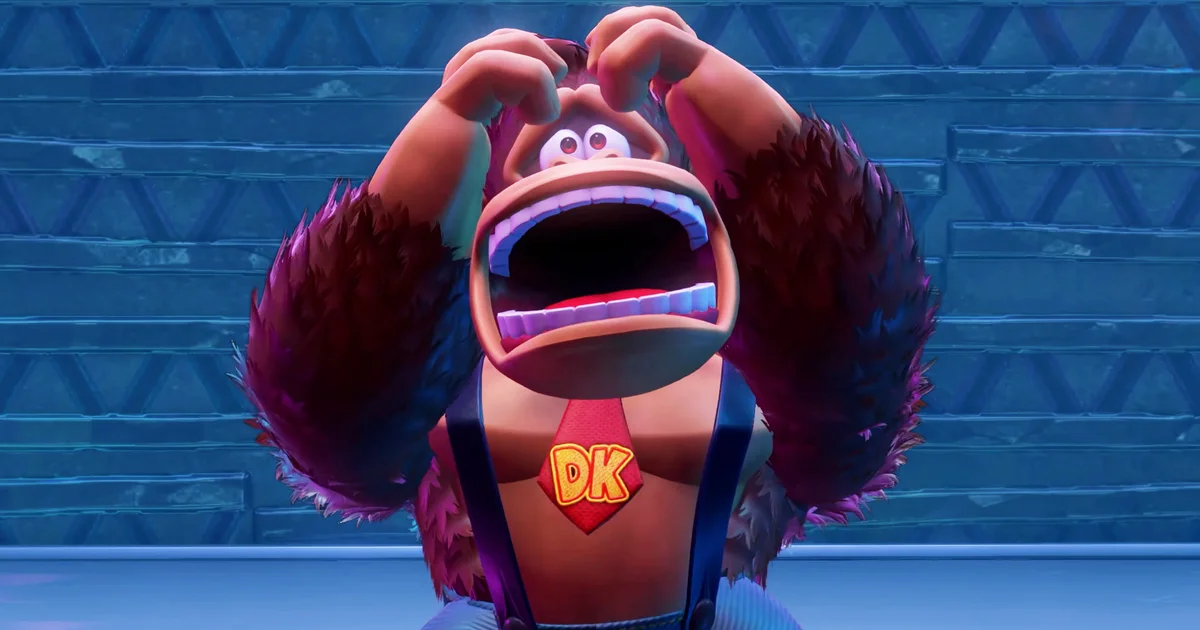
A sharp, well-built central mechanic paired with inventive design twists helps make Bananza a delightfully absorbing 3D platform adventure, elevated by a lovable core character bond.
If you want to share my thoughts on Donkey Kong Bananza, you almost have to start from the end. No spoilers, naturally, but I do need to say that I think this game has one of the finest climaxes of any Nintendo release. The ride toward that moment is packed with energy, with story beats and fresh mechanical ideas stacked in a genuinely enjoyable way. I found myself grinning as the game hurtles toward its final stretch. It’s been put together with real mastery.
The big showpiece in Bananza’s later portion brings to mind the wedding sequence from Mario Odyssey, though it captures the exact sort of experience that a new-to-Nintendo project lead may be eager to bring in. Kazuya Takahashi directs Bananza, and his previous standout work was Final Fantasy 15—another game celebrated for its visual flair. You can feel some of that Final Fantasy taste for spectacle here too, blending it with Nintendo’s own love of mechanical peaks rather than narrative ones.
So, yes—I was truly taken with that finale. During the climactic confrontations, my foot kept time with what was happening. I was smiling constantly. I actually laughed out loud at a few of the bold ideas the game throws at you. I even sent an excited text—full of expletives—to a reviewing friend I knew was playing. I was thrilled. Still, I wasn’t always quite as consistently delighted along the way. I guess that sums up the DK Bananza experience. When it really lands, DK really lands. When it doesn’t… well, it’s not Odyssey, is it?
All of this makes Bananza a difficult title to review. The truth is, I don’t love it quite as much as I feel I might—maybe even should—considering the strong base it has. Even so, it’s excellent nonetheless.
At the core of those impressive foundations is Bananza’s destruction technology, which essentially lets DK smash through the world around him. You can’t fully flatten an entire stage, since the big overall frame is built from materials that don’t break, often looking like metal supports similar to the backdrops from the original Donkey Kong. However, wide areas of the terrain can be destroyed.
The whole game is built around this idea. At its most basic, you can slam into the ground or the side of a mountain to uncover hidden goodies, and there are plenty of them. At a deeper level, you’re constantly thinking about how each material behaves and how they affect one another. There’s a clear ranking for hardness (oo-er missus): stone will crumble thorny ground or mountains formed from dirt or sand, but if you’re trying to break down concrete, you’ll need a denser option—obsidian works nicely.

In much the same way that Breath of the Wild was the first genuinely “post-Skyrim” Nintendo outing—meaning it borrowed the design breakthroughs of a major rival—DK Bananza can absolutely be seen as Nintendo’s newest post-Minecraft experiment. But as is so often true for Nintendo, copying the formula isn’t enough on its own. Every element needs to be pushed a little further.
These materials aren’t only there for tearing up the environment; they matter during fights, too. Every enemy you face can appear in variations connected to multiple materials, turning this layering directly into a gameplay consideration. A foe made from obsidian demands careful planning to defeat. One wrapped in thorny terrain can’t be punched without taking damage, but it can be crushed easily if you use a different material. Meanwhile, an enemy fashioned from the extremely reactive “boom rock” should be treated less like a danger and more like a moving explosive—ideal for carving out a new stretch of the environment or taking down another enemy through a friendly-fire blast.
And then it keeps going, producing intriguing results. As more materials arrive—ones with traits that go beyond simple hardness—the thought process becomes even more complex. Choosing the correct material, and using it the right way, can open access to new areas or make previously intimidating encounters much easier. In boss fights, in particular, materials start launching and colliding with such intensity that, at times, the frame rate nearly stalls—something that feels close to the experience of setting off far too many TNT blocks in Minecraft at once.
It shows just how impressive these systems can be that the brief technical stutter is something you quickly move past—those moments of heavy interaction are absolutely worth a slight slowdown. The open-ended Odyssey-style layout, with countless collectibles waiting around every corner, means many of the puzzle challenges can be tackled either through their intended solutionor by approaching things with fresh ideas beyond the usual playbook.
These materials also mesh with DK’s abilities, letting him temporarily take on the shape of another creature—like a zebra. They’re the namesake “Bananzas.” Once you reach the later sections, you’re juggling all of it: ripping up bits of terrain to ride across or smash into opponents, then triggering a transformation, and smoothly swapping between forms to dodge attacks and get through tricky hazards—while quickly calculating the best path ahead… it genuinely does…
deliver.
At the same time, it sometimes stumbles. Bananza puts DK and his new partner Pauline on a journey toward the planet’s core, which requires digging downward. In Bananza, a “world” is essentially a “layer,” and rather than a variety of rock types, each layer basically functions as a familiar-style video game setting. It checks the familiar “biome” boxes—mines, jungles, beaches, and more imaginative twists. It’s all there. I also really appreciate the game’s pacing: occasionally, high-intensity, action-heavy layers arrive and are soon followed by calmer, unhurried stretches. Still, a number of layers can feel like they’re mainly there to fill time. So you get a mix of strengths and weaknesses.
In the preview, I mentioned a worry that the smashing mechanic might wear thin before the end of a full game. That concern didn’t hold up, because each layer introduces new resources and fresh ways to use DK’s destructive toolkit. You’re kept in near-constant motion with new things to do. Then, though, I ran into a different problem: there’s a lot of material, but much of it seems to be underused. Promising ideas show up, and you can’t help but wonder how the mechanic will evolve… only for that development to largely never arrive.
This pattern keeps showing up. DK’s transformations, for example, all have clearly defined purposes—many puzzles will require one Bananza form or another. At the same time, I’d say a large share of the transformations don’t see much use in practice. A skill tree gives DK meaningful upgrades, but numerous improvements for the Bananza forms feel almost trivial. One transformation, in particular, really stands out: once maxed out, it becomes a dominant, game-shifting power—certainly a good thing. Unfortunately, it also makes the limitations of the rest feel even more obvious.
Beyond that, I have a few smaller complaints. Individually, they might seem minor, but together they add up to the sense that Bananza just doesn’t fully reach timeless status. For instance: the destruction system can leave behind small fragments that are tricky to get rid of. That’s usually manageable for most of the game, but later on, you run into plenty of extremely dangerous, damaging, health-draining areas. Miss even a tiny bit of it during a boss fight… and you’re out!
When it comes to boss encounters, I don’t think there’s a single fight that isn’t reused. Materials get swapped around and the like—but even when major story bosses are brought back, it starts to feel a little stale. This issue reminds me of Mario, which also leans on boss repetition. Still, Bananza’s bosses aren’t like Mario’s familiar three-hit showdowns. They’re more puzzle-like and built around spectacle. It’s comparable to a Zelda game requiring you to take on each dungeon boss twice.
Here I am, complaining. Seriously—waterworks. And yet: I really loved this game. Even as I was getting wiped out by an absurdly small, intensely damaging splash of lava that I somehow didn’t notice, I never felt like putting the controller down. Time really does fly. That momentum carried me through the story even when moments threatened to drag. After the midpoint, the pace accelerates noticeably, and by the time I saw the credits roll, I was genuinely eager to jump into its post-game challenges.
Maybe that’s where Donkey Kong Bananza earns its real power. It isn’t the kind of boundary-pushing “mega wow” experience that Odyssey offered. But it captures the exact sort of play where you slip into a trance, your thinking syncs with the game’s design, and suddenly hours disappear. If you searched for “sticky game design” in a dictionary, you’d probably find Bananza illustrated.
It’s also surprisingly good at tugging at your emotions—just in its own distinct way. It’s a playful story about an ape and a young girl, yet it lands with unexpected tenderness. During the preview, I worried that Pauline’s upbeat encouragement—delivered through different voice reactions as you push through challenges—might start to feel annoying. Instead, she turns out to be genuinely likable. The story cutscenes are packed with charming moments, supported by engaging animations and warm dialogue whenever DK stops at a rest point to recover his health. There’s real feeling here, the kind Mario can only dream about.
The character interactions are genuinely delightful. That said, I would’ve enjoyed a bit more representation from older characters such as Diddy and Dixie—but Pauline is a fantastic addition to the DK lineup. It’s hard for me to imagine the upcoming DK film focusing on anything other than this pair.
As I already noted, when Bananza hits, it’s truly remarkable. Occasionally, though, it feels like it loses its focus or doesn’t properly build on some of the excellent groundwork it sets up. Those are the kinds of details that keep it from being a true classic in my view—even if it still earns a strong, heartfelt endorsement. Despite my many critiques, it clearly stands as the newest best Donkey Kong adventure that doesn’t include the word ‘Country’ in the title—which puts it in a standout spot.
A copy of Donkey Kong Bananza was provided for review by Nintendo.