The Chinese Room has built something out of a set of inherited ideas, but this action RPG comes across as shallow and stripped down, with its strongest value coming from standout character work and the voice cast.
Sadly, the end result doesn’t quite work. We already expected this follow-up to 2004’s rough, yet much-loved Vampire: The Masquerade – Bloodlines wouldn’t land as a role-playing game in the same spirit. We also knew the developer The Chinese Room—taking the project over from Hardsuit Labs—had reshaped Bloodlines 2 into more of an action-focused experience, specifically an action RPG. Expectations were tempered, and that’s reasonable, since concepts shift over time. Still, Bloodlines 2 doesn’t really succeed as an action game, a stealth outing, or an immersive simulation, leaving it stuck in a foggy mix of indecision and, in the end, feeling rather underwhelming.
Many of Bloodlines 2’s issues seem to stem, somewhat ironically, from what it does well. The opening story from Hardsuit Labs—“you are a newly turned, thin-blood vampire who must increase in power”—has been swapped out by The Chinese Room for a setup where you start as a powerful Elder vampire, awakened after a century in hibernation. From the very beginning, you’re astonishingly capable. With a single strike, you can toss a mortal into the air. You can scramble up buildings with the agility of a spider and sprint in sudden, high-speed bursts. You can jump enormous distances and even glide across the air, almost like true flight. When these abilities come together, Bloodlines 2 finally lets you feel like the intimidating, supercharged threat it wants you to be. You’re already the apex predator from the moment the game starts, and that’s undeniably exciting.
Yet there’s no real sense of progression. As an action RPG, it offers little to no meaningful character growth (and barely any customization). You have four abilities tied to your clan, and you’ll unlock them all within the first few hours. After that, there’s nothing else to chase. Skills don’t mature, evolve, or change into anything new. You can, if you want, grab abilities from other clans, but that won’t make you stronger overall or expand your combat toolkit. It only provides variety—giving you a chance to mix your four abilities and potentially find a favored combination, though that never happened for me. I mostly stuck with my default powers across the full 25-hour run. With that, along with the lack of loot or equipment, character development feels almost non-existent. Action RPGs thrive on power fantasies: the core aim is to grow stronger as you advance, with builds and choices driving you forward, but that element is missing here.
As a result, it becomes harder and harder to care about side missions, even though they award the points you need to unlock abilities from other clans. Still, calling them “side quests” makes them sound more important and intriguing than they are. In practice, they’re essentially errands in Bloodlines 2—sometimes straightforward fetch-and-assassinate jobs, other times disguised just enough to pass for something else—tasking you with killing vague targets or retrieving parcels. There’s little real storytelling or narrative weight to them. The only meaningful value lies in the quest-givers themselves: the clan leaders, who are genuinely worth meeting thanks to their memorable portrayals. Their performances are excellent and their remarks can be surprising, even sly. You can also flirt with them and stumble into playful, cheeky interactions if you handle things the right way, but those moments are handled poorly, usually reduced to black screens and brief dialogue (with different sounds depending on your companion). Even with the charm of these exchanges, the repetitive nature of the tasks—paired with thin rewards and no clear development of relationships—means you’ll likely stop seeking them out. And these are the only side quests in the game.
On the bright side, the main plot is decent. It wraps up cleanly, with a pair of twists that may sound familiar at first, though they still land as surprises. That said, I should point out there are quite a few one-time characters who feel like simple story tools during the campaign, showing up briefly before disappearing once you’ve dealt with them. You’re meant to care about them, or at least what they say, but without any prior narrative ties, that becomes difficult.
The story’s driving setup centers on a supernatural complication: during your Elder vampire’s awakening, something went wrong, and your mind became occupied by the presence of another vampire’s consciousness—a police detective named Fabien. You also carry a mark on your hand that seems to bind or restrict you. Fabien is written like the classic noir detective, to the point that he narrates what happens in the style of those detective stories, which is entertaining even if it occasionally veers into the absurd. That playful tone is especially valuable in a world depicted as dark and heavy. Unexpectedly, the game also carries a fair amount of humor, used with skill to sharpen conversations.

The cast is a joy to talk with, and their performances land well, while the settings are frequently striking—presented in a gritty, melancholy style.
Fabien’s constant presence fills the stretches that would otherwise be empty space in the game, improving the overall experience and functioning like a built-in guide who helps put everything in context. After all, you aren’t exactly rooted in your present time or place. I especially enjoyed the exchanges between you and Fabien each morning before you rest, where the events are revisited, reframed, and reinterpreted. Those beats bring an extra, reflective layer to an experience that otherwise focuses mainly on fighting and eliminating enemies. Fabien gives you something to sit with and consider. He also introduces much-needed structural variety, since you’ll take control of him between the major sections of the story through sequences that feel like memories.
One of the things I like most about playing effectively as two different characters is that the game lets you make a clear contrast
the alias of the Elder vampire you control, you step into the role of a fast-moving assassin built for action. By comparison, Fabien is the opposite of that idea: instead of fighting, he helps you achieve objectives through conversation and reflection. As a vampire, Fabien comes with useful tools for this approach, including the ability to read and manipulate what others think. You can persuade people that you’re someone else and then draw their secrets out of them; you can dig into their minds to uncover memories and then interrogate them after a bit of mental groundwork; and you can influence them to carry out actions they would normally refuse. These ideas are compelling, yet—much like other elements of the game—they feel constrained. They don’t really grow, and the way you’re meant to apply them is clearly signposted. In most cases, there’s only one ability that fits a given solution, and you aren’t encouraged to experiment with the alternatives. Fabien also tends to nudge you toward the right move, which makes it hard to slip up.
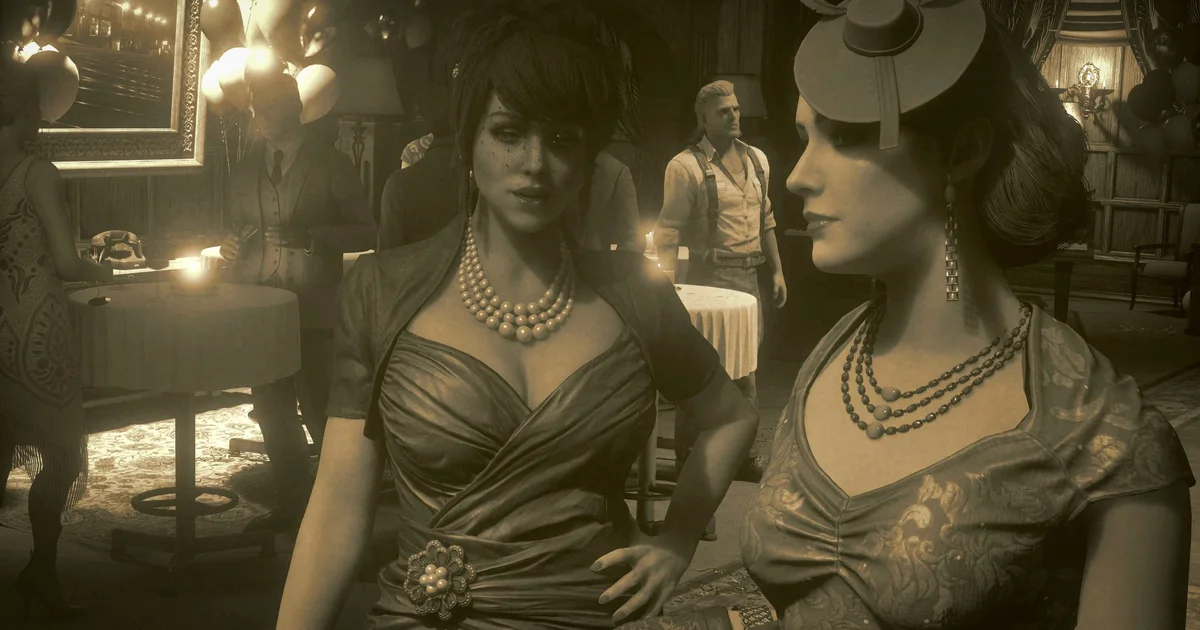
Still, Fabien gives you a strong reason to view the world—and its people—from a different angle, and it largely works. Going even further back, to 1920s Seattle, makes it more intriguing, especially when the city is dressed in the polish and glamour associated with the Roaring Twenties. It’s a shame that this sepia-styled period only shows up in a handful of isolated scenes. I would have enjoyed spending more time escaping the drab sections of Seattle that the game leans on so often.
Fabien’s role improves the overall experience. Ronan Summer’s voice work is the standout, particularly when you use Fabien’s abilities to animate furniture or talk to a suggestive filing cabinet—elements that Summer also provides himself. The voice performances throughout the game are a major strength, and that isn’t faint praise. From the sharp, cutting exchanges of older Mrs. Thorn (Bethan Dixon Cate) to the sharp wit of the nosferatu Tolly (David Menkin), nearly every character lands with confidence. That quality is a real asset, though it’s frustrating that some of these standout secondary characters never really connect to the central storyline, remaining stuck in their set locations. It’s unfortunate that they aren’t used more broadly.
The main cast benefits more, and Bloodlines 2 consistently signals that your dialogue choices shape how they respond. “Lou appreciates that,” or “Lou loves that,” or “Lou is irritated by that”—it all shows up, with Lou being one of the most important figures in the game. That implies your decisions are building toward something: a relationship, a shift in standing, or some kind of benefit. Still, I couldn’t shake the feeling that the practical payoff is fairly small. Beyond the occasional offhand remark, it’s hard to see what you truly gain, which is disappointing given that the way the game handles dialogue choices is one of its most interesting features. With no quick-save or manual-save options, you can’t conveniently replay conversations, so you’re forced to get things right the first time—which does create pressure, and I’ll admit I like that tension. Talking with key characters was one of the few moments where I genuinely paused to weigh my choices, because I wanted to avoid making mistakes. Yet near the end, that careful thinking felt pointless. People I’d spent hours building connections with turned up only as brief entries in an epilogue, completely absent during the finale.
Beyond relationships, the game also gestures at bigger decisions that could alter your experience in Bloodlines 2. You can throw your support behind particular factions and leaders, and later, heated dialogue will push you on what you intended once the chaos has settled. Those moments do seem to be acknowledged in the epilogue at the end. Even so, I felt like my control was limited—there wasn’t much real reward for the way I believed my actions were shaping events, other than removing a large number of enemies. It often felt like the game was traveling along its own predetermined track, regardless of what I did. I can’t easily confirm or disprove that because there’s no way to backtrack at critical points, but my suspicion is that your choices likely won’t change outcomes very much.
This leads into the action side of the game, which is, at its core, where its attention is concentrated. As mentioned earlier, you’re naturally very capable in close quarters, but you also have special abilities you can call on during fights, depending on your clan. I chose the Ventrue clan, which let me pull off impressive moves—for instance, taking command of groups of enemies and forcing them to battle one another. And when I lined up the abilities properly, I could even snap the necks of an entire group of foes with a kind of magic, without ever getting in range, which was extremely satisfying. The catch is that these abilities aren’t always ready. To activate them, you need to feed and consume blood first, which means you’ll spend plenty of time fighting without them—making the overall experience less enjoyable. More often than not, it turns into a grind of close-quarters brawling: while you can drop a civilian with a single punch, vampire opponents require more effort, especially later on. Expect lots of chaotic battles where you’ll dash in and land hits, scrambling to drink blood to restore your health until either you go down or they do.
There’s at least some depth, though. By linking sprints with strikes, you can pull off roundhouse kicks, dropkicks, and flying knees, and they feel satisfying to execute. You can also use telekinesis to seize firearms you’ve dropped and have them fire in short bursts, or grab melee weapons with your mind and hurl them away, with smooth animations to match. Throwing a gun into someone’s face after you’ve shot them is a fun detail—I actually enjoyed that. Still, pulling off these moves can be awkward in the middle of chaotic fights, and it often leads to grabbing something pointless, like a bottle, or even grabbing a body part with very little damage. You can pick up enemies as well, but the range of your pull is limited—though sometimes it’s enough to drag them over the edge of a rooftop.
What I can’t quite understand is why Bloodlines 2 won’t let you equip swords or make use of weapons you find on the ground. From a thematic standpoint, I get it: as an Elder vampire, you likely wouldn’t want to dirty yourself with mortal weapons. But removing those options also means the game doesn’t give you any fresh tools for dealing with tougher situations as you progress, which is a pretty common approach in action games. So you’re left with four powers and fists that become more and more ineffective, and that combination starts to feel exhausting over time.
That said, clashes can occasionally break out—especially when you choose a stealth-focused approach. There are stretches where you’re streaking over a battlefield in the dark, dropping in on enemies to snap their necks or sink your fangs into them, then slipping back into the shadows to use your upgraded abilities. In those instances, Bloodlines 2 delivers the vampire fantasy I’m looking for. It can make me think of Batman at the docks in Batman Begins. Still, too often it turns into a disordered melee, with you getting dragged into the chaos, sent flying around like a piñata, and no real way to find a steady pace. That’s genuinely irritating. When tougher opponents show up—stronger than the repetitive foes you meet early on—the stakes rise, making the frustration even worse.
There’s little room to vary your approach, and on top of that, the whole experience feels strangely hollow. The game world seems stalled, missing any sense of energy. Look at the regulars in Silky’s biker club: it’s the same group, every night, with no meaningful way to interact—mirroring much of what surrounds you. It feels like wandering through a stage set filled with cardboard stand-ins. The small number of civilians you encounter—an assortment of sex workers, the homeless, occasional couples, and businesspeople—usually have no more than a single line to share. Most buildings stay locked, and even places you can access, despite looking good, generally limit you to one NPC you can speak with. This isn’t a game built around exploring and stumbling onto surprises; it’s about following instructions and ticking off tasks on cue. Even during rooftop shootouts with bystanders overhead, the people on the ground don’t react. The mood feels drained, much like some of its inhabitants, and that becomes especially troublesome when you’re forced to crisscross the map over and over. Bloodlines 2 does get noticeably better in the back half: you dig into the city’s hidden, secretive layers and find more engaging spots. But for the most part, they’re still just attractive hallways that you won’t be returning to.
When Bloodlines 2 leans into The Chinese Room’s strong suit—this studio is known for moody exploration games such as Still Wakes the Deep, Amnesia, and Everybody’s Gone to the Rapture—there are moments worth enjoying. The title does have redeeming qualities. As mentioned earlier, the characters and parts of the dialogue are frequently enjoyable. However, too many problems remain, and there are far more than there should be. I’m fully in favor of shifting attention toward action rather than interactivity and RPG systems, but that only works when the action itself compensates for what’s missing—when it’s actually gripping. When the action feels dull and thin on detail, the final experience doesn’t land. The Chinese Room should be credited for managing to produce something from this project, yet it feels as though the game was assembled quickly just to ship it—so everyone, including us, can get on with it.
A copy of Vampire: The Masquerade – Bloodlines 2 was supplied for review by Paradox.