The Psychonauts studio Double Fine is back with an unexpected, transformative adventure brimming with enchanting awe and striking beauty.
Part of me thinks I should explain what happens a couple of hours into Keeper. Then there’s the bigger issue: how the experience keeps reshaping itself, again and again, from that point onward. These moments are so major and so spellbinding in Double Fine’s newest outing — a captivating trek through a mysterious world, which in spirit may nod to thatgamecompany’s revolutionary Journey — that giving it five stars without going deeper almost feels like I’d be shirking my own responsibility. Still, no. I’m going to leave a good portion of Keeper’s secrets untouched, so you can meet its extraordinary feeling of wonder without any blemishes.
Keeper begins, more or less, on a rock. In the distance, harsh mountain peaks loom above churning water, climbing away from a bleak stretch of coast toward a green-grey sky. Against this muted backdrop, an unlikely hero takes form: a worn lighthouse suddenly infused with awareness, teetering on spider-like legs made of rope and stone. At first, its rocking, shifting balance demands steady control just to stay upright. But little by little — with a gentle push from Twig, a curious seabird that has recently perched on its lantern — those tentative steps settle into a steadier rhythm. From there, a silent journey unfolds, supported only by the faintest suggestion of story, through breathtaking sights that all guide you toward the island’s elusive, all-encompassing summit.
Your shaky expedition kicks off with you moving through a lonely, though faintly familiar, landscape of crumbling roads and homes that have long since been abandoned. The visuals lean on darker tones, yet the camera keeps repositioning relentlessly, revealing beauty around every corner — pulling back to show waves slamming into the grim shoreline, or drifting upward to catch the swaying lighthouse in a clean silhouette as a weak sun breaks through heavy green clouds. Then, without warning, the route tightens, the camera turns, and that slight sense of recognition slips away, replaced by something stranger: a huge mountainous silhouette, supported by fast-moving legs, fills your view.
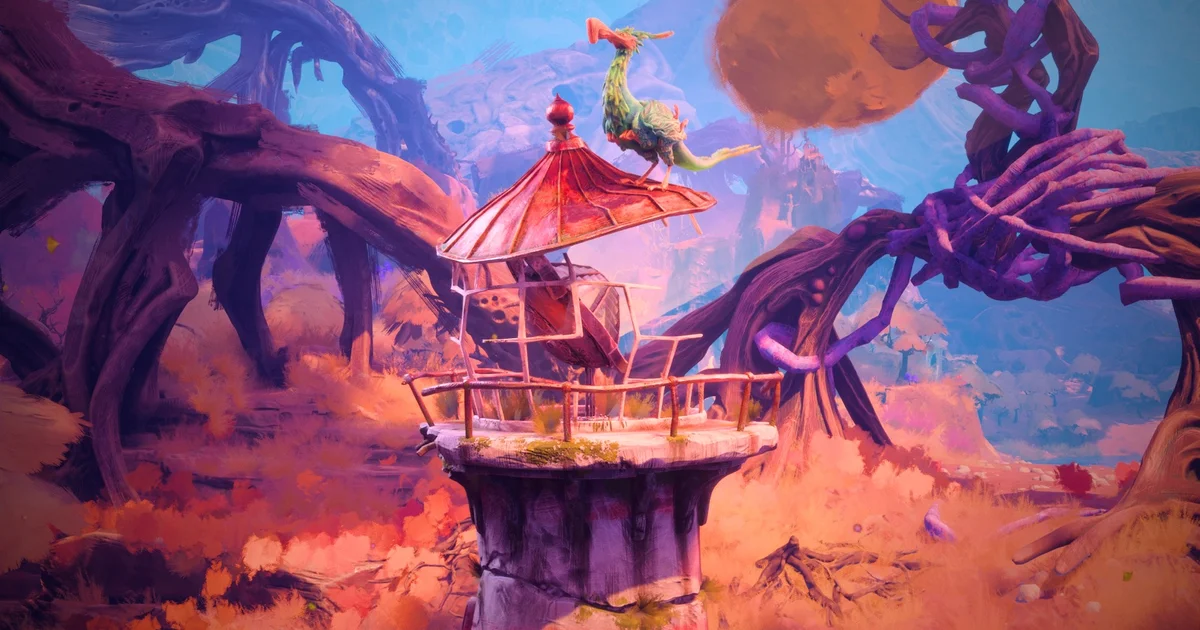
Keeper might be the most gorgeous game I’ve ever played (based on the 276 screenshots I captured). From the big early reveal to its final fade into darkness, Double Fine’s world overflows with sparkling discovery — so much so that I can’t recall a single moment across its roughly five-hour runtime when I wasn’t quietly stunned. Dusty plains and thundering herds soon make way for dangerous crimson-rock cliffs, backed by dazzling sea views; cramped valleys of collapsed stone and towering roots turn into precarious plateaus strewn with colossal bones; flower-speckled meadows give way to twilight caverns, bright coral stretches, and deep fungal forests. The makeover keeps going, and every transition is matched with a reactive soundtrack that seems to dizzy-swerve between lively percussion, ethereal synths, and ringing bells.

Everything in Keeper feels like a flash of radiant color, shaped into thick swirl-like brushstrokes and presented with maximum impact thanks to that nonstop moving camera. Even the hallways are so detailed and so thoughtfully lit that they almost feel capable of bringing tears to an art lover’s eyes. And it all feels truly alive. Sentient rocks scamper around bubbling bioluminescent pools on stick-like legs; fuzzy worm-birds zip through waving azure grass and tuck themselves into their odd stone dwellings; delicate creatures with trailing tendrils drift gently in the wind — and that’s before you come face to face with the seriously enormous creatures. It’s spellbinding: a perfectly surreal ecosystem, expertly blended through art, animation, and sound. I’m not exaggerating when I say I spent the whole experience with a steady internal chorus of “oh wow.”
If anything starts to blur that pure amazement early on, it’s the worry that Double Fine’s bigger design decisions may not line up perfectly with its artistic goals. In the first stretch, Keeper can feel somewhat constrained, nudging you along a tight route that leaves little space for wandering off or trying experiments. You’ll dutifully push forward as the camera rotates to reveal another impeccably composed view, occasionally stopping you with an obstacle. In those moments, your main tool is the lighthouse beam, controlled through the right analog stick on your controller. It’s a satisfying way to make the environment react — nature springs to vivid life as the light ripples across the world. Aim it closely, though, and it unlocks even more powerful effects: restoring ancient mechanisms or clearing obstructions by forcing organic clumps to explode. When a more active method is required, you can send Twig to operate levers or adjust movable rods, then call them back when you’re done.
This is a strong base for inventive puzzle work, though it’s something you may want to approach with a little restraint at the start. The answers aren’t just straightforward; they’re clearly highlighted, and you’re rarely far from another on-screen prompt explaining what you should do (to their credit, these can be switched off in the menu). Double Fine’s decision to lean toward approachable gameplay rather than deeper complexity may not win over everyone, but it helps ensure that the wonder you feel doesn’t curdle into irritation — and that, ultimately, feels like the sensible approach. Over time, Keeper does expand. At first, that fixed path loosens gently, and then the puzzles start to provide more room to roam. In a land of peaks touched by clouds and spores like candy floss, players get a different type of freedom. Wrapped in pink fluff and given the ability for relaxed levitation, Keeper briefly shifts gears into a platformer. And it’s during this part — drifting past breathtaking waterfalls and gliding through the skies alongside sky whales — that I truly began to appreciate
just how good it feels.
Keeper may be, as much as anything, a celebration of the satisfaction found in every move — and looking back, I likely should have seen Double Fine’s end-game ambition coming earlier. At first, the charming physicality of those tentative, wobbly steps settles into strides that feel more assured; the strides then burst into frantic bursts of speed, which give way to towering jumps and soft, airy glides. And just as it feels like Keeper may have finally reached its boundaries, a truly bold shift takes place — fueled by a new kind of propulsion, and highlighted by a sequence of kinetic spectacles so exuberantly staged that I actually found myself applauding with genuine delight. Of course, the core interactions don’t drastically change, but they’re redirected toward challenges on a far grander scale. Then, right when you think you’ve got Keeper figured out for good, it pivots once more, and again; each reinvention brings its own distinct movement style. By the time the world spun by in a flash of pure psychedelic brilliance, driven by electrifying beats, I was completely won over.
The part of me that wonders whether I should be more forthcoming about Keeper’s surprises is also the part that would normally be tempted to examine its slightly uneven early tempo, its progression that can feel a touch too streamlined, and its puzzles that come across as relatively modest. Still, that isn’t the lens I’m using for today’s review. Instead, these thoughts come from someone who went through Keeper in a single, absorbed sitting, genuinely captivated and thoroughly enchanted by the remarkable craft on display. Keeper is a charming dose of wonder; lovingly made, quietly affecting (yet never drifting into excessive sentiment), and it finds Double Fine — a studio not usually guilty of misjudging its bold creative risks — at its very best.
A copy of Keeper was provided for this review by Xbox Game Studios.