From coconuts to black holes and watch components, Lumines returns in outstanding form.
Video games can be baffling. I’ve long felt that Tetris is the definitive title: the kind we’ll still all be playing when the last light of the world finally fades. Still, I’m convinced there are puzzle games that do even better. And in this case, there’s at least one that clearly wins.
The reason is simple: Tetris just keeps speeding up until I can’t stay ahead. It might be the greatest video game ever made, it might even be my personal favorite, it might be the very emblem of our planet—but I’m also, frankly, a pretty average Tetris player. That’s the real issue. At a certain velocity, many people end up settling into “average” territory. Then Tetris ramps faster and eventually ejects you from the board.
That’s where Lumines comes in. Lumines is also built around falling blocks, but rather than constantly accelerating, it adjusts speed and rhythm more regularly. It reshapes how the challenge works in ways that are more impactful than you might expect. Some moments are quicker, other moments are slower—and slower doesn’t automatically translate into easier. Your blocks may clear more slowly, meaning your play space fills up sooner.
Then Tetris Effect arrived. It basically reshaped Tetris into something closer to Lumines: it wasn’t only a matter of faster, faster, then over—you got a real shift between brisk and sluggish, with “oh, that’s interesting” sprinkled in the mix. Slower could be either a relief or a new kind of pressure depending on what the board gave you. The key point is that slow and fast were always genuinely different. This was Tetris with rhythms that kept evolving, constantly poised to pull you in, frustrate you, and entertain you.
So, if you’re still with me, here’s Lumines Arise—essentially Tetris Effect redesigned as a Lumines game. It’s a fantastic title. Let’s say that plainly from the outset. I’m going to be absorbed by it for the rest of the year, so if you’ve got any urgent messages for me, write them on a slip of paper, tear it into tiny bits, and throw them into the air—because I’m busy arranging blocks. Of course, Lumines Arise can’t fully capitalize on the biggest ideas from Tetris Effect because it’s already built around them. As a result, this brilliant game lands a touch less hard than Tetris Effect did. We’re talking about differences measured in microns—or something just as tiny—yet they’re still there. Why? Lumines’ standout challenge is that there was less to learn in the first place.
Anyway! Enough of the moody detours. Set aside the dark clothes and feelings of despair, because even if there wasn’t anything to improve, this still delivers in a major way. Jump in.
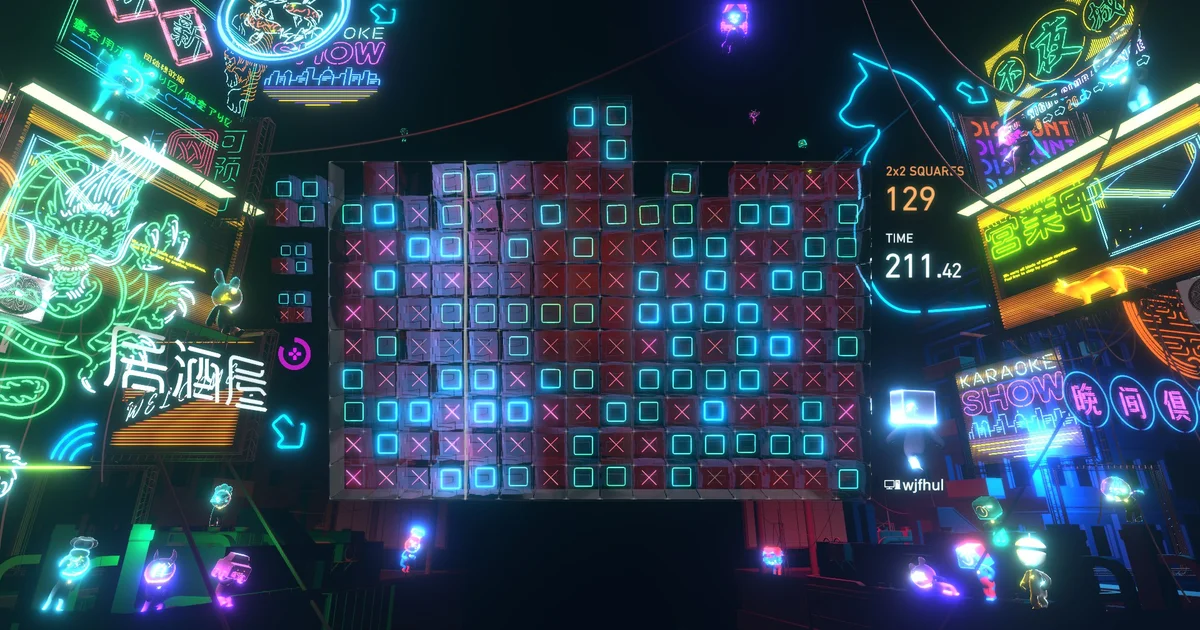
A quick primer for anyone who hasn’t met Lumines yet: blocks fall, always as 2×2 squares, sometimes with a cheerful attitude and sometimes with a distinctly unhelpful one. They drop in varied arrangements using two colors. Your job is to sort those colors into the correct 2×2 blocks to clear them off the board and earn points.

That covers the basics. But there’s more to it. The playfield is wide, more like a movie screen than the compact comfort of a typical well. Every few seconds, a timeline sweeps across from left to right, wiping away any blocks you’ve correctly matched by color.
But wait—there’s still more. Before the timeline passes, you can boost those colored clusters by stacking additional blocks of the same hue onto them. Multipliers, in other words. And the whole experience is musical too: each block drop, each rotation, builds into the soundtrack’s changing atmosphere, shaping the melody, widening the leitmotif, suggesting bridges, and driving into exhilarating middle-eights.
That’s the essence of Lumines. Let mixed colors pile up until they reach the top edge of the display, and it’s over. Do it exceptionally well, though, and you’ll move through multiple stages where the block colors evolve, the musical layers shift, and the background visuals keep changing to match. Marvel!
Now, Lumines Rise takes all of that and pushes it a bit further. No—pushes it quite a lot further. In terms of sound, there are plenty of “hit” moments, along with intriguing stages where a jumble of creaks, scrapes, and coughs come together to produce something new. (The soundtrack is composed by Hydelic and Takako Ishida, who contributed to Tetris Effect: Connected.)
Visually, the blocks don’t just change color—they also transform. For a moment, they show up like tiny PlayStation Xs and Os inside shiny, hard-candy shells. Then they can take the form of speckled eggs and feathers, or a delightful mix of legumes. One of my favorite levels features watch escapements and clock faces, while another summons black holes that may or may not be holding an astronaut.
In addition, the space around the blocks gets playful makeovers too. Earlier Lumines stages leaned into low-orbital disco satellites and dancing robots, but here you’ll find segments where balls roll toward or away from the player when blocks are cleared. At least one level is awash with water: blocks placed to the left or right of the play area tilt the whole environment. There’s also a camera that responds to your multipliers—zooming in and lunging forward in staggered motions before pulling back, looking visibly disappointed when you really mess it up.
Besides those additions, there’s also a noticeable mechanical shift. Lumines has always been built on geometric foundations, using fuse blocks that let you set off chain reactions with blocks of the same color.
Squares tumble and the floor gives way in stages. Still, Arise adds Bursts, its version of Tetris Effect’s Zone mode, where you could stack cleared lines into exhilarating streaks.
Bursts is an intriguing twist. During regular play, a gauge fills up, and once it’s ready you can trade it for moments when falling blocks help form a huge, steadily expanding cluster of similarly colored blocks somewhere on the board. Grow that mass and the score climbs. Aim it so it clears blocks with the wrong shade, reshape it as needed, then watch it spread over the game’s captivating stage. At the same time, the timeline shifts along with the size of the mass, showing how many more sweeps it will make before the Burst finishes. When the Burst period ends, you collect your earned points and wipe out every same-colored block you just created. After that, all the other blocks—the colors you didn’t target—drop in from above, and you’re hit with another surge of multipliers.
Bursts stands out. Whereas Zone often felt like it kept telling me I was playing in the wrong way, this mode is much simpler to turn into something satisfying—and harder to turn into something exceptional. So when should you start a Burst for the best payoff? How many chains should already be building across the board? Do you wait until you hit MAX Burst, or will a clever 70 percent push be enough? I keep enjoying Lumines because there’s always another layer to uncover. This is yet another chance to learn.
Alongside the main mode—which, much like Tetris Effect, plays through groups of stages, each with its own finishing score—there’s also the playlist and an endless mode. I’m likely to spend most of my time there once I’ve worked through those stages more thoroughly. Multiplayer includes a burst battle that dumps garbage blocks onto your opponent, plus a selection of score-attack leaderboard challenges. One of my favorites is the one where you have to fend off a steadily rising wave of blocks without getting overrun.
There are also challenges—essentially Lumines Variations. One of them, which I personally can’t stand, asks you to use combos to crack open an egg within a set time limit. That means you have to manage your available space and leave room for all the extra color mess that won’t actually help you. Another one asks you to work through strange Lumines patterns that split the screen. Yet another drops blocks in different shapes and sizes. There’s more than enough exciting content here to keep you engaged for a full month, after which you can put the points you’ve earned toward upgrading your in-game avatar.
I may be missing something, or not giving certain elements the attention they deserve. But that’s Lumines for you. These games have always come with quirks, yet the core mode is so remarkably fun and absorbing that it grabs my attention and makes it hard to focus on anything else. Unlike Tetris, Lumines never needed ideas borrowed from Lumines to get better. What it really needs—and this is just my take, especially since we also have the Steam Deck—is a Switch 2 release, so that wonderful panoramic screen you’re holding can return this impressive game to its portable roots.
A copy of Lumines Arise was provided for this review by Enhance.