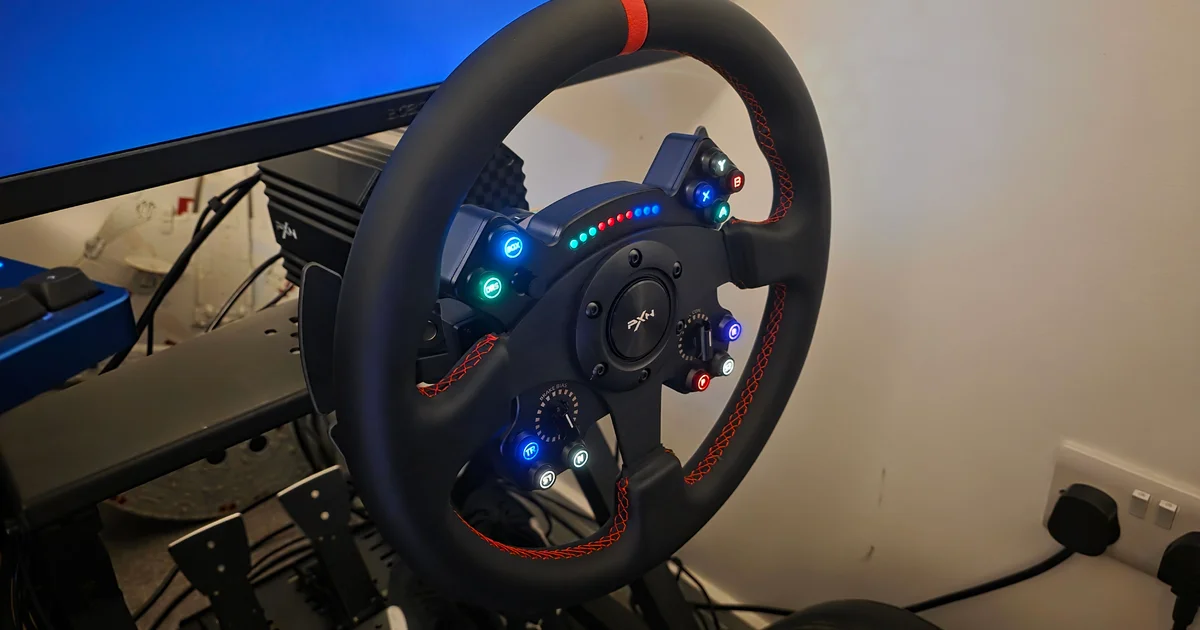
Direct drive wheels—those that pass the forces your car would deliver in a simulation straight to your hands, without intermediary parts such as gears or belts—are seeing a noticeable surge in popularity. Nearly every major brand has now moved into this higher-end segment, rolling out wheel bases that bring a stronger sense of energy and realism, often at prices that are becoming easier to justify. Brands like Logitech, Corsair (Fanatec), Thrustmaster, and Turtle Beach are part of the trend, and so are specialist players such as Moza, which has shaken things up with a wide catalogue, thoughtfully built software tools, and compelling value.
Now, Shenzhen-based PXN is aiming to mirror that momentum with a lineup of PC-only wheel bases, wheels, pedals, and bundles priced to compete directly. I’ve been putting their top-spec £349 VD10 10nm wheel base through its paces, along with the £249 W CS R2 and £159 W DS R2 wheels, to find out whether this relatively new arrival has managed to carve out an edge over the more established names—and whether it might grow into a disruptor that could even take on Moza.
PXN VD10, W CS R2 and W DS R2 review: hardware overview
The PXN VD10 is a fairly compact wheel base when set against other 10Nm options, and that rating lands comfortably in the middle of the direct drive range. (In my testing, entry-level models typically sit around 4–6Nm, while high-end units can reach roughly 25Nm.) With its 258x125x125mm dimensions, the VD10 is simple to secure to your sim rig using two or four bolts—or you can clamp it to a desk. The box includes both mounting methods.

In terms of design, there’s little that stands out dramatically. The VD10 uses a familiar aluminium alloy casing, with grooves designed to help it shed heat. At the front, the wheel rim connects using a quick-release system, while the rear offers a power input in the style of a laptop, three USB-C ports for accessories such as pedals or shifters, plus a USB-C output that runs to your PC. Consoles aren’t supported, though an external adapter should make it workable. A power switch sits at the back, but there’s no clearly reachable emergency stop button, which is disappointing. The full unit weighs around 7.4kg—just a bit more than the similarly powerful Moza R9.
The 330mm W CS R2 and 300mm W DS R2 wheels look more distinctive. Both feature sturdy magnetic paddle shifters on the back, a pair of analog paddles underneath, and a wide selection of controls on the front, including face buttons, sticks, dials, and more. The CS model looks more like a conventional racing wheel, with larger, chunkier backlit buttons. The DS wheel uses smaller buttons made from white plastic and skips backlighting. The CS is also clearly wider overall, adopting a full-circle shape that suits rallying and drifting better than the DS’s more typical D-shaped form.
Here’s a look at how the two wheel rims measure up—the larger, rounder CS is on the left, while the DS sits on the right.
Even with those differences, the overall build quality is comparable across the set. You’ll find structural metal, stitched faux leather on the rims, and plastic used in most other areas. Compared with Fanatec’s GT DD Pro, which leans more heavily into a plasticky feel, these rims are clearly a step up—and at this price, I don’t have major complaints.
PXN VD10, W CS R2 and W DS R2 review: software overview
PXN’s software suite is fairly polished, with a layout and overall feel that bring Moza’s Pit House to mind. As with that software, the main screen lists every connected device. Settings for the wheel base, rim, pedals, and other accessories each get their own section. Tooltips are included to explain what each control does, though I’d still welcome more detailed guidance—especially to make it easier to decide what to tweak depending on the game you’re playing.
There are also dedicated screens for updating firmware on connected devices and for checking which games are supported. Firmware updates to the base and wheels add compatibility for SimHub, a third-party application that can take over from PXN’s software—unlocking extra features and improving game support. For instance, I used it to get the wheel’s LED shift display working in Assetto Corsa Evo, and it ran smoothly with little effort.
One less common feature is the ability to bring up a digital driver display on your phone. The software produces a QR code you scan, which opens a webpage showing your live data. If you can keep your phone within your field of view, it can be a convenient alternative to buying a dedicated sim racing display.
The main drawback for me comes down to game support. F1 23 appears on the games page as supported, but on first launch I still had to set up every button manually. For a button-heavy title like F1, that’s a bit of a chore. I’m not sure
if setting up a preset needs cooperation from developers, just keep in mind that there’s…
there’s a downside to going with PXN instead of more well-known brands such as Logitech, Thrustmaster, or Fanatec.
PXN VD10, W CS R2, and W DS R2 review: gaming performance
After mounting it quickly to my usual Next Level Racing GTTrack cockpit, I had a great time testing the wheelbase alongside the two rims. Most of my session was split between Assetto Corsa Evo and F1 23. Because the wheel and rims are designed for PC only, I didn’t spend any time using them on consoles.
How much force feedback you get is apparent right away in Evo. You can quickly pick up the texture of a kerb, a jolt from a patch in the road, or a loss of grip when you throw the car into fast corners or heavy braking. Even though I’m still new to manual shifting, the paddles felt dialed in and delivered strong, tangible feedback. Accessing the buttons on the DS can be a little awkward, especially when you’re wearing gloves, but the CS has a small edge thanks to its larger buttons and a clearer layout for the four face buttons located in the upper-right area. A four-way stick also makes it easier to move through menus, while the brake bias and traction control dials sit where you can reach them when adjustments are needed.
In F1 23, the force feedback feels a bit less refined; still, after making a few changes in the menu, I was turning in lap times that were only a few tenths off my best results using the (notably more expensive) Moza R9 or Logitech G Pro Racing setups I’ve mainly relied on. Once again, I noticed the DS felt somewhat difficult to reach controls on, including the Multi Function Display, which lets you choose your next tire compound or tweak brake bias. Even so, these actions can be handled in other ways—using one of the two dials (for example, brake bias) or by pressing a button to tell your AI engineer what you want (such as switching to the next tire). Because of that, it isn’t a major drawback, and the smaller DS diameter also made it feel a touch easier to work with.
In F1 games, shifting is something you’ll do often, and both rims delivered a solid, dependable feel. It may not be quite as satisfying as the Moza GS V2P GT wheel, but it was fully adequate for what I needed. Having analog paddles underneath is especially important for F1 titles, since at least one is required for shifting during standing starts.
Overall, the force feedback detail and the build quality of these wheels line up with Moza models at comparable prices, and they edge out options from brands like Turtle Beach. I got the best results when running at medium torque levels—around 6Nm. Moza still leads with its more capable software tools, which are presented more clearly and with more depth, but PXN ended up feeling closer overall than I expected.
PXN VD10, W CS R2, and W DS R2 review: conclusion
At their current (Black Friday–discounted) prices, the PXN VD10 along with the CS and DS wheels are genuinely strong alternatives. You get a satisfying experience from the moment you unbox them, software that’s easy to use even if it’s somewhat restricted, and hardware that feels built to last. The direct drive motors deliver detailed force feedback and stand out versus cheaper belt-and-gear solutions like the well-known G29/G920, though you may not get the same level of fine-tuning depth or the breadth of game support you’d see with Moza, Fanatec, or Logitech. The lineup is still fairly small, with only a handful of wheelbases and rims available right now, but since there’s also a shifter, handbrake, and button box available, the core accessory needs are at least covered.
To wrap things up, I’m really impressed by PXN’s first release, and I’m curious to see how their range develops. Moza has shown that it’s possible to improve force feedback detail, broaden game compatibility, and expand what you can tweak in software over time. If PXN takes a similar approach, it could become a genuinely compelling option.