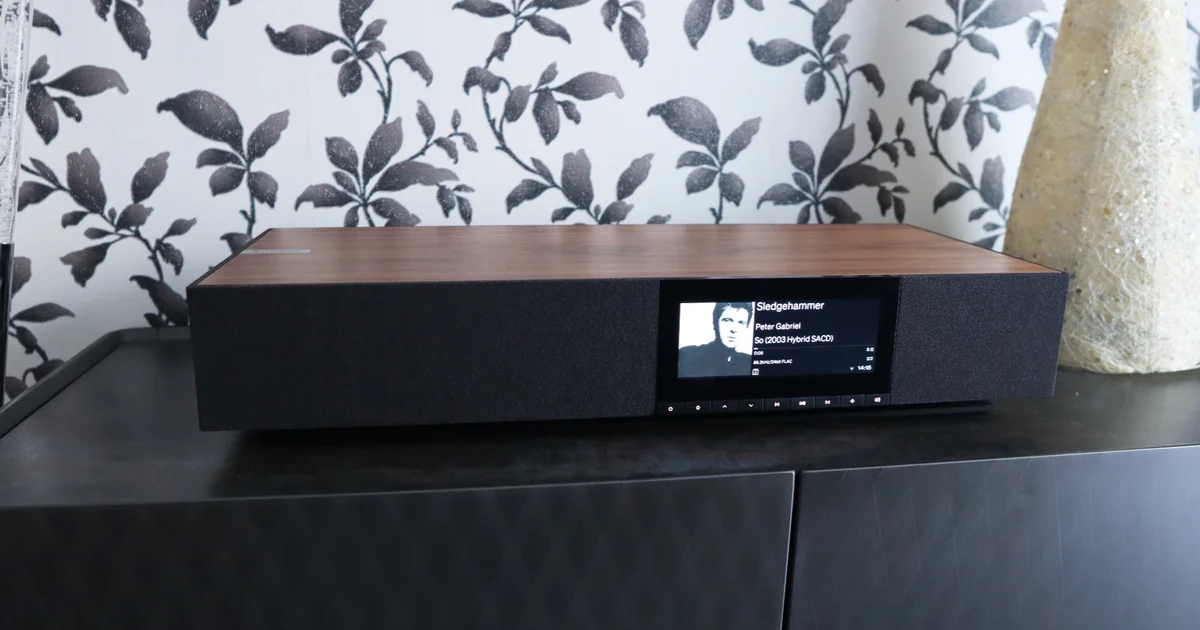
Although the Cambridge Audio Evo One isn’t a type of product I usually look into, I got intrigued when “gaming” was suggested as a potential feature of this premium £999/$1499 all-in-one audio system. Rather than a conventional gaming soundbar, it feels closer to a classic hi-fi component—yet with 14 built-in speakers and support for high-end gaming TVs, it actually lands as an impressive option worth putting on your shortlist.
In terms of appearance, the Evo One gives a modern take on the hi-fi cabinet style associated with the 1970s. You get a prominent 6.8-inch IPS screen across the front, plus a removable black fabric grille with a walnut finish on the top. It manages to blend old-school charm with a clean, contemporary look, so it should slot into almost any room.
Weighing 14.5kg and coming in at 67.5cm wide, it’s the sort of speaker that benefits from a stable, high-quality surface. Mine spends its time on my dining room sideboard for listening to music, and it also fits neatly beneath my 32-inch monitor on a desk during gaming sessions. The unit rests on a recessed base that lifts it slightly off the floor—an understated but welcome design choice.

The big display is genuinely helpful for getting to what you need without delay. It’s capable of showing VU meters, album artwork, and more, and it can even act as a clock. Below the screen, the button layout covers everyday controls such as volume changes and track skipping. While the controls may feel a touch less luxurious than the illuminated dial and touchscreen approach on the competing Naim Mu-So 2, they still do the job without any fuss.
When it comes to connections, the Evo One is well stocked. There’s HDMI eARC so you can pair it with your TV (or a gaming monitor) as you would with a premium soundbar, plus a USB port for playing files directly. For networking, you get Ethernet, and there are also aux-in and optical inputs. The system further includes a moving magnet phono stage, so you can add a turntable and enjoy vinyl through a contemporary setup. You can also stream over your network and send audio from your phone (either directly or via Cambridge’s Streammagic app), with support for Tidal Connect, Spotify Connect, Deezer, and Qobuz. On top of that, it offers AirPlay 2, Google Cast, Bluetooth 5.1, and it’s Roon Ready for subscribers. Music can also be received through the app from a network server using UPnP (the method I’ve been using with my QNAP NAS via Plex).
Beyond its support for Spotify Connect and UPnP, I particularly want to highlight the Google Cast integration. Plenty of people may be surprised that I only just came across this feature, but it really is possible to set up multi-room audio over Wi‑Fi using two or more speakers that support Google Cast through the Google Home app. Within the app, you can create a speaker group that includes units in different rooms (each speaker needs to be assigned a distinct room label in the app) and then bring everything together with just a couple of taps—no requirement to match brands or models like you’d do with Sonos. In my living room setup, I’ve got a Naim Mu-So Qb 2, while the Evo One covers the dining area, and it runs smoothly.
If you prefer to control everything from elsewhere, the Streammagic app is there for that purpose. It provides the same kind of command over playback as the unit’s screen, while keeping the streaming services mentioned earlier accessible through a more straightforward interface. You can also tweak extra options like room compensation and speaker positioning, plus use a seven-band EQ for more detailed sound shaping. The app also guides you through initial setup, including step-by-step help for joining Wi‑Fi and performing over-the-air firmware updates, so the system is ready in only a few minutes.
The Evo One also claims something notable: it packs what may be the largest driver lineup in a single enclosure, using 14 drive units supported by more than 700W of amplification and digital signal processing. Cambridge says this arrangement is designed to produce deep, controlled bass. The speaker package includes four 25mm silk dome tweeters, four 57mm aluminium cone mid-range drivers, and six additional 70mm woofers, aimed at delivering punchy sound that can fill larger spaces.
With such a broad range of drivers and so many ways to use it, I went into testing the Evo One with big expectations for this Cambridge system. The first thing I noticed when listening to “September” by Earth, Wind & Fire and “2112” by Rush was how wide and how deep the soundstage felt. The audio reaches well beyond the physical footprint of the unit while still sounding precise and clear, making it easier to pick out details—like the distant bongos during “September,” or the flowing water heard in the “Discovery” section of “2112.”
In the Bee Gees’ “Nights on Broadway,” even though the song’s outstanding harmonies take center stage, I could still make out the clavichord and electric piano lines in the background. I also like to use a live recording of George Benson’s “Affirmation” (credit goes to DankPods) to judge soundstage, thanks to the crowd ambience at the beginning, as well as the track’s percussion and clapping—details that remain audible even during a busy live performance. For something even more layered, Brand X’s “Dance of the Illegal Aliens” is an especially packed jazz fusion track, with everything from energetic bass and rolling drums to more percussion. On this one, the bongo hits felt positioned away from you in one direction, past the unit’s edges, and nearly at the rear of the listening area.
As noted earlier, the Evo One handles bass with real depth and control. In some listening situations, it may drift a little into the mid-range, giving the overall sound a slightly more forward character—but if you want to fine-tune the balance, EQ adjustments can help.
In launching
In The Invisible Man by Marillion, the track leads with a deeply affecting bassline, paired with an atmospheric vocal from Steve Hogarth. His delivery highlights both his range and force, while also bringing a kind of weight and fullness that suits the darker, more intricate songs. I felt something similar while listening to Steven Wilson’s Meanwhile from his recent album: you hear a tough, gritty bassline in one section, then a shift toward lighter acoustic guitar textures afterward — you can definitely feel that low-end rumble.
Even when the lower frequencies seem a bit dominant now and then, there’s still plenty of room for other details to come through clearly. On James Taylor’s September Grass, his warm vocals and the acoustic guitar accompaniment stood out with impressive clarity and depth, without ever sounding cramped or pushed to the side of the mix. The same was true for Jack Johnson’s Tape Deck: his vocals, the song’s pared-back acoustic guitar lines, and the restrained drum and percussion touches all found their own space in the overall balance.
Unlike many alternatives, the Evo One’s high frequencies don’t come across as sharp or overly forceful, and the system doesn’t follow a V-shaped tuning approach that elevates bass and treble above everything else. Instead, it delivers a clean, crisp treble response, which I noticed during the engaging percussion opening of Steely Dan’s Do It Again. That sort of control can be difficult for any speaker to achieve, but the combination of an energetic character and a wide soundstage helps Cambridge nail it with style. The Strokes’ On The Other Side poses an equally interesting test: the intro pairs a driving bassline with steady cymbal accents, and while the bass keeps its momentum, the cymbals never seemed buried — they stayed clearly present within the mix.
With a wide soundstage and steady results no matter how far you sit from the speaker, the Evo One also fits well for gaming. To be fair, it isn’t the most conventional use case for this type of system, but linking it to a compatible TV or monitor (less common, but still possible) through HDMI eARC produces a genuinely satisfying setup. You get a powerful low-end for atmospheric effects like gunfire or engine roars, paired with a spacious mid-range and treble that keeps vocals easy to understand. I’m not recommending it for high-precision competitive eSports such as Counter-Strike 2, where accuracy is vital, but for large-scale cinematic games — including Cyberpunk 2077 and even my usual Forza Horizon 5 and EA FC sessions — it shined, handling deep engine rumblings and far-off crowd chants especially well.
The Cambridge Audio Evo One is a genuinely impressive all-in-one system that works wonderfully for both gaming and music. The build quality and finishing are striking, and I find it hard to imagine sending it back, especially given how good it looks in my dining room. It also offers flexible connectivity options, the benefit of a large display, and support via a convenient app. The sound is expansive, detailed, and remarkably clear: you hear tight bass, rich midrange tones, and a surprisingly bright treble that sounds fantastic. Some people may prefer a speaker that doesn’t emphasize the low-end quite as strongly at times, but to my ears it still stands out as a major technical success. It’s well worth recommending as one of the top picks for console or computer speakers — a rare product that checks nearly every box, as long as it physically fits the spot where you plan to place it.