Santa Ragione offers a rebellious, at times genuinely shocking, and often laugh-out-loud first-person horror tale that—despite feeling a little insubstantial in places—still delivers an oddly captivating, genuinely original look at a set of important ideas.
One element that may have been partly lost amid the noise surrounding Horses before its launch is how unexpectedly funny it is. The humor runs deep into the dark, and the jokes frequently hover right at the edge between amusement and revulsion. Even so, writer and director Andrea Lucco Borlera’s first-person horror—his first game developed in close collaboration with Saturnalia’s creator Santa Ragione—comes through with a strongly individual perspective. It’s hard to pin down in a straightforward description, but if you imagine Animal Farm being reworked through Pier Paolo Pasolini’s Salo on one side, while a meme-famous Garry’s Mod clip pulls the other way, Horses gleefully swings between those poles, eventually settling somewhere in the middle.
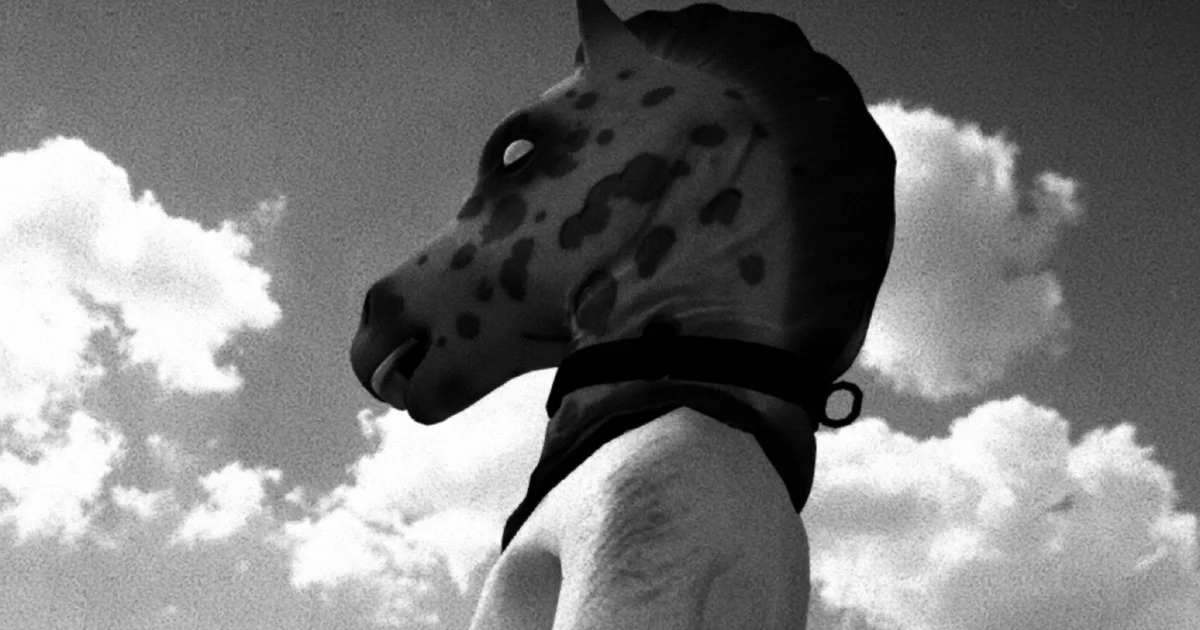
There are stretches in Horses that will definitely throw you for a loop — even though it’s nowhere near the devastating, decency-rattling work some people have promised — and there are also moments that are so intentionally ridiculous that the only honest reaction is laughter. At times, it’s tough to tell where one ends and the other begins; Horses’ offbeat approach builds a deliberately disorienting atmosphere. A former film student, Borlera draws heavily on cinematic storytelling techniques, using a tight 1.33:1 aspect ratio, a stark monochrome look, and dialogue intertitles that bring the silent-movie era to mind—possibly tinged with echoes of old propaganda newsreels. Throw in quick cuts, live-action insertions, split-screen composition, and picture-in-picture framing, and you end up with a restless, experimental patchwork of unusual stylistic choices: lifelike textures clashing with clumsy, awkwardly animated character models; unnervingly extreme close-ups; and an almost complete lack of diegetic sound, replaced instead by the steady whir of an unseen film projector—an oppressive, destabilizing presence that’s likely to make you feel uneasy.
Meet Anselmo, Horses’ blank-faced protagonist and stand-in for the player. Just before turning 20, he’s sent away for 14 days of hard labor at an isolated farm. Maybe, as his father’s blunt birthday note suggests, it’s meant to “build character”; maybe it’s intended to make him “finally start behaving like a man”. Very quickly, we learn that Horses lives in a world of moral extremes, complete with its own outsized, manufactured version of social expectations and norms. From there, a two-week apprenticeship in the Italian countryside begins—and soon takes a deeply troubling turn.
If the well-meaning farmer’s stern warning not to enter his room isn’t enough of a red flag, his treasured “horses” soon make the point: naked, dirty-looking humans wearing rubber masks over their heads. It takes an unsettlingly long time for anyone to fully recognize what they are. The concept is undeniably absurd and outrageous, though it also carries an uncomfortable kind of understanding—because their (pixelated) nudity emphasizes their dehumanized state rather than aiming for cheap titillation. For many players, this image is likely to trigger an immediate emotional response. But Anselmo—built as a blank slate—keeps moving forward, pulled along by the relentless rhythm of the farmer’s rules.

Morning means breakfast—three whimsically decorated biscuits that, in a playful way, hint at what’s coming—then you head out as the workday kicks in. Early on, the chores feel routine enough; you’ll move between the tool shed, the vegetable plot, and the horse pen, then back again—watering crops, looking after the animals, cleaning up waste, and doing whatever the farmer instructs. Occasionally, visitors come by to expand on the beliefs behind the world outside Horses, only to vanish again. The day ends with dinner, a bit of conversation, and possibly a restless night marked by disturbing dreams. But as soon as rebellious forces start to seep into the farm’s own philosophical microcosm, everyday life collapses into chaos, and your days—along with the farmer’s expectations—grow increasingly extreme.
As harvesting vegetables and chopping wood give way to burials and beatings, the hours become stranger and more grim over roughly the next three or so. Still, while Horses’ content warning is thorough—covering everything from suicide to sexual violence—it can be a touch misleading, implying an unfiltered horror parade of atrocities that never actually arrives. Despite the game’s oddball, jarring visuals, Horses isn’t built as that kind of experience. It sticks to a darkly whimsical tone from start to finish, often pairing dread with humor, and even its most intense scenes stop just short of becoming gratuitous. In fact, it enjoys provoking you—you might gasp, you might flinch, and you may well struggle to find words—but it never feels casual about it, and it never slips into overt exploitation.
That said, it’s clear the goal isn’t comfort. Borlera’s approach looks engineered to break the audience out of complacency. Horses isn’t subtle; it delivers its themes in bold, vivid strokes rather than leaning into deeper analysis—much like it’s just as eager to spark immediate, physical reactions as it is to encourage more thoughtful reflection. It works in that regard, though it may also feel brief and somewhat lacking in weight. There’s also room to question the choice to include simplified options—implying meaningful narrative flexibility where there really isn’t any—which can occasionally lead to awkward moral mismatches and distracting contradictions that muddy the message. Even with those issues, Horses comes across as a reflective, intentional project that explores oppression and subjugation, along with the structures and routines that sustain them, in ways that remain strikingly off the beaten path.
With story-driven experiences that are tightly designed, you often end up asking yourself: what does this particular tale gain by being presented as a game? If there’s an answer to be found, it likely comes down to the sense of uneasy involvement and helplessness Horses creates—where futile resistance slowly morphs into something more hopeful. It reads like a direct challenge to hypocrisy, whether that hypocrisy is rooted in institutions or elsewhere, and it feels especially relevant right now as puritanism and anti-intellectualism keep pushing back into the spotlight—while people labeled as “different” are increasingly framed as threats to society. Horses’ methods, along with its attraction to the grotesque, won’t click for everyone. Still, if even a hidden encounter in the toolshed—complete with a rubbery horsehead that wobbles—has to plant the seed for its call to action, then so be it. It may be exactly what’s needed to make the point land.
A copy of Horses was provided for this review by Santa Ragione.