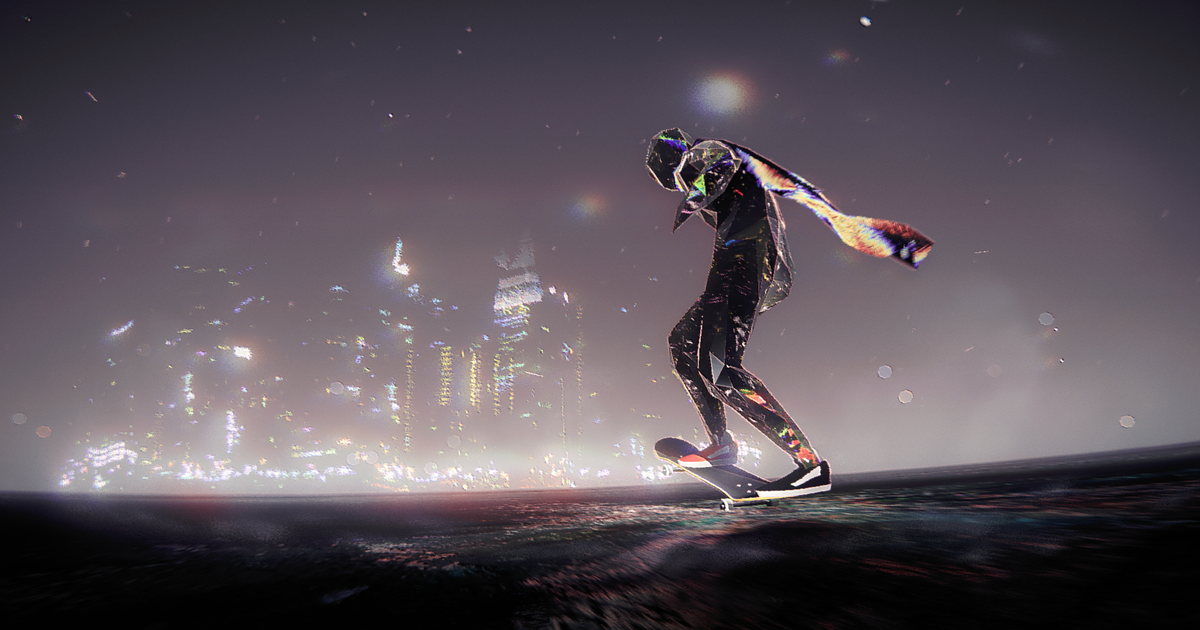
Troubling sleep? Is the Moon shining too hard? Feeling tempted to swallow it whole? This simple urge to unleash a demon from the abyss sits at the heart of this striking, standout tale—one that just happens to include skateboarding.
It has almost been two decades since I last lived in New York City, yet there’s still something magical about running into art that can hit such a vivid, personal chord with its audience—even when it’s just one person. Skate Story is exactly that kind of experience, and for plenty of reasons, it’s easy to see why it remains a timeless game. Sure, my hands look like a pair of rigid talons, my pre-arthritic joints are flaring up like a Guy Fawkes bonfire. My left shoulder aches in that familiar way it does whenever I get absorbed in digital work, and my heartbeat is pounding in the heels of my palms because I’m clenching my controller. Honestly, this is what movement-heavy, combo-driven gaming looks like once you’re no longer a fleet, well-oiled machine. I’m a deskbound sort of person built out of SSRIs and stubborn discomfort—and yes, I still have to skate.
The road to Skate Story took six years, and it was paved with breathtaking trailers, but Sam Eng kept the details on the lyrical charm and wonderfully strange tone he achieves throughout the game largely under wraps; this is very much a product, which Eng has discussed in interviews, where New York City serves as the guiding spark. It reads like a lively love letter to psychogeography, starting with faint, ethereal impressions of the city—like mist clinging to a window—before turning into a full-on tribute to recognizable places and everyday elements that make up the metropolis. Still, at the very beginning, there’s nothing at all—just a huge, moonlit emptiness.
The player character is a demon with uncomplicated needs: because the Moon glows far too brightly in the underworld, nobody can ever really rest. When the demon decides to eat it, the Devil chips in a little help (the skateboard)—but of course it comes with a cost (their soul). That’s how the Glass Skater comes to be, though there’s never just one Moon, and no soul across any stretch of time and space should ever place trust in the Devil. As someone who’s dealt with insomnia for years—back when I was handed absurd amounts of sedatives—the quest for sleep hits closer to home than I can properly explain. I also have a deep admiration for this brand of aggressively petty determination, because, honestly? We’re going to take the Moon apart completely.

I’m not a die-hard follower of Tony Hawk’s Pro Skater. That said, I was a pretty capable snowboarder back in the day, and I actively collected Mack Dawg VHS tapes and TransWorld magazines to get me through the off-season. My real introduction to skateboarding didn’t happen until my first job at a magazine. We needed a hands-on sports feature for a particular issue, and when the opportunity came up to learn how to skate, I was guided—since I was the youngest and the most physically able person on staff—to be pushed into a quarterpipe in a gentle but firm manner by a Canadian model called Mikey, who wore Vans slip-ons decorated with foot graphics.
Skate Story feels refreshingly different from a Pro Skater-style game: it plays more like a narrative adventure thrill ride that still demands skateboarding. I’m not sure what I expected when I started it, even though I was captivated by the trailers like so many others, but I didn’t anticipate how easily it would click for me on the same dreamlike frequency. Eng walks you through the basics of street skating with a light touch. You start with foundational moves like learning to ollie and powerslide, then you build toward intermediate and increasingly complicated tricks that earn better scores. These achievements are called Souls, the game’s currency, and the Skater can spend them to buy new skateboard components and stickers at the shop.
Street skating is a tool for everyone, and the Skater moves the board as if it were part of their own body. There are obstacle gauntlets, portals, and timed end-of-the-world events that could feel like a lot for a game that’s about skating—though not only about skating—yet it all comes across in a wholly open-ended, satisfying way (you can’t botch it permanently, but you can go back to the board and try again, with the thrill and nerves of knowing each attempt will come out differently). Eating the Moon isn’t simple, so the Skater has to link tricks together as smoothly as possible to form combos, then finish them with a perfectly timed stomp meant to hurt the Moon. Eng leans into stomping within specific target areas during boss fights, almost like hunting down weak spots on a colossus. There are also “Moonlit Spots” scattered around the landscape that you can activate to grab a hefty haul of Souls. Many of the later boss encounters are laser-focused choreographies—varying in complexity—and they pulled me into a genuinely euphoric flow. None of that would land the same without the outstanding music from Blood Cultures and John Fio (and a special nod to Rabbie the rabbit’s voice effects—it quickly became a kind of ASMR for me).
To me, the heart of Skate Story is the chance to approach the game as an emotion-led narrative, using psychogeography as the lens. As someone who really admires Cosmo D games, I love moving through a city—or any busy, story-filled environment—with one foot in imaginative space and the other planted firmly in reality. The game introduces a set of NPCs I genuinely value, and it’s obvious they’ve earned their place in my heart. With plenty of dry humor, Skate Story also takes on the way skateboarding gets labeled as an antisocial punk danger—an idea that has carried major weight for minorities and people in marginalized positions across many communities. Time and again, street skating has opened the door to both belonging and self-definition, even in spaces built to be rigid. In the end, it highlights the distinct traits of particular places and cultures: it’s all about making adjustments and staying resilient, and offering plenty of meanings to different kinds of players—because skateboarding, at its core, moves through space as a deeply personal, physical experience, flaws included.
For Sam Eng and Skate Story, that setting is New York City. On one especially indulgent detour, my thoughts started linking Eng’s fellow New Yorker and writer Samuel R. Delany to this experience—mainly through his novel Dhalgren. That book left me both annoyed and reeling, along with a handful of his short stories, all of which share a wild, elusive method of working with place, identity, metaphor, and “mythological resonance” (and he also captures New York effectively across many of his other works; although Dhalgren is set in a midwestern city, it still carries a distinctly New York flavor). Skate Story takes on many of the same concerns, from circular text and looping structure to prismatic reflections, repetition, and the elasticity of perception, all while you kickflip through a lively chain of Moons. And although Dhalgren has been read as a roundabout look at capitalist power, here Eng gives us the spiraling logic of the Devil’s geometry—one that sets the boundaries of the underworld and determines the Skater’s route.
Of course, there are more direct intertextual nods—Evangelion in spades (I laughed; it’s that perfect kind), place-focused postmodern narrative games like Kentucky Route Zero and Norco, classical philosophy, a brush of Derrida, poetic passages, a touch of Dante, and reminders of literary film. Ultimately, it reads like a postmodern fable for those who don’t fit neatly, carefully assembled with real precision. In Guy Debord’s own words, “the clumsy quest for a new lifestyle is the only truly exciting pursuit.” And if wandering on foot (“drifting,” specifically in the French sense) was treated as a form of defiance when psychogeography first appeared, then skating in order to feed on the Moon turns that rebellion up dramatically. Still, there’s hardship—quite a bit of it—because the Skater is glass. The game repeatedly brings home the physical cost, while also delivering a bold feeling of renewal each time the Skater rebuilds themself and tries again. On top of that, Sam Eng’s wit really comes through. This creator understands the power of staying light even when things are absurd, and that matters a lot in a game built around loops.
My objections are relatively minor and mostly personal. My learning process was slower and more demanding than it was for many others, largely because I deal with multiple orthopedic concerns. I knew this going in, and I still paused when needed, making full use of the preventive ergonomic gear I brought along—yet I kept finding myself stuck repeatedly trying to push through the harder boss fights, even when it came at a price for my body. As I mentioned earlier, I haven’t played other skateboarding titles, but I do have some real-world experience in a board-based sport. My usual stance feels natural (left foot forward), and after I officially got the switch stances down in-game, my Skater started showing up as goofy (right foot forward). That led to a fair amount of mental fog, especially when I zipped through au naturelle while the small “SWITCH STANCE” label flickered in the corner of my screen. (Was it telling me to do something? Was it just reporting a status? It really threw me off.) At times, I even hopped off the board by mistake during impressive combos simply because I pressed the wrong button, which made me hiss with frustration. Then I’d back off to the Skater’s Dream (a neutral hub space) to nurse my wounds.
Without question, Skate Story is my game of the year—and possibly one of my favorite narrative experiences ever. It’s striking, laugh-out-loud funny, emotionally resonant, and tough in the way you hope a well-built story will be. Above all, it feels like a surprisingly rewarding piece of writing to me, one I find myself almost gleeful about taking apart slowly, at my own rhythm, over time. It’s an adventure powered by adrenaline and genuine curiosity; it includes moments that break the fourth wall, quiet stretches, charming small characters, and—across the board—absolutely gorgeous visuals (seriously, the menu design! It’s an S-tier game menu). If the Skater is like a pilgrim, and Rabbie the rabbit acts as his Virgil, then roast me like a marshmallow in the fires of hell, because I’m ready to jump back in and experience it all again. Sam Eng has said this is deeply personal to him, yet that closeness doesn’t keep it from feeling shared: there’s a universality here. We may all have to work through the Devil’s geometry, but with a bit of luck and persistence, we might just make it out together.
A copy of Skate Story was provided for this review by Devolver Digital.