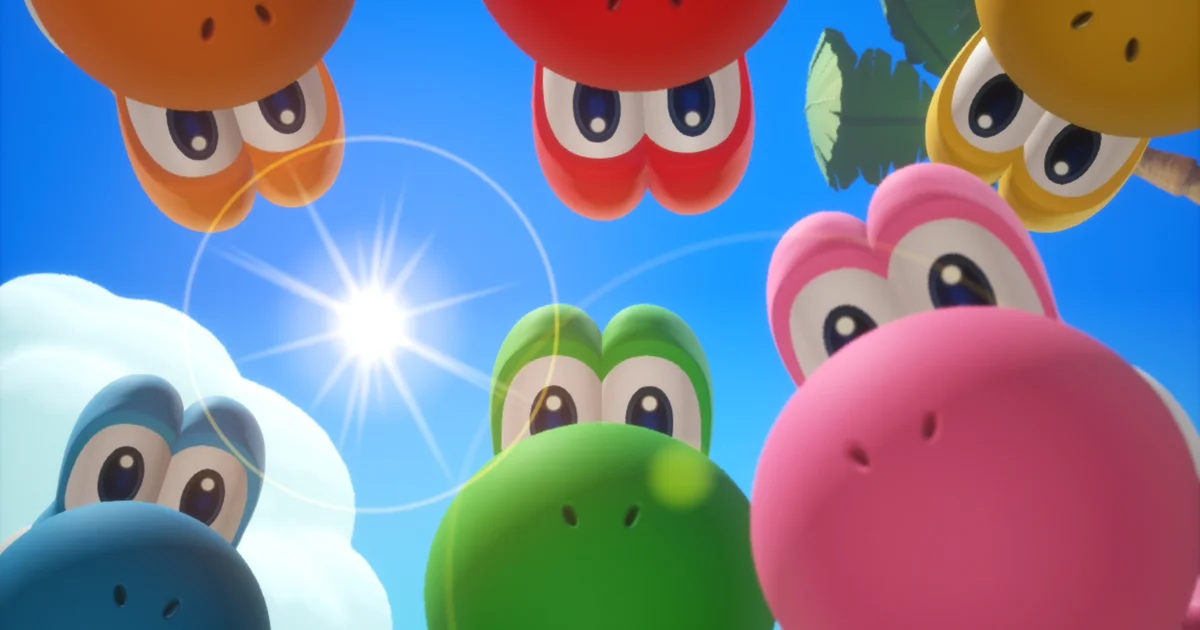
A captivating response to one of Nintendo’s all-time great games.
Yoshi and the Mysterious Book might well be the most delightful surprise of the year so far—and it has certainly been that for me. At the start, I wasn’t expecting much. For one thing, the name struck me as a little bland, and since it wasn’t Zelda or a mainline Mario entry, I figured I could just pass on it.
Turns out, I was wrong. This latest Yoshi outing feels clearly tuned for a younger crowd—there’s no real jeopardy, and you won’t get wiped out, with most difficulty coming from the occasional confusion over what you’re meant to do next. Still, I genuinely think there’s something substantial here for players of every age. That’s the theme again: surprise, and the joy of it. Yoshi and the Mysterious Book is a real treat.
I should admit I was baffled at first. The game draws its visuals from Yoshi’s Island, that SNES classic built around folded-cardboard sets and gentle pastel tones. The new entry dials back the papercraft look in favor of stronger 3D detail, yet the corners of each stage still melt away into sketches. On top of that, Yoshi’s animations have a slightly dropped-frame feel that can make the action resemble a flipbook.
Those hand-drawn stage boundaries were what threw me initially. Yoshi’s Island was an exceptionally imaginative platformer, but it largely followed a simple A-to-B structure. You start on the left and head to the right. However, when I reached what I believed was the finish of a stage in Yoshi and the Mysterious Book, something odd happened: nothing. I couldn’t walk off the screen into the next area. I was still inside the level itself. The game, it turns out, has a different idea of what “ending” a level should mean.
This comes down to the game’s core concept. In this adventure, Yoshi has to fill the blank pages of a living encyclopedia. Each spread of the book (when I was working mostly with print, I never lost the fun of calling these DPSs) becomes a fresh region, and every level grows out of one of the creatures that lives there. So you might, for example, dive into Remote Isle and try to learn everything you can about the goonie birds—those diamond-shaped gulls from—well, I think—Yoshi’s Island itself.
Studying a creature isn’t as simple as moving only from left to right, even though the gameplay remains a 2D platformer packed with jumping and platforming. The biggest difference is that, instead of constantly pushing forward, you’re investigating what everything around you might do. What happens if Yoshi tries to eat a goonie bird? What if he throws an egg at it? If that egg lands and bounces into the fire, what then? And where could it be nesting?

There are a couple of key things to keep in mind. First, if you’ve played any Yoshi platformers in the past, the move list still feels very familiar. Yoshi can grab objects with his tongue and swallow them, turning them into eggs. Those eggs can then be thrown around for fun and other effects. The beloved, elastic flutter jump is still here, along with the ground pound. You can also set an item on your back—just like the old days, carrying baby Mario and Luigi—so you can use it when the timing is right. Maybe it’s a flower that lets Yoshi sprout blossoms as he moves. Maybe it’s an apple someone wants to eat. Or maybe it’s something that can smash through obstacles.
Second, treat all of those mechanics like pieces in a chemistry set. This is truly a “test it with that” kind of game. Often, you’re trying to figure out the creature’s behavior. At other times, you’re working toward it—cue barriers and platforming hurdles. Sometimes you’re figuring out how it reacts to its surroundings. Other times, you’re tracing where it comes from. From those basic ideas, the levels take shape as a chain of discoveries.
When you complete a level’s big breakthrough—something that gives you a solid grasp of the creature—you head back to the DPS again. From there, you can either set your sights on a new creature or go after anything you didn’t manage to learn about the last one. That’s such a clever loop, because the more you understand one creature, the more it often reveals connections and opportunities involving others. The whole ecosystem links together in genuinely satisfying ways.
I don’t want to give away too much of what’s here, because Yoshi and the Mysterious Book is packed with delightful discoveries. Still, one kind of creature in particular stood out to me—these ones cling to surfaces and then change how the world reacts. I also ran into another critter that feels like it’s part bubble gum and part trampoline. There are dozens of these fun little characters throughout the game. It’s essentially a living gallery of creatures, complete with bosses, puzzles, and a steady stream of sweet jokes and
Sure! Here’s the rewritten content with synonyms and restructured sentences while keeping the HTML tags intact:
on top of that. Meanwhile, the levels cover everything from forests filled with hollow trees to coastlines where pirate ships sit in nearby caverns. In short, it’s a game that feels built for play.
This sounds wonderful if you’re a kid, I’d imagine. But for adults—especially anyone who’s old enough to remember Yoshi’s Island from back then—things feel rather different. Physics has long been the quiet driving force behind Mario-style games, and Yoshi’s Island took it a big step further, going deep into how the materials in the environment behave—something you’d later notice in games like Angry Birds. Thanks to the SNES hardware, Yoshi’s world let enemies be flattened, crushed, or warped. It wasn’t just a Newtonian setup anymore; it leaned into Young’s Modulus. (Someone explained it to me once, and I’m not going to mess it up by trying to restate it perfectly here. The good news is that it’s easily searchable.)
So, strangely enough, when I think back on Yoshi’s Island, I don’t picture the experience as mostly about straight-line stages. Instead, what comes to mind is the kind of feeling Yoshi and the Mysterious Book creates. Both games invite you to explore—interacting with the world and uncovering what it holds. A watermelon can double as a gatling gun. A dandelion seed can function like something that changes your mind. And that yellow stuff that gathers on surfaces can be pierced through, but you can also end up stuck inside it. Incredible!
I’d even go as far as to say Yoshi and the Mysterious Book isn’t simply a follow-up, but a game shaped by the experience of playing Yoshi’s Island. It’s a title centered on imagination and the uncommon care Nintendo consistently pours into its platformers. It’s a revelation. It’s a delight.
A copy of Yoshi and the Mysterious Book was provided for this review by Nintendo.