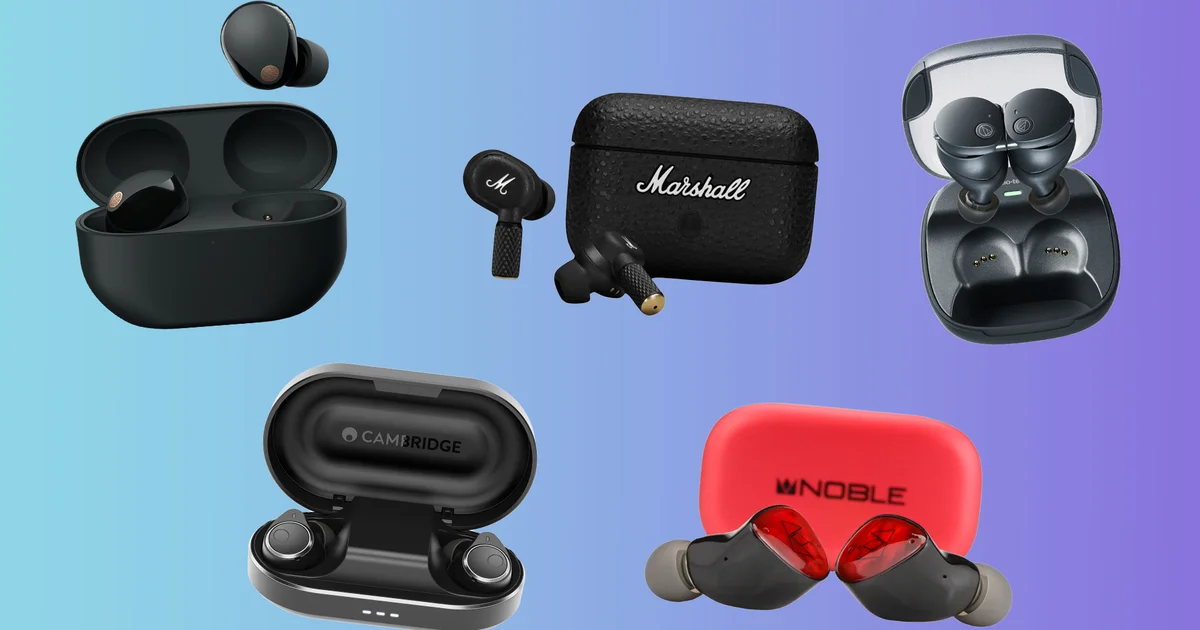
If there’s one part of tech that’s really taken off lately, it’s wireless earbuds featuring noise-cancelling technology. Over the past few months, we’ve seen a wide spread of options appear across different budgets, from long-established audio names as well as newer arrivals. In this review, I focused on a handful of premium models that I’ve already tested, to see whether any truly feel notably different—or more deserving of your time.
Keep scrolling to get my take on the main contenders from Sony, Cambridge Audio, Marshall, Audio-Technica, and Noble Audio. You can also browse straight to the section that matches the product you’re most curious about.
Sony WF-1000XM5 review: Turns out the established ‘best’ is genuinely impressive
Purchase:
The Sony WF-1000XM5 have been on the market since July 2023, meaning they’re close to two years old now. Because of that, they’ve built a reputation as the go-to “best” choice for many reviewers—people who are typically far more dialed in to audio subtleties than I am. Much of their appeal comes from top-tier noise cancellation, lively sound quality, and a comfortable fit.
One of the first things I noticed about the XM5s is just how much smaller and lighter they feel compared to their predecessors, which were visibly bulkier—especially their charging case. By trimming the design, Sony has made the earbuds easier to carry, to the point where you could realistically misplace them in a hurry. They’re 25 percent smaller and 20 percent lighter than the previous generation.
Overall build quality is excellent. Both the case and earbuds use a sleek, glossy plastic finish, and the hinge action feels satisfying. The case stays fairly understated, with minimal branding or decoration: it’s black, topped with a rose gold Sony logo, includes a small status LED, a USB-C port, and a pairing button around the back.
When you wear the earbuds, they lock into place using a twist-and-push motion, forming a snug seal that helps boost noise cancellation. On-ear touch controls handle playback and let you fine-tune noise-cancelling levels. That said, the rounded design of the controls can make them a little awkward to use compared with earbuds that offer sharper, more defined buttons.

Pairing is simple, and the XM5s also come with Multipoint Bluetooth support enabled from the start. That makes it easy to switch between devices—so you can share with friends using different gadgets, or stay connected across your phone, laptop, and another device at the same time. If you’re into workouts, the XM5s are also rated IPX4 for sweat resistance.
Sony’s app for the XM5s is packed with features, including spatial audio and head tracking for things like answering calls. If you want, it can also adapt your listening profiles based on your routine. Codec support is solid too: you get standard SBC and AAC, along with Sony’s options and the more capable LDAC format if you’d like to go deeper with your audio.
Noise cancellation works in a simple on/off way, which is a step back from Sony’s older over-ear products that offered more granular control. Even so, the earbuds’ noise cancelling is outstanding, doing a great job of cutting out most sounds on busy train journeys—though a few voices may still come through. Sony achieves this with a redesigned microphone system: three microphones in each earbud, including dual feedback mics intended to handle lower frequencies, supported by a newly built-in processor. Transparency mode also feels natural, without turning your surroundings into something artificial or overly processed.
The XM5s deliver reliable battery performance, too. You get up to eight hours of playback from the earbuds when using Bluetooth with active noise cancelling switched on, plus another 16 hours from the charging case—bringing the total to 24 hours. Unlike many competitors, this lines up with the XM4 model, and it still looks very strong for a premium pair of earbuds.
Compared with earlier Sony models, the XM5s’ sound profile has been adjusted somewhat. Sony seems to have traded a bit of low-end warmth for extra clarity and more fine detail—more in line with a Bose-like tuning, if you’ll allow the comparison. That doesn’t mean the bass has lost personality, though, because there’s still plenty of richness that keeps listening feeling full and polished.
The gritty bass in Steven Wilson’s Meanwhile stood out for both clarity and reach, even as the track got more intricate, with vocals and acoustic guitar braided throughout. Meanwhile, the bold synth bass in Earth, Wind & Fire’s Let’s Groove added weight and impact without tipping into overpowering territory.
The mid-range is especially engaging. In Al Stewart’s Time Passages, you hear a lively presentation and excellent detail alongside his full-bodied vocals, plus the small textures in acoustic guitar and organ. Jimmy Buffett’s Tonight I Just Need My Guitar delivers a similar impression, pulling strong clarity and detail from his vocals, the song’s leading acoustic guitar, and the far-off percussion—held back just enough that the superb soundstage makes it feel distant rather than muddy.
The XM5s also create a convincing sense of where sounds are coming from. Earth, Wind & Fire’s September shows this through the wide placement of distinct bongos, while Paul McCartney’s Little Willow positions the choir and backing vocals off to the sides. That kind of spatial feel can also be a plus for mobile gaming.
The high end isn’t overly aggressive, and it matches the mid-range in both precision and crispness. The relentless cymbal hits in On The Other Side from The Strokes can be tough to sit through on some of the other headphones I’ve used, but here they come through cleanly. Thanks to the roomy soundstage, the competing percussion intro in Steely Dan’s Do It Again also has room to breathe, with the electric piano tones, congas, and guiro feeling clearly separable and easy to track.
As you’d expect from earbuds priced at £219/$311, the Sony WF-1000XM5 deliver standout noise cancelling, a secure fit, and audio that’s rich, clear, and wonderfully detailed across the full frequency range. They’re also much more compact than earlier models, making them a lot easier to live with day to day. In the end, it turns out those “best” earbuds have good reason to earn the title.
Cambridge Audio Melomania M100 review: A genuine surprise from industry veterans
Purchase:
The Cambridge Audio Melomania M100 feels more like a wildcard in this lineup, coming from a company that—at least in my view—really captures what it means to be a “heritage brand.” After I was impressed by their previous model, I had reason to hope for good things from this new release…Over-ear noise-cancelling P100 headphones have clearly set a high bar for me, so it’s fair to say my expectations were already running pretty elevated when Cambridge Audio launched its first ANC-focused in-ear model.
The M100 comes in a slimmer, more streamlined charging case than the XM5s, which should make it easier to slide into a pocket. Still, the earbuds and case give off a slightly more plastic sensation than Sony’s higher-end offerings. Like Sony’s design, though, this case doesn’t bring much visual flair, sticking to a glossy Cambridge Audio logo and a USB-C port on the back.
Getting the earbuds seated is simple: you twist and push them into place, and the included ear tips create a snug seal for solid noise isolation. A range of extra tip sizes is also included to suit different ear shapes. The M100’s touch controls function well, but they can feel a bit awkward at times, largely because the earbuds are smaller. When it’s time to pair, you need to press and hold for close to 10 seconds.
The in-built voice prompts make it easy to confirm when pairing is finished, and choosing “Southwark” inside the Melomania Connect app gets Matt Berry to announce that your headphones are connected. The app is simpler than Sony’s in terms of controls, but it still allows finer-tuned noise cancellation, plus a low-latency gaming mode. What it doesn’t include is Sony’s spatial audio feature set and other advanced options.
I was genuinely pleased with how well the M100’s active noise cancellation handled real-world noise. On two hectic train trips into London, and again on the Underground, it blocked out most background sounds effectively. With a strong seal, it performed well overall, though it doesn’t completely wipe out sharper, higher-pitched noises such as scratches or alarms. There is a transparency mode if you want to stay aware of what’s around you, but I found it a little more artificial than what the XM5s deliver.
Battery performance is also straightforward. Expect about ten hours from the earbuds with ANC switched on, or up to 16 hours without it. When you factor in the charging case, the total rises to a very strong 52 hours.
In terms of sound, these Cambridge Audio earbuds strike a “clean and understated” character. The output is balanced, with no single frequency range taking over, which helps create a natural, enjoyable listening experience across a wide mix of genres.
While listening to a live take of Rush’s 2112, I picked up impressive detail, and Steven Wilson’s Meanwhile impressed just as much with its airy, atmospheric presentation. That track eventually moves into a rougher sound with notably clear low-end—something that’s satisfying without becoming overpowering.
Even lighter acoustic material shines. Paul Weller’s Pinball from Brian Protheroe comes through rich and well-finished, highlighting the detail in his acoustic guitar work, the simple rhythmic drive, and his recognizable vocal tone. The same strengths show up in OMD’s Locomotion, which adds a broad soundstage and draws out those more distant backing vocals.
The treble stays smooth, which you can hear clearly in the cymbal crashes during the chorus of Paul Heaton’s Fish N Chip Supper, without ever feeling too bright. In Easy Lover, the opening cymbal-and-drum burst is controlled and doesn’t turn harsh. Vocals are delivered with confidence too—Noel Gallagher’s Council Skies set sounds crisp, supported by a groovy musical backdrop.
The Cambridge Audio Melomania M100 could end up as the surprise highlight across this series of mini-reviews: you get a clear, polished sound, effective noise cancellation, and a comfortable fit. With a promotional price of £99/$119, it’s also excellent value.
Marshall Motif II ANC review: Buds for rock enthusiasts
Buy:
The Marshall Motif II ANC takes a noticeably different route from the previous two models, leaning into the brand’s rock background for a distinct style and sound signature. Priced at £169/$170, it sits among the more premium choices in this lineup, which naturally sets expectations high.
Design-wise, they look much closer to AirPods than the others, using a shape that sticks out from the ears rather than relying on a twist-and-push fit. The standard tips provide a reasonably secure seal, and the case reminds me of the older AirPods I used with a previous MacBook Pro. It’s compact, feels good to the touch, and carries classic Marshall visual cues that match the earbuds themselves.
Pairing through Bluetooth is quick and easy: open the earbuds, then hold the button on the case and they connect right away. The Motif II ANC touch controls are well suited to media playback and include tactile or audio feedback, making them easier to use day to day.
Battery life lands in the middle of the group. The earbuds last up to six hours with ANC on, or as long as nine hours without it. With the charging case included, that comes to a total of 30 hours or 43 hours, respectively. It’s also an improvement over the earlier model.
As for noise cancellation, the Motif II ANC is arguably the weakest performer of the three. You can still hear nearby conversations and train announcements clearly, even when it’s set to the highest level.
The controls are user-friendly, featuring three noise-cancellation levels, along with a transparency mode that feels mostly natural, though it also has a slightly synthetic edge. In the Marshall app, you’ll find a range of EQ options, the ability to change touch-control behavior, firmware updates, and coverage for Spotify Tap. There’s also a Battery Preservation toggle to help stretch overall listening time.
When I listened, their sound came across a bit softer than the other options, with a sense that the audio sits slightly farther away. That said, they still deliver an enjoyable, energetic experience—especially in busier surroundings like Easy Lover, where you get clear higher-frequency detail from constant cymbal activity and a decent amount of low-end presence.
On Donald Fagen’s IGY, vocals sound clear with a respectable sense of width, while the drums move across the mix alongside the bright, jangly guitar line. Turning the volume up improves the soundstage, though it does reduce the bass response a bit in the process. The same holds true on Dire Straits’ Money for Nothing, particularly during the track’s opening. The Doobie Brothers’ Learn To Let Go is just as clean and well-balanced, surrounded by a compelling soundstage that frames Michael McDonald’s expressive vocals.
I found the Motif II ANC especially capable in the mid-range. Softer tracks like Fish’s Mr Buttons show off crisp detail in both vocal and guitar work, with vocals staying right up front. You also hear this clearly on Mac McAnally’s All The Way Around and Jack Johnson’s Tape Deck, where brighter tonal elements come through nicely.
Rush’sStick It Out is a weightier rock offering, built on rough-edged guitar passages and forceful drumming, with Geddy Lee’s punchy vocals sitting at the center. The vocal delivery was impressively crisp, and both the riffs and percussion felt sharply defined. Marshall’s rock roots clearly come through in these earbuds.
I also really enjoy the classic Marshall look of the Motif II ANC, especially when paired with their energetic, engaging performance—it makes for an overall distinctive listening experience.
—
The bass comes through solid and full, with plenty of depth that suits the rock-and-pop tracks I usually use to evaluate audio. For the price, though, the noise reduction doesn’t quite reach the top level they advertise.
Audio-Technica ATH-CKS50TW2 review: Class-leading battery longevity in a larger case
Buy:
Audio-Technica is a company best known for professional studio headphones and high-fidelity gear, rather than everyday Bluetooth earbuds. Still, the real draw of the ATH-CKS50TW2 compared with the other models shown here is twofold—and it isn’t directly tied to sound quality in the way you might expect.
First, these earbuds come in an attractive dark blue shade that holds its own against Sony’s newest headphone releases and offers a welcome break from the many all-black options you see everywhere. The charging case is a bit thicker, but it still stays reasonably pocketable, and it includes a transparent lid so you can see the earbuds inside.
Once you take the earbuds out, they pair up magnetically—handy for both stability and power saving, since that’s what powers them down. Battery performance is where the bigger case earns its keep. The ATH-CKS50TW2 can run for as long as 65 hours per charge: 25 hours from the earbuds themselves, plus another 40 hours provided by the case. That’s remarkable, and in some scenarios it’s close to twice what the competition delivers. After living with them for a while, putting them back in the case, and then leaving them untouched for two months while on vacation, I came back to find they were still at 90 percent battery.
The earbuds use the standard twist-and-push fit, and the included tips create a sturdy seal that supports their active noise cancellation. In my ears, the buds felt larger than the other options in this lineup. I’d chalk that up to the extended battery life, along with the physical buttons placed on the upper side.
Those buttons are a little unusual for in-ear headphones. Here, they’re used for volume control and media playback. I’m glad Audio-Technica built them into the ATH-CKS50TW2, though the experience felt a touch like touch controls—just in a different sense. You need precision when pressing, and at times that means keeping the earbuds steady to make sure the controls register reliably.
At this mid-range price, I found the noise cancellation does a good job, cutting down the noise from my PC fans and a loud mechanical keyboard. That said, some sharper sounds and voices still get through when I’m commuting. To be fair, more established brands can do better, but this remains a solid effort from Audio-Technica.
The Audio-Technica Connect app includes the usual set of features for fine-tuning settings like noise cancellation and switching between EQ presets such as Bass Boost and Clear Vocal. You can also turn on a Low Latency mode for mobile gaming, or download soundscapes like ocean sounds—useful for winding down and drifting off.
Like the earlier Marshall models, the ATH-CKS50TW2 defaults to a sound profile that’s naturally at home with rock. It brings a warmer character, leaning into a deeper, more controlled low end thanks to its 9mm drivers. I thought it shone with tracks like Rush’s “Stick It Out,” where the bassline and gritty guitar riffs are front and center, as well as the heavy synth bass on “Let’s Groove” by Earth, Wind & Fire.
That warmer tone also strengthens acoustic-focused music, including Jack Johnson’s “Better Together” and James Taylor’s “Don’t Let Me Be Lonely Tonight.” In those songs, the reassuring bassline supports his clear vocals and guitar playing. However, the mid-range came across slightly pushed back, whether that meant vocals or the detailed drumming in Brand X’s “Not Good Enough, See Me!”—which usually deserves more prominence.
On the treble side, these Audio-Technica buds stay refreshingly transparent, highlighted by the competing percussion intro in Steely Dan’s “Do It Again.” Both that track and the Brand X selection also revealed a wider soundstage than you’d expect from earbuds like these.
The Audio-Technica ATH-CKS50TW2 stands out for its comfortable fit, outstanding battery life, and a bass-forward sound if that’s your preference. For the £125/$179 bracket, though, the app experience feels a bit limited, and the ANC doesn’t match the strength of its top rivals. If you’re mainly after excellent endurance, you’ll likely struggle to find a better option at this price.
Noble Audio FoKus Amadeus review: Rock me Amadeus
Buy:
My final pick is the Noble FoKus Amadeus. These earbuds sit somewhere between mainstream consumer models and the audiophile territory that brands like Noble Audio are known for. With a price of £279/$320, they’re the most expensive option here, and they’ll need to deliver clear advantages over Sony and Cambridge Audio—especially.
Visually, they’re also the most striking choice in this group. You get a dual-tone red-and-black metal charging case, plus a smooth glossy finish on the earbuds themselves. The Amadeus fits securely using the usual twist-and-push method, and they don’t feel overly bulky in the ear, similar to the earlier models.
That said, the charging case is larger than you might guess from the earbud size, and it’s taller than the other cases here. As a result, it can be a little harder to slide into a pocket quickly. It is portable, but it’s worth keeping that in mind.
The Amadeus sits comfortably in your ear using the standard tips, though extra sizes are also included if you want something smaller or a bit larger. Noble has chosen touch controls on the earbuds to handle functions like media playback. They work well enough, even if I personally find touch controls on earbuds a little annoying.
The Noble FoKus app makes it easy to fine-tune features like the 10-band EQ, set up the touch gestures, and turn ANC on or off. It doesn’t provide particularly advanced noise-cancellation controls, but the app integrates…
—
If you’d like, I can help with anything else!
Bluetooth pairing is simple thanks to Bluetooth 5.4, and the earbuds also back aptX Adaptive and LDAC—supporting higher-resolution wireless audio. That’s a strong benefit, especially for their intended audience of audiophiles.
The Amadeus’ active noise cancellation does a reasonable job at cutting down some mid-range distractions, but I still heard a fair amount of vocal content and higher frequencies slipping through. It’s solid, but it doesn’t match the effectiveness of rivals such as Sony, or even Marshall and Cambridge Audio. On the whole, it felt more like an additional layer over passive sound blocking rather than a system that meaningfully reduces incoming audio on its own.
Battery performance is strong. You can get up to 12 hours from the earbuds alone on a full charge, and the charging case adds another two and a half full charges. That gives you roughly 40 hours in total—quite competitive—and enough for about a week of typical use before you need to recharge again.
For sound quality, I went in with high expectations for the Amadeus, considering Noble’s excellent track record with both wired and wireless earbuds, as well as their over-ear headphones—like the attractive FoKus Apollo. These earbuds use a new 8.3mm dynamic driver, the first time Noble has done this, which makes them especially interesting.
Overall, I found the Amadeus delivers sound that’s clean and accurate, with some of the deepest bass I’ve encountered in wireless earbuds. Listening to Rush’s Workin’ Them Angels on the default EQ highlighted deep, detailed lows with impressive reach. Switching to Brand X’s Dance of the Illegal Aliens showed a bassline from John Giblin that stayed powerful and satisfying, even inside a busy jazz-fusion mix.
High-end detail is a standout here. Phil Collins’ cymbal work on that Brand X track sounds exceptionally clear, offering a level of fine detail that feels enjoyable rather than fatiguing. The top end doesn’t come off overly bright or sharp, which likely has a lot to do with the substantial low-end foundation underneath it. That effect was especially noticeable on Steely Dan’s Do It Again, where the competing percussion intro brought plenty of depth and nuance alongside a straightforward bassline later in the track.
The mid-range sits a touch back by default, aligning with the more V-shaped tuning Noble has chosen—one that leans into bass and treble. For example, in James Taylor’s September Grass, his vocals remain smooth and warm, but they feel a little quieter against the track’s bassline and its bongo and cymbal patterns.
That bass-forward presentation can sometimes overpower a bit of clarity and subtlety in lighter tracks, including James Taylor and Mac McAnally’s All The Way Around. Still, with a few EQ tweaks, you can raise the mid-range without giving up much of the Amadeus’ rich low-end character.
The Amadeus’ soundstage and sense of width also impressed me. In denser songs—such as the two Brand X picks and September from Earth, Wind & Fire—there’s plenty of separation. Percussion sounds crisp and set back where it should. In addition, during a George Benson live recording of Affirmation, the track includes a noticeable amount of space for the audience’s applause, chatter, and percussion variations before the music fully kicks in.
The Noble FoKus Amadeus is a truly impressive pair of audiophile-grade wireless earbuds. They draw you in with tight, deep bass, along with excellent clarity, width, and overall detail throughout the full frequency range. If your top priority is sound quality, they’re an excellent choice. Still, the ANC performance is only moderate, and the price is higher than many alternatives—making it hard to recommend them ahead of options from Sony, and even Cambridge Audio.
So, that about covers it. These are five compact reviews of wireless earbuds that recently landed on my desk, each with its own strengths. When it comes to an all-around package, I still think Sony’s XM5s are difficult to beat, even as a premium model. For bold, powerful audio, I’d pick the FoKus Amadeus. Battery life is a category where Audio-Technica is hard to match, while the unmistakable look of Marshall is their signature.
I should also call out the M100s from Cambridge Audio. Because they’re the most affordable option here thanks to a discount, they’re surprisingly strong performers. If you’re looking for a first pair, they’re a great starting point from a brand that’s been part of the industry for years.