In the last few years, we’ve seen a noticeable rise in genuinely mainstream Android phones that can stand up to flagship handsets on paper, with only a limited number of trade-offs in day-to-day use. For quite a while now, whenever someone asks me for a recommendation, I’ve generally suggested putting money into a budget-to-mid-range model that brings a solid OLED display, a capable camera system, and reliable battery endurance. For many people, that balance is what truly counts.
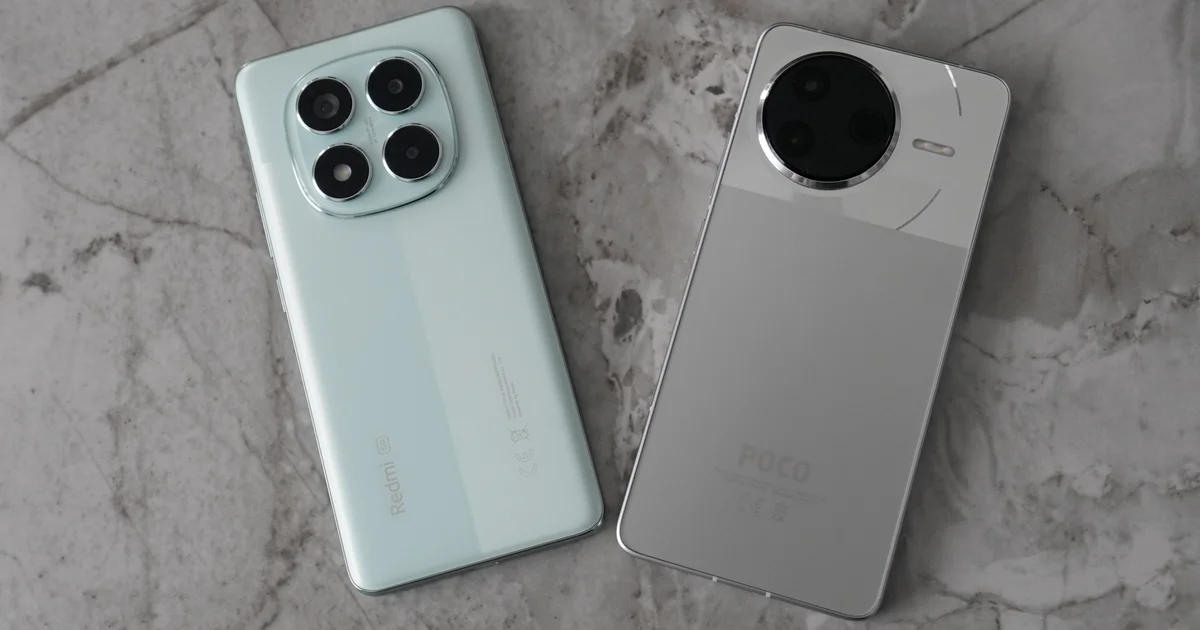
With that in mind, I wanted to take a closer look at two stand-out options from this price bracket: the £299/$370 Xiaomi Redmi Note 14 Pro and the £499/$499 Poco F7 Proy. I’ve tried both in two short reviews below, aiming to judge how they perform and whether they justify the cash you’ll be paying.
Xiaomi Redmi Note 14 Pro review: Is it plastic fantastic?

Purchase:
The Redmi Note 14 Pro makes a strong first impression thanks to its eye-catching teal finish (called Coral Green) on the plastic rear. This two-tone approach also shows up along both the top and bottom edges, giving the phone a more distinctive look. If teal isn’t your style, it’s also available in black or purple.
There are updates compared with last year’s model, including the switch to Gorilla Glass Victus 2 and the addition of a more capable IP68 rating for water and dust resistance—something that was previously limited to the Pro+ version in 2024. Still, moving to IP68 has come with a downside: the headphone jack has been removed.
On the front, you get a 6.67-inch OLED display with 2712×1220 resolution and a 120Hz refresh rate, producing sharp, responsive visuals. It supports Dolby Vision and HDR10+ for compatible content, and the screen edges curve slightly, helping the Redmi Note 14 Pro feel a bit sleeker both in your hand and in your pocket.
This panel is rated for up to 3000 nits at peak brightness, improving on its predecessor. The result is punchier HDR performance and plenty of clarity during sunny work trips around London.
In terms of photography, the Redmi Note 14 Pro doesn’t radically change what we saw last year. You still get a 200MP main camera with a 1/1.4-inch sensor, plus an 8MP ultrawide (¼-inch) and a 2MP macro lens. The selfie camera, however, has been upgraded from 16MP to 20MP, and it now has a wider f/2.2 aperture.
Typical wide-angle shots come out quite well, with plenty of detail and more natural-looking colours. That said, because there’s no dedicated telephoto lens, relying on cropping or heavy zoom can reduce overall quality. If you stick to the main sensor, you’ll likely be happy with what the Redmi Note 14 Pro delivers for its price.
Inside, the Redmi Note 14 Pro runs on a MediaTek Dimensity 7300 Ultra SoC, an upgraded take on the mid-range chip you’ll find in cheaper devices such as the Nothing CMF sub-brand Phone 1. In a round of benchmark tests, the figures don’t stand out, which helps explain how this model compares with more expensive alternatives.
| Benchmark | Xiaomi Redmi Note 14 Pro | Sony Xperia 5 V | OnePlus 12R |
|---|---|---|---|
| Geekbench 6 Single Core | 1038 | 2069 | 2019 |
| Geekbench 6 Multi Core | 2948 | 5585 | 5438 |
| 3D Mark Wild Life Extreme | 850 | 3725 | 3694 |
| GFX Aztec Ruins High Tier | 17fps | 59fps | N/A |
| GFX Car Chase | 23fps | 60fps | N/A |
| PC Mark Work V3.0 | 13292 | 12466 | 14075 |
Even so, benchmarks are only part of the story when it comes to real-world performance. In everyday use, the Redmi Note 14 Pro felt quick and responsive for common tasks—such as jotting notes in Google Docs while I was on the move, and browsing social media and Google Discover for updates.
Once you move beyond routine usage and into heavier workloads, you may notice occasional stutter or slowdowns. When I tried demanding games like Wuthering Waves, I had to lower the settings to keep the frame rate feeling smoother. Lighter titles—such as Mario Kart Tour—were much easier to play, and EAFC Mobile performed well using standard settings, although it benefited from enabling the phone’s gaming mode to improve frame rates.
The Redmi Note 14 Pro also includes a range of gaming tools aimed at improving performance. If you swipe in from the left side while the phone is rotated to landscape during a game, you can view real-time FPS information, and you can decide whether the device should lean toward visual quality or prioritise frame rate. It also supports features like screen recording from the tab view, along with a do-not-disturb mode designed to help you stay focused during play.
The phone runs HyperOS, Xiaomi’s heavily customised version of Android 14. It draws inspiration from Apple’s iOS, in a similar way to Honor’s MagicOS. That influence is especially noticeable in the quick settings panel, which you access by swiping from the right edge of the display—an experience that feels immediately
It delivers an Apple-like experience when it comes to brightness and volume controls. I’ve already spent time with MagicOS, so I’m comfortable with it, but if you’re coming from other Android versions, you may need a little time to settle in.
As an Android offshoot, it’s perfectly reasonable, bringing a number of Google’s newest features, including Circle to Search and the use of Gemini as an assistant. Alongside that, this model includes Xiaomi’s own AI add-ons, which you’ll notice most in the gallery app when editing images—things like object removal and portrait blur with an artificial bokeh look. There are also more advanced options, including background removal, FOV expansion, and AI-assisted automatic video editing.
One thing I dislike about HyperOS is the amount of pre-installed bloatware, including Xiaomi’s MI app store, along with OneDrive, the Opera browser, and the Booking.com app. Honor does this too, and I just wish more manufacturers would keep their Android skins leaner. When it comes to updates, Xiaomi says the Redmi Note 14 Pro 5G will receive three OS upgrades and four years of security patches.
Battery life is generally very strong here. In the PCMark Work V3.0 test run at half brightness, the phone’s 5110mAh battery lasts just a bit over 13 hours during multitasking and everyday use. Charging is also supported at up to 45W, though the box doesn’t include a charger. That 45W rate is lower than the previous model’s 67W, and it’s only a little more than a third of the 120W supported by the higher-end 14 Pro+.
At the £299/$370 price, the Xiaomi Redmi Note 14 Pro 5G is a solid all-round handset. It may not feel like a flagship at this level, but it does well in looks and day-to-day features, and it also delivers decent camera results, strong battery performance, and enough power for casual gaming and multitasking. While I’m not especially keen on HyperOS, a bit of basic maintenance can keep your device running neatly if you’d prefer a cleaner setup.
Poco F7 Pro review: A mid-range smartphone with flagship capabilities
Buy:
The second candidate is the Poco F7 Pro, which pushes its price right up to the edge of the mid-range category at £499/$499. From the moment you pick it up, it feels like you’re getting noticeably more phone for your money. The build pairs a sturdy aluminum frame with a glass rear, giving you a smart silver rectangular slab that’s comfortable to hold. It’s available in black or blue as well—though the standout Poco yellow is notably missing.
The F7 Pro also brings a major improvement to its IP rating. It now offers full IP68 water and dust resistance, a big step up from the F6 Pro’s splashproof level with an IP54 rating. You also get a useful pre-fitted screen protector and a protective case out of the box, which is a thoughtful touch.
On the front, there’s a large 6.67-inch AMOLED display with QHD+ resolution and a 120Hz refresh rate, making everything look smooth, crisp, and sharply defined. Peak brightness reaches up to 1800 nits in high-brightness mode, and it can climb to as high as 3200 nits for HDR content—though, as is common, you may lose a bit of subtle detail and clarity at those levels.
What makes this feel more mid-range than flagship is the dual-camera setup on the F7 Pro. It includes a 50MP main sensor and an 8MP ultrawide lens, with no telephoto option available. The main camera does a good job for everyday shots, producing images with plenty of vibrancy and clarity across different lighting conditions, while also preserving a strong level of fine detail. Portrait photos using the 2x mode deliver natural bokeh around the subject, which I found especially impressive.
The lack of a telephoto lens becomes obvious when you go past 2x, where both detail and overall sharpness drop off. The ultrawide camera also doesn’t quite keep pace with the main sensor; images can often turn out grainy and miss out on finer detail.
In classic F-series fashion, the F7 Pro’s biggest focus is what’s happening under the hood, driven by a Snapdragon 8 Gen 3 chip. Not long ago, it was the most powerful processor you could find in an Android phone, so seeing it in a mid-range device translates into excellent performance for the money. For example, it’s the same chip used in the Honor Magic V3 and Magic 6 Pro.
So it won’t come as a surprise that this phone handles a wide range of activities well, from gaming to more moderate productivity and multitasking. Geekbench 6 results were very close to those of the Magic V3, though the F7 Pro just about edges it out in multi-core performance. It also delivered strong frame rates across the two GFXBench tests, lining up with the cover display performance on the Magic V3 and doing better on the main screen.
| Benchmark | Poco F7 Pro | Honor Magic V3 | Honor Magic 6 Pro |
|---|---|---|---|
| Geekbench 6 Single Core | 2111 | 2214 | 2243 |
| Geekbench 6 Multi Core | 6254 | 5699 | 6813 |
| 3D Mark Wild Life Extreme | 4567 | 4471 | 5191 |
| GFX Aztec Ruins High Tier | 97fps | 46fps | 88fps |
| GFX Car Chase | 118fps | 57fps | 104fps |
| PCMark Work V3.0 | 17147 | 17419 | 15173 |
The F7 Pro is incredibly strong in demanding games like
COD Mobile or Wuthering Waves during testing, while also bringing along the same Game Turbo capabilities found on the Redmi Note 14 Pro. With this, you can swipe in from the left while your phone is in landscape orientation during gameplay to check live FPS stats, though it’s oddly not possible to choose whether you want to lean more toward visual fidelity or smoother frame pacing. The interface also lets you start screen recording on the spot, and you can enable a do-not-disturb setting to stay focused on what you’re playing.
Poco operates as a sub-brand of Xiaomi, so it makes sense that both handsets share the same Android interface. As a result, HyperOS shows up on the F7 Pro and feels very much like the version on the Redmi Note 14 Pro. That means you’ll find a number of iOS-like touches, including the notification panel, along with pre-loaded apps such as the Opera browser, plus system utilities that come with ads and can’t be removed. When it comes to software support, Xiaomi says the Poco F7 Pro is set to get four OS upgrades and six years of security patches.
Battery performance is especially strong here. In the PCMark Work V3.0 test run at 50% brightness, the device’s large 6000mAh battery delivers roughly 20.5 hours of multitasking and everyday use. It also supports fast charging of up to 90W, and the box includes both a charger and cable—an appreciated bonus.
I’m particularly keen on recommending the Poco F7 Pro at its £499/$499 asking price, thanks to its flagship-class performance, outstanding battery endurance, and a polished design that still feels accessible. The camera results are fairly solid, though the HyperOS build of Android doesn’t feel as streamlined as what some rivals offer.
That’s the full picture—an overview of budget-friendly and mid-range Android smartphones for 2025, along with how they’re currently holding up. Overall, the verdict looks unexpectedly upbeat, even if these two choices come with a few small quirks.