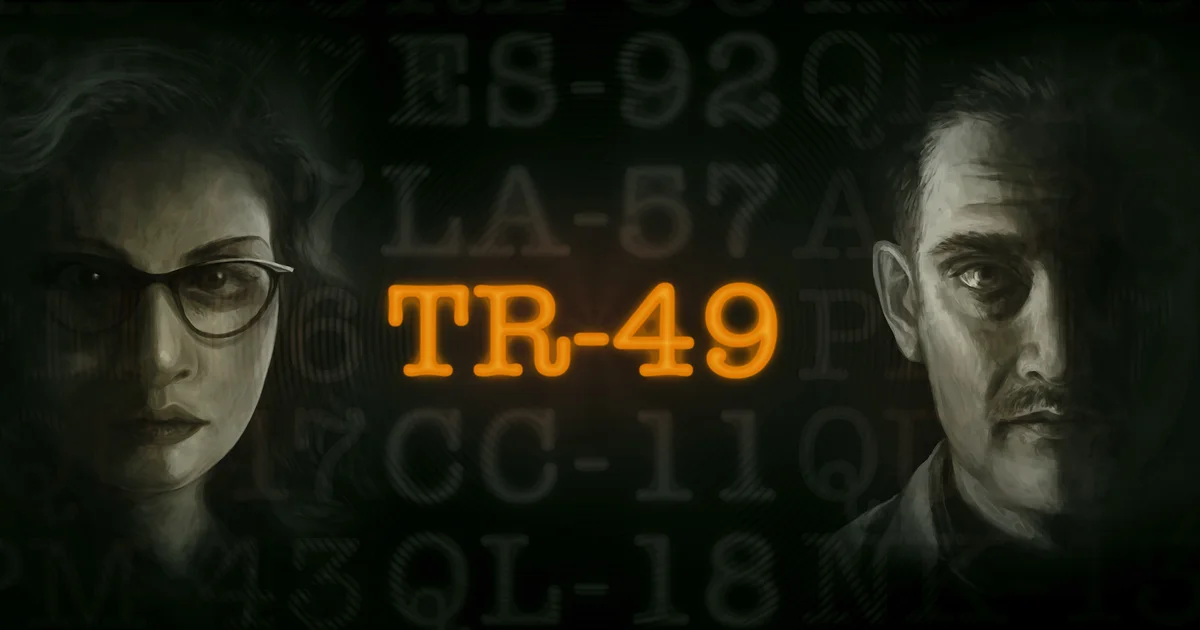
Inkle combines the thrill of digging through archives with audio-led storytelling, crafting a surprisingly resonant narrative about obsession and a machine.
TR-49 lives as much in the player’s mind as it does on the screen, and I consider that a brave choice—because it asks something from us. It’s rooted in our hunger for answers, in that constant need to understand. This experience depends on independent thinking, where you must work things out for yourself, since otherwise the momentum disappears. At times, you may feel like you’re caught in mental loops, but those periods of reflection matter: they create room and time to think things through. To speculate. To sit with questions. To reconsider. All of it is essential to grasp the bleak, shadowed elements that lie behind the mystery hidden within TR-49.
On the gameplay side, TR-49 is built around exploring an archive. You work at a retro-styled computer terminal—when I say retro, I mean genuinely retro, roughly from the 1940s—stemming from the well-known British wartime codebreaking operation, Bletchley Park, if my memory serves. Still, you’re not actually in Bletchley. Instead, you’re placed in a crypt under a church, with the machine in front of you, tangled among cables, wiring, and equipment. A voice comes from the device—an adult male voice—pressing you to power it on and start digging through the archive. It’s an unsettling opener.
Your task is to track down a book—because at its heart, this game is about literature. The strange machine was supplied with books and other written materials to form a database, and you scour it in search of a title that’s vanished from the physical world. In practice, you’ll enter source codes made up of two letters and two numbers, similar to TR-49, the code that gives the game its name. If the code you type matches something stored in the database, you’re pulled into that entry, accompanied by a mechanical whirr and a click as the focus shifts. It feels gratifyingly physical, and I liked how clearly the “feel” of my keyboard keys mirrors the act of operating the machine (note: you can also use a controller or touchscreen).
The codes are something you’ll have to uncover, and that’s where the game shows its nerve: it won’t just hand them to you. In many ways, you’re left in the dark—there’s little explanation beyond the premise. You start with no idea who you are, what’s happening, or how the machine works. Early on, you’re encouraged to stumble around blindly, entering codes at random and hoping something lands, which you often manage to do. The expectation is that, eventually, you’ll trip over something meaningful—an arrangement of names, titles, authors, and other key details. From there, an interconnected structure should begin to emerge, shedding light on a broader story.

That’s a lot of information to hold in your head, but luckily the game takes care of the bookkeeping—no extra notebook required. A journal quietly fills in and organizes entries as you find them, sorting material by author and highlighting the most important points. It can even point out areas you may want to return to. It’s a genuinely useful system for a game like this, though I still struggled a bit at the start.
I spent a couple of hours treating TR-49 like one of those Magic Eye puzzles before it finally clicked for me. I followed the advice I was given—matching sources to titles—but mainly because I was told to. For me, it felt like groping in the dark, waiting for a moment when everything would suddenly make sense. The longer it took, the more my frustration grew, and the more detached I became from my own efforts. TR-49 struck me as cold and distant, always a step out of reach. I had to push myself to stay engaged. I’m bringing this up because you could feel something similar while playing, and it’s also part of the risk the game takes—provoking those kinds of reactions to fuel what comes next.
Wandering through an archive might sound slow or tiresome, but it only feels that way depending on what you’re reading. Here, the material centers on interests in the mysterious nature and promise of dark matter energy. That subject isn’t dull, and neither are the people writing about it: it’s a collection of eccentric voices from the early 20th Century, with ideas that brush up against the occult—people discussing dream exploration, and the unravelling of the mind. Their accounts come across as odd, vivid narratives. They’re woven into archive pages that, in our real world, would belong to books—granting these fictional authors a sense of credibility and making the claims feel that much more thrilling. A strand of science fiction runs through it, but it’s the kind that doesn’t feel far from magic, where almost anything starts to seem possible. Through the machine, it can feel like you’re pursuing ideas with real, groundbreaking potential.
That said, the real backbone of TR-49 is the people who built the machine. As you sift through the entries they wrote, you gradually uncover their lives—because everything inside the device was entered by someone, meaning every piece of it carries a perspective, a feeling, and the reactions they left in response to other entries. Many voices appear throughout the archive, surfacing again and again, sometimes separated by years. It’s through these voices that the game’s deeper story comes into view: moving and personal, with unexpected twists and turns, injecting the kind of individuality that makes both the game and the archive feel alive. The final puzzle—what you’ll ultimately untangle—is their greatest dilemma.
It’s genuinely impressive how much TR-49 includes, if I’m being honest. At first glance, you might not expect much. Beyond the crypt setting and the archive pages, there’s not an endless amount to look at; and while the spoken audio injects urgency and momentum, along with a feeling of a larger world, it can only carry you so far. Long stretches of silence pass, broken only by the occasional line and a haunting cello lingering in the background. The heart of TR-49 really is in the archive pages, and it speaks to Inkle’s storytelling skill that it can draw out something this deep from them. There’s also something striking about how your role as a player—your interactions and choices—mirrors the sweeping ideas discussed across the archive entries. A lot from this game will stay with me, and it’s admirable how much it manages to evoke from such limited resources—truly admirable.
To be clear, though, that doesn’t mean TR-49 always landed with me. As I noted, I ran into tough patches at the beginning and again near the end, when I searched for clues again and again but didn’t find any—leading to significant frustration. Going back and forth between the journal and the archive page too often wasn’t especially enjoyable. And when I strayed from what the game seemed to want me to do, my enjoyment dropped, too. Whether that says more about my own approach or about the game itself isn’t entirely clear. I suspect it’s on me; with the answers in hand, the clues become obvious. They really are there. Still, I can’t change the fact that I had a bumpy experience that I didn’t always find fun.
Even so, during those rough moments I respected TR-49 for staying composed and for pushing me, the player, to do the work. By requiring my attention, it made me more invested—and it left a stronger impression for it. It was—and I really mean it—I’ll stop saying this now, a bold creative gamble. Whether you’ll enjoy TR-49 the way I did may come down to how patient you are with puzzle-solving, but if that sounds like your kind of challenge, there’s a deep enigma inside this machine that won’t slip away easily.