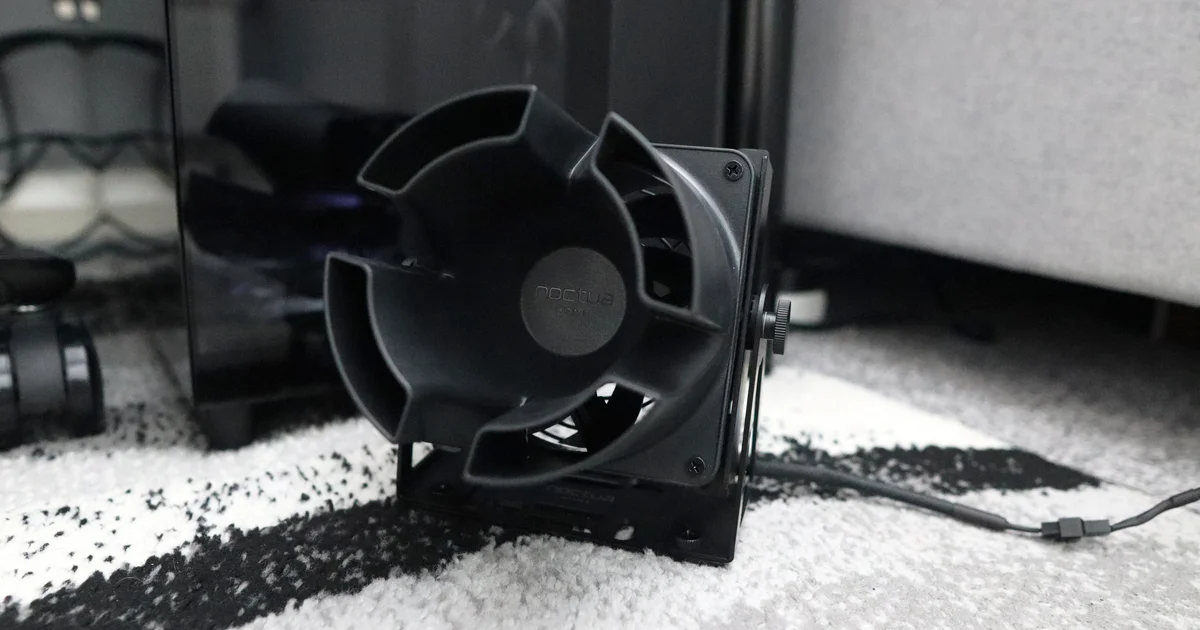
Just because a business shines in one specialty, it doesn’t automatically mean it can switch tracks and deliver the same level of triumph in a completely new area—right? Noctua may be among the rare exceptions. The Austrian brand has taken one of its well-regarded, high-performance PC fans and turned it into a surprisingly capable desk fan, after years of waiting and plenty of talk.
This straightforward desk fan was first mentioned six years ago during Computex, where it quickly became a topic of conversation. Attendees were drawn to it precisely because it was so unusual. When the expected release window of late 2021 arrived and passed, fans began producing their own concepts—3D-printing versions and slotting Noctua fans into desk-friendly housings to imagine how the product might look if it ever came to market. After all, if Noctua fans are praised for running quietly while still delivering strong performance in PCs, wouldn’t the average user benefit in a similar way?
Jump ahead to May 2024, and Noctua finally unveiled its Home range. The lineup includes several cooling-focused accessories: hubs, adapters, and two fan variations. One option is designed to cool electronics, from gaming consoles to AV receivers. The other is built for cooling people—and that’s the model we’re looking at here.

With all that build-up, does the finished product live up to expectations? In short: mostly, though it really depends on what you’re trying to do. While it’s small, Noctua suggests it can cool an entire room, but that doesn’t fully match what it delivers. Instead, think of it as a personal desk fan that you can run even at higher settings without annoying everyone nearby. In my experience, it’s among the quietest desk fans I’ve used, continuing Noctua’s reputation for producing near-silent case fans and CPU coolers.
In reality, the NV-FS1 is essentially a PC case fan: a 120mm Noctua NF-A12-x25 mounted inside a metal frame, with front fins that help channel airflow. It also keeps the kind of industrial charm Noctua is known for. The front uses plastic, while the rear relies on a solid metal base to hold the fan securely. The metal stand feels notably sturdy, and the dense plastics offer a satisfying texture. With the stand, you can tilt and swivel the fan to almost 180 degrees, with only minor limitations caused by the cable running from the back.
The included cable arrangement is distinctive. Although the idea initially sounded like a USB-powered fan, the finished version uses mains power. That choice enables higher RPMs and, as a result, stronger airflow. You get a full selection of regional power adapters, along with a power supply, fan cables, and a PWM controller that includes a dial to control the fan speed. Having everything in one box is convenient, though the controller being placed far down the cable may be awkward depending on how you set it up. Oddly enough, the wiring feels reminiscent of a PC setup, which means the connectors are slimmer than you’d usually see on a conventional desk fan.
Because the NV-FS1 is sold as a complete kit and arrives already assembled, there’s nothing stopping you from swapping in a bigger fan if you want additional airflow. Noctua notes that the kit supports both 120mm and 140mm fans. That means you could potentially fit the larger 140mm fan from the NH-D15 cooler to push even more air. You can also purchase parts separately to build extra desk fans, handle repairs, or convert it to run on 5V USB power. Beyond the sheer novelty of its existence, it’s refreshing to see the Austrian company embracing the kind of customization and flexibility you’d expect from its PC roots.
Unfortunately, the NV-FS1 isn’t anywhere near the most budget-friendly desk fan in its category. It costs £86/$99, which is pretty steep for a typical desk fan. This stands out even more when you can 3D print your own official casing for a small fraction of the price, assuming you have access to a 3D printer. Meaco also has stronger—sometimes even wireless—options starting around £35. One personal favorite is the Meaco 260c, which blends the benefits of a compact pedestal fan with a built-in nightlight and adjustable speed settings. Still, it doesn’t capture half the appeal of the NV-FS1.
There’s just something about the idea and execution behind a Noctua desk fan that I genuinely appreciate. This is the kind of product the community wanted, and Noctua delivered it. When a company answers real customer needs—especially the more quirky ones—it softens the usual sense of corporate detachment and profit-first thinking. Noctua makes for an excellent example of a brand that not only produces standout products, but also pays attention to the people who actually buy them and use them day to day. Without that, a brand is just a label. The NV-FS1 isn’t perfect, not by a long shot, but the fact that it exists is still something that makes me happy.