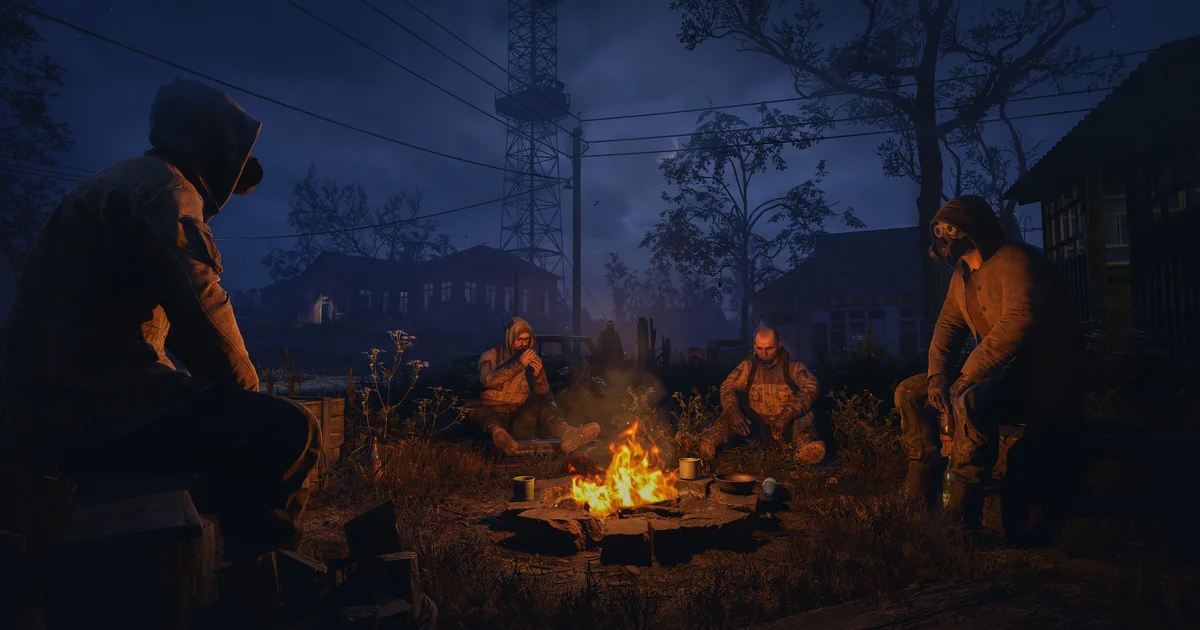
It’s hard not to argue that Stalker 2: Heart of Chornobyl has gone through the most chaotic production process of any game ever made. In the last four years, developer GSC Game World has had to steer through a global pandemic, a continuing conflict affecting its home country of Ukraine, repeated cyberattacks, leaked builds, and even a fire that badly damaged the server area in its Prague headquarters.
Still, Stalker 2 was already facing major obstacles before Covid-19 ever arrived. First unveiled in 2010, the sequel was originally scheduled to launch two years later, but the plan slowly unraveled amid circumstances that remain disputed, and that collapse ultimately led to GSC Game World shutting down. In 2014, the company was brought back to life, starting with a return to the Cossacks franchise. Four years afterward, Stalker 2 was announced again, produced by a mostly new crew, since the studio’s founder, Sergiy Grygorovych, had stepped away from game development for the most part.
This background matters if you want to understand how Stalker 2 ended up where it is today. It also begs a natural set of questions: What sort of game has actually emerged from all this upheaval? How closely does this Stalker 2 connect to the original idea from fourteen years ago? Does it deliver on the series’ long-standing ambition to provide a truly open-world survival shooter? And, given that the genre may have already reached its high point, what role—if any—can Stalker 2 still play in that open-world space?
I’ll start by addressing the first of those questions with Ievgen Grygorovych, the CEO of GSC, the game director for Stalker 2, and Sergiy’s brother. “We didn’t bring over anything from the first attempt,” he says, while also clarifying that one element behind why development of Stalker 2 stalled was directly tied to Sergiy stepping away. In Grygorovych’s words, the original studio head found the act of building games “exhausting,” and then chose to chase other interests. “The bar changed, and we couldn’t reuse what we had built before.” Grygorovych adds that this applies well beyond tools and technology—down to the story itself. “Even the narrative of the original Stalker 2 got dropped,” he explains. “We rebuilt it from scratch, drawing from the lore of Stalker 1.”

I’ll handle the second question myself. Last week, I spent three hours with Stalker 2, playing through its first two chapters at GSC’s Prague office. Based on what I saw, Stalker 2 looks like exactly what GSC set out to deliver: a survival shooter within a unified open world, one that feels as strange and uncompromising as the Zone shown in the original trilogy.
As for the last question, that one calls for a more thorough answer.
The opening of Stalker 2 echoes 2007’s Shadow of Chernobyl, with your character carried through the Exclusion Zone on the back of a flatbed truck. Unlike the original, you’re not a nameless, easily forgotten stalker. You play as Skif, a young stalker who has teamed up with a scientist named Hermann to run a private experiment in the Zone, using a very rare artifact. While neither character’s background is explored in great depth, it’s still evident that Skif is chasing the payout he expects from this job—and that he either comes back with results or doesn’t come back at all.
This opening chapter (which also doubles as the tutorial) is a clear, brisk introduction to the Zone’s hazards and horrors. To secure the gear he needs, Skif heads into a radioactive bunker packed with dead scientists. After that, he faces a group of thieves, works through a chain of anomalies, and encounters a damaged boat that’s being hunted by something called a Poltergeist—something I narrowly managed to get away from.
From Stalker 2’s first chapter, I took away two main impressions. First, it’s a far more polished and refined experience than any of the earlier Stalker games. From the strikingly atmospheric approach to environment design to the more grounded and tactile feel of the combat, it clearly surpasses what GSC has made before. Second, as the opening unfolds
compared to earlier Stalker entries, the Zone itself has managed to keep only a sliver of its former allure and sense of mystery.
of its hostility. I died twice during this opening stretch—first when a bandit circled me in the middle of a fight, and again when a dangerous anomaly in a cave caught me after I couldn’t dig up a valuable artifact hidden somewhere inside.
Unsurprisingly, things don’t play out the way Skif expects. Before he’s even close to devouring the threat, another Stalker strips him of all his gear, and then he’s nearly torn apart by mutant dogs. Only then does the Zone really begin to open up, giving you the choice to roam and investigate at your own speed.
It genuinely feels like you can head wherever you want. Climb a water tower—or any other higher point—and you’ll look out over the Zone’s rust-colored terrain stretching to the horizon, with the red-and-white smokestack of the Chernobyl NPP barely visible far off. Stalker 2 is set in the same area as the original, which is part of why it’s described as a direct sequel. “We included a lot of locations from the first game [but] we had to adjust them for an open world,” Grygorovych explains. That, apparently, turned into one of the biggest hurdles for the sequel’s development. “It required a lot of passes through level design and gameplay systems; we didn’t anticipate how many revisions we’d need,” he adds. “It’s rewarding to solve challenges you’ve never faced before.”
Back in the Zone, I make my way toward a cluster of houses built on a hillside, where I find a group of bandits holding a Stalker prisoner inside one of the buildings. I could ignore them, but I decide to step in—sneaking up on the three bandits and taking them down quickly with my pistol. The captive, a Stalker named Zhorik, shares the location of a nearby cache of supplies. Still, he asks me to help with another rescue: Gloomy, another Stalker, has also been captured by the same group.
I agree and move to the redbrick building complex where Gloomy is supposedly being held, which becomes my first real firefight. While the fighting feels tighter than in earlier releases, it still clearly carries the soul of Stalker. Some details are especially striking. For example, when you aim down your weapon’s sights, you can follow your bullets as they travel through the air, making it easier to adjust your aim at longer ranges. And while human foes can be oddly hard to put down, aiming for the head almost always leads to instant death.
Even so, what truly sets Stalker’s combat apart is the blend of smart positioning, tense peeks around corners, and the frantic surges of movement. I rush the complex with a low-quality submachine gun, but it stalls after just two shots. I sprint to cover to clear the jam, but the bandits drive me back with a grenade. I eventually find another hiding spot behind a tree, though not before taking several hits to the torso—forcing me to wrap up and bandage myself. It’s rough, gritty, and thrilling. Even if the AI can be uneven, sometimes it charges in a way that gives itself away, yet overall it’s usually able to outthink you.
After getting Gloomy out—who doesn’t exactly show a lot of appreciation—I turn to the main goal, which takes me to a settlement split between different sides. One group is made up of experienced Stalkers, unofficially represented by a figure called the Gaffer. The other side is a paramilitary organization led by General Zotov. Both factions want my help finding a Stalker named Squint, who’s accused of killing one of Zotov’s men. Of course, they all have their own reasons for pushing for his capture, along with their own ideas about where to look.
As I walk through the village and prepare to hunt for Squint, it becomes clear that Stalker 2 leans strongly toward delivering its story. This information comes through detailed conversations with branching dialogue options and full voice acting. Grygorovych says this was a major priority during the sequel’s development. “We wanted to build a story-driven game with meaningful narrative content,” he notes. “It’s definitely not a Baldur’s Gate, but you’ll still get plenty of dialogue lines, multiple paths, and even within a single conversation, you often have several choices.” He explains the purpose is to deepen the role-playing side of being a Stalker in the Zone. “I wanted players to feel like they’re truly inside the Zone—and that they can role-play as themselves,” he adds. “You can choose different dialogue routes in the same situation and end up with very different emotions.”
Grygorovych is right that Stalker 2 isn’t Baldur’s Gate—at least in the English version, the writing doesn’t match that same level of tonal depth (Stalker 2 is a game you may want to consider playing in Ukrainian for a more genuinely authentic experience). That said, the English voice work is a clear step up from the original trilogy, and in my view it’s even better than the localization work 4A Games handled for Metro: Exodus.
Still, even though Stalker 2’s stronger narrative focus comes as a surprise, this franchise has always benefited from its underlying systems—especially how the Zone and its residents respond to you and to each other. During my short time in the Zone, I kept running into these mechanics in action. For instance, while I was creeping along the edge of a compound, a mutant suddenly lunged at me from the side, triggering a fire anomaly right before it reached me. It then bolted, squealing, back into the Zone. I also saw bandits fight mutants, NPC Stalkers confront bandits, and even a Stalker I’d just helped during a quest jump into a skirmish as he headed back toward the village.
While I cannot assess Stalker
Throughout that section—at least for the stretch I played—it felt strikingly lively, brimming with fresh, unfolding opportunities. That kind of flexibility isn’t reserved for the open world alone; it’s also built into quests and the broader campaign structure. When I wanted to find Squint, for instance, I could follow a couple of side objectives the game lays out, or I could simply do what I did: just… track him down. A nearby point of interest caught my attention, so I went to investigate it (and I’ll hold off on naming the spot…
so I don’t spoil the moment), and it happened to be exactly where Squint had been concealing himself. From there, the plot smoothly picked up, moving you into the next step of the mission—where you may choose to take Squint out under General Zotov’s orders, or help him escape the Zone by collecting an artefact from a nearby anomaly.
This responsiveness is part of what GSC wants to use to set Stalker 2 apart from other open-world releases. As Grygorovych puts it, “Many games give you a lot of freedom to move, letting you roam around and discover things, but they usually don’t offer much meaningful branching in terms of what happens next in your story.” He adds, “When we shape the kind of experience we want players to have, we don’t borrow cues from how it was handled in this game, or [that] open-world title. We understand from the start that we’re making something fundamentally different.”
The surprises didn’t stop there, either. I decided to support Squint by grabbing the artefact, then pushed into a cave network for a tense confrontation with a bloodsucker—a tentacled mutant capable of slipping into invisibility. After I managed to defeat it and obtain the artefact, though, I got a “mission failed” notice. Pardon me, Stalker 2, but shouldn’t that be “mission accomplished”? It didn’t take long to see the game was right: when I returned to Squint’s hideout, I discovered he was dead.
I’m still unsure what actually happened—whether a mutant or a bandit showed up and killed him, whether Squint accidentally set off one of the many traps he’d laid down to prevent an ambush, or whether this was simply a familiar kind of bug. I asked the developer responsible for the session whether this was intentional, and he only shrugged, noting that Squint wasn’t a particularly vital character. That explanation seems to check out. Even after “failing” to help Squint, the story continued without interruption, and I was still able to sell the artefact I’d found for a solid payout.
While Grygorovych’s comparison of the narrative to Baldur’s Gate 3 might be a stretch, the two games do overlap in another area. Just as Larian’s title draws from the systemic role-playing foundations of Ultima and reframes them for a modern audience, Stalker 2 leans into a variety of more or less forgotten ideas tied to open-world design. In a period when many releases rely on carefully tailored experiences like God of War: Ragnarök, the flexibility and adaptability of Stalker’s 2 irradiated sandbox stands out as both refreshing and genuinely engaging. And if it keeps refining and growing that approach across its entire exclusion Zone, GSC Game World may have something truly special on its hands.