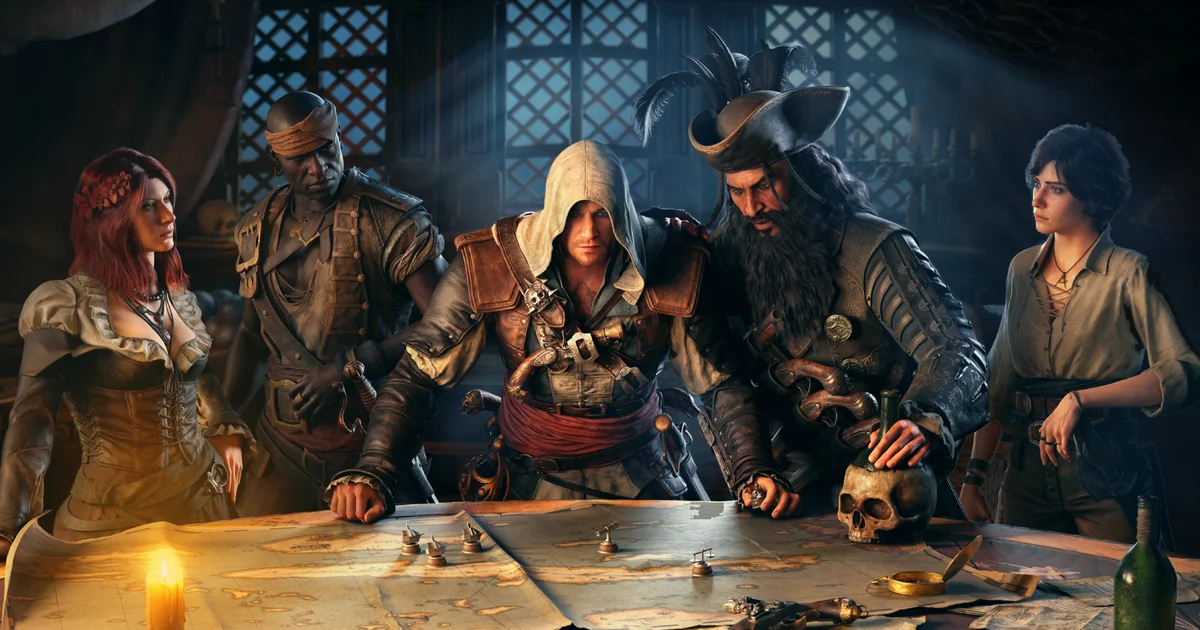
“I’m looking for meals that won’t upset my stomach, and for walls that can actually stand up to the wind. I want a full, satisfying life.” Edward Kenway’s slide into piracy isn’t driven by daydreams of enormous wealth or a craving for fame. What he wants is simple: to live comfortably, without sinking into poverty. The Welsh privateer who later becomes a pirate never set out to be pulled into a storyline tying Assassin buccaneers to the Templar navy—he just gets swept up in events. Still, because he’s a natural survivor, a sharp opportunist, and a restless drifter, life at sea turns out to suit him unusually well. In 2026, this tale feels just as refreshingly straightforward as it did back in 2013.
That’s exactly why I’ve developed so much patience for Black Flag Resynched. You could say that updating a game from only 13 years ago feels unnecessary—especially since Assassin’s Creed 4: Black Flag still plays fairly well, and you can currently jump into the series’ sixth entry on modern consoles through Ubisoft + without much trouble. Still, the truth is that the title has started to show its age. The open world looks great, but it’s a touch deceptive. Atolls and islands invite you to explore, yet they hide little beyond a single treasure chest, surrounded by stretches of emptiness. Missions hint at threads and then drop them, frequently ending earlier than you’d expect, without delivering a satisfying conclusion. Kenway’s chaotic pirate persona has always felt a bit mismatched with his strangely Assassin-like fighting style, and every time a fight broke out, that disconnect was noticeable.
Ubisoft clearly wanted a lot from Black Flag—wants that its two-and-a-half-year development cycle couldn’t really support. When Ubisoft revisits it, Ubisoft Singapore is trying to tick off some commitments that have been hanging around for years. Resynched keeps the original’s world layout and narrative structure, but it rebuilds the settings and character models. It also polishes parkour and combat systems, bringing them more in line with the wider narrative universe instead of feeling like “just another Assassin’s Creed release.” On top of that, it uses more than 13 years’ worth of water-based and simulation know-how, so the ocean comes across as a living force rather than mere backdrop.
Of course, there’s always a catch. I’ve been told the team “developed from the ground up using the latest version of the Anvil engine,” the same tech used for the stunning Assassins’ Creed Shadows. I expected Resynched to essentially be Assassin’s Creed Shadows wearing a Black Flag outfit—but it isn’t. Some textures may feel slightly off, and you may notice occasional pop-ins or blur as cutscenes shift into gameplay. There are also oddities in the physics that I can’t fully put into words. For example, when you use a rope dart (basically Scorpion’s get over here moment from Mortal Kombat), it sometimes whips an unsuspecting British naval officer off a ship and into the water. As fun as that can be, there are times when officers appear to float in mid-air for a moment, drop for no obvious reason, and then bounce back to their positions like nothing happened. Even the camera can behave oddly—such as starting to pan away from you during a tense stealth crawl through tall grass as you try to slip up on a plantation house to steal a key from some well-off swindler.
Even so, I’m oddly taken with the game’s flaws: the occasionally strange physics, the unpredictable and glitchy camera… maybe my affection for the original explains some of that, but for Kenway it mostly works. He’s a messy sort of guy, a loud brawler, an anti-hero. In a way, we’re playing (if you dare to go way back) inside a simulation that’s already inside another simulation. If I wanted to be cheeky, I could argue these glitches are simply “Animus quirks,” or that Ubisoft intentionally baked them into a four-dimensional meta-story—something along those lines.

Black Flag looks gorgeous, yet you can still see a bit of wear along the edges of the Animus.
But neither you nor I are that easily fooled. We can tell what’s really going on here: a modern engine wrestling with the limitations and quirks of a 13-year-old release. Resynched is vastly different from Shadows. In Ubisoft’s own words, “there are no levels, no gear scores, and no progression barriers.” Combat wasn’t built around health calculations and modifiers. So, even with it being squeezed into the Shadows engine, combat unfortunately comes off as rough. At the same time, it has a rough texture that reminds me of more chaotic action-adventure games from the 360 era—something in the neighborhood of the Arkham Asylum/Brutal Legend/Prototype range. You grab an opponent, shoot or stab them, and push forward. Parries are far too dominant, and you can’t use your hidden blade in combat because you’re not really an Assassin. Fair enough! Instead, you’re given a set of improvised pirate tools, each one seemingly with only a small chance of overwhelming the game’s physics. Yes! Chaos! It really does bring you back to 2013 (in a good way).
Many Assassin’s Creed games carry a certain seriousness that I genuinely find charming, but Black Flag has always been the odd one out. You don’t truly get to play as an Assassin, you spend more time sailing than climbing walls, and your lead character is a cheeky rogue who cares more about enjoying himself than about “Apples of Eden” or “The Observatory.” The occasionally uneven visuals, the engine behavior, and the combat system in Resynched match that vibe perfectly. It’s almost like you’re seeing the game through a rum haze—at Kenway’s expense, of course. I didn’t even mind that, midway through a pretty crucial narrative moment involving the famous female pirate Anne Bonny, everything suddenly slipped underwater as the ocean bugged out around and over the ship. Big problems like that might indeed get fixed by launch, but it seems like there’s still a lot of
engine-related oddities that feel pretty rooted to me.
Is Black Flag Resynced as contentious a remake as a title like The Last of Us? I don’t think so. What’s at work here is different. There’s plenty of new substance in the Caribbean setting, more richness to the Golden Age of Piracy, and stronger player control plus a touch of fantasy that helps you fully step into the experience. And sure, even if the rough seas sometimes haul you away in the middle of a cutscene, it happens. What if the lock-on…
either feels overly stubborn or swings too far off during combat? For all its quirks, the game carries a charming kind of clumsiness that fits Kenway—and his awkward, half-grin.
It’s almost like Ubisoft tried to squeeze the older template from 2013’s Black Flag into a snugly fitted pirate costume for 2026—trying to revive the original spirit before handing it to us for entertainment. In a way, that’s a little unsettling, yet I can’t deny I’m curious about what it might mean. With all the added refinements, Resynced also highlights several odd development ideas that showed up in those borderline seventh- and eighth-generation console releases. The core “go here, do this” open-world formula that Ubisoft was mocked for a decade ago now comes across as pleasantly familiar—probably because there’s genuinely more to do on the map, and each island isn’t just a procedurally generated copy pretending to be something worth your attention.
That’s why this remake earns its confidence the more you spend time with it. As the layers of detail come into focus the further you push, I’m willing to overlook the occasional graphical weirdness and engine quirks that pop up. I went into Black Flag Resynced with doubts, but left genuinely taken by Ubisoft’s clear understanding of what keeps this entry among the more enduring chapters in the Assassin’s Creed series. If this is the direction Ubisoft plans to follow as it revisits the rest of the AC lineup, then—much like an unsuspecting Welshman edging toward involvement in a worldwide conspiracy—I’m staying cautiously interested. Still, after seeing the blowback tied to those infamous Unity glitches, I have a feeling I may be in a small minority. I can’t help wondering how many of these concerns can be addressed before the game arrives in early July.