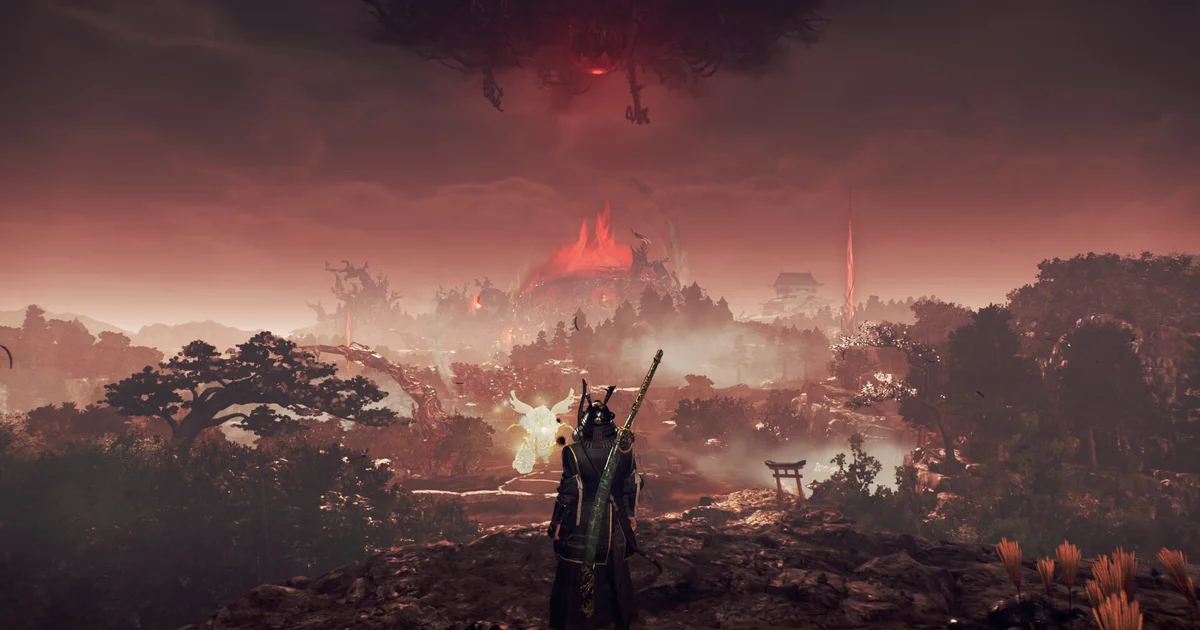
For Team Ninja and Koei Tecmo, creativity is what fuels progress, and Nioh 3 once again refines its established formula—pushing an already outstanding “masocore” franchise to heights it’s never reached before.
The Nioh series isn’t exactly known for subtlety: it draws a clear line between good and evil, the powerful and the weak, and leaves very little space for anything in between. From feuding clans to the maneuvers of political insiders, this contrast sits at the center of Team Ninja’s pseudo-historical storytelling. Nioh 3 leans into that sharp outlook, casting it against the rival Tokugawa brothers at the start of the Seventeenth Century. You play Takechiyo, who represents goodness—honorable, righteous, upright. Your sibling, meanwhile, is a bitter little rat pulled toward ancient forces that are, naturally, beyond his understanding—making him the embodiment of evil. His hunger for authority and renown is so intense that it has somehow called up a supernatural “crucible” from the deepest layers of space-time, and the resulting chaos is so vast it breaches four major chapters of Japanese history. Uh oh!
And so the Nioh 3 story kicks off. Somehow, as the most unlikely descendant of Tokugawa Ieyasu, you’re pulled through multiple periods of Japanese history. Your job—no, your destiny!—is to wedge yourself into the tangled politics of the shogunate and undo the harmful influence your brother unleashes across the Heian period, the Bakumatsu period, antiquity, and more. Even by Nioh standards, this is ridiculous. Still, that’s exactly what makes it work, I think.
This “time traveler” premise is particularly useful for Team Ninja. After two prior entries focused on the biggest upheavals of the Sengoku era, it gives the studio freedom to step outside its familiar timeline and highlight other sides of Japanese culture—mixing history with legend while also adding more background to the “spirit stone” MacGuffin that anchors Nioh’s dense lore.
That said, I don’t think this setup meaningfully strengthens Nioh’s narrative. Most of the plot is still delivered through over-the-top cutscenes that only really click if you’re paying very close attention, alongside short animated moments that clarify character motivations and major turning points. The storytelling leans heavily on shouting, repeated deaths, and constant pressure for the main character to push onward, while other characters handle problems back here. It may be a bit out of step with the era it’s portraying, but that isn’t why most people return to Nioh, is it?
For my part, what hooks me is the combat and the inventory system. And yes, really—Nioh’s build customization has always been one of the series’ signatures. The earlier games were a real treat for anyone who loves loot, and Nioh 3 raises the bar. This time you can explore two full character setups: samurai and ninja. Previously you had to commit to one or the other, which meant fast weapons like kusarigama or dual swords had to share the same build as heavier, more forceful options such as naginata or odachi.

In Nioh 3, switching between ninja and samurai is quick and seamless. That gives you access to two complete, separate builds with a simple press of R2. It follows that your ninja—built around dodging without draining stamina and setting up back attacks with impressive ease—will lean toward rapid, stamina-consuming techniques, while your samurai focuses on landing heavy damage through slower, more ki-demanding strikes. Other arrangements may work too, but that general logic carried me through about 60 hours of Nioh 3 with only two or three genuinely memorable bumps along the way (so, yes, it’s simpler than the previous two games).
Still, doubling your loadouts means doubling your time in the menus. The longest stretch I spent staring at stats, armor set bonuses, and the tiny differences between buffs that change by just 0.1 percent was around 28 minutes in a single sitting. I can practically see a few of your eyes drifting off already—sorry about that. But there are also plenty of people watching their screens right now, nodding and saying “yes, yes,” because, like me, they’re a little unwell and take comfort in this sort of Spreadsheet Simulator chaos.
Thanks to the strong level scaling in Nioh 3, even small stat improvements actually matter. Swapping to new gear every five levels or so is baked into the main experience. Team Ninja also makes it much less of a grind by letting you auto-sort your lower-level equipment whenever you pray at a shrine—reducing the most time-wasting chores and handing you level-up materials almost as a bonus. You can even auto-equip the best items from your inventory, which can be adjusted by weight category or set bonus, so you’re less likely to accidentally fat-roll into combat the next time you step into an encounter area, even when a tengu is waiting.
Once you’re properly kitted out, it’s time to steel yourself and call on a little kiri-sute gomen (or: right to strike). Nioh 3’s large areas take cues from Elden Ring in a way: yes, there’s one clear marker for reaching the next point in the story, but it’s complemented by a solid selection of side quests that feel worthwhile without becoming overwhelming. Clear out bases, hunt down dangerous foes, chase cats around, send weasels out of the sky, take on secret boss fights, and try to keep your footing while the pulsing, towering Crucible hovers overhead at all times… This isn’t Far Cry or Assassin’s Creed. Team Ninja calls Nioh 3 “open field,” not “open world,” and I agree with the approach—the scale and layout of the maps feel just right. I only felt a little worn out with one of the four big zones, and that happened because I had over-leveled myself by repeatedly completing an optional mission to obtain gear tailored for an odachi-focused build, which carried my samurai through much of the experience.
As you’d expect from the series, the combat is as outstanding as anything you’ll find in this genre. Nioh 3 hits the top tier. I was initially unsure about how ninja and samurai differ (“I want high poses for all weapons,” I grumbled after…)