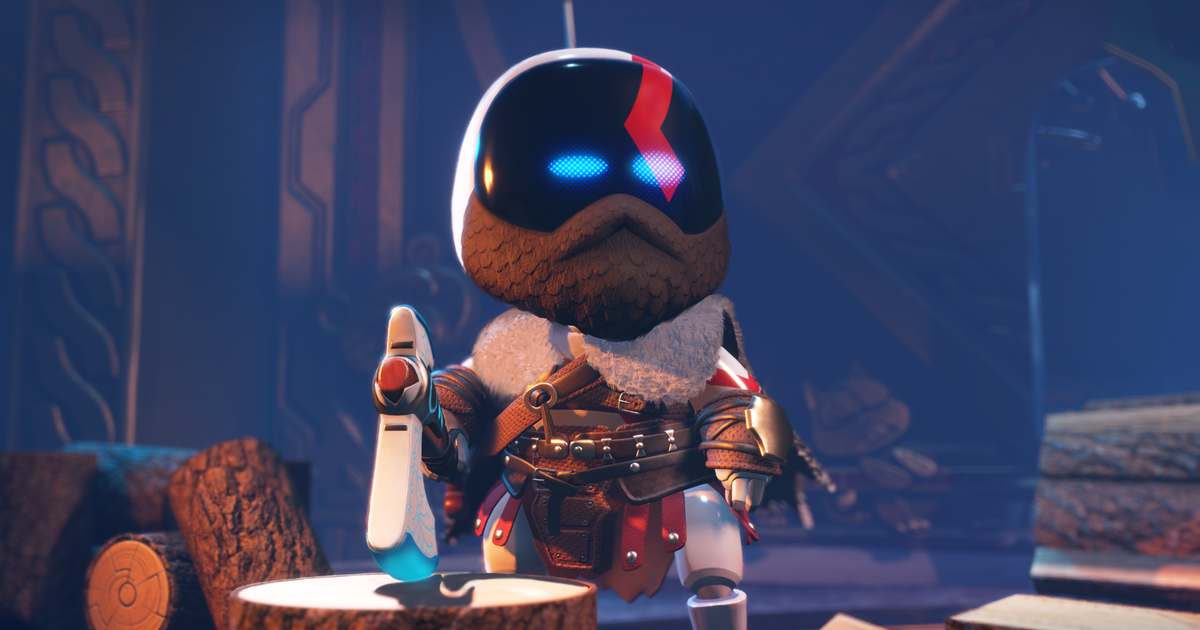
Very few titles managed to generate as much excitement during their Summer Game Fest showcase as Astro Bot, the latest project from Team Asobi. This is the studio behind Astro’s Playroom and Astro Bot: Rescue Mission. In my time with Astro Bot—roughly thirty minutes—I came extremely close to finishing almost all of the playable demo. I say “almost” because, although the main quests drawn from its galaxy-themed menu are fun for the whole family, a few extra bonus missions hidden in the background are far more demanding, delivering a level of difficulty that can stand up to some of the classic PlayStation platformers (yes, I’m looking at you, Crash Bandicoot).
“This particular level,” explains Nicolas Doucet, the founder of Asobi and creative director of Astro Bot, as he guides me through an early area themed around flamingos, “is designed to feel enjoyable for everyone—but for a very, very young child, we wanted it to work like a playground. It might even become the only experience they choose to engage with.”
He adds, “At the same time, we have to think about the game’s difficulty curve and the overall pressure of the experience. That’s why, aside from the main path that takes you to the boss, we also add these additional challenges—and that’s precisely where a lot of PlayStation characters show up.” One example is Bloodborne’s Lady Maria. Doucet told me there was “no hidden significance,” even though many players have speculated it could point toward a long-rumored Bloodborne follow-up, remaster, or PC release.
Picking up on the playground idea, Doucet goes on to explain that it reflects the careful, systems-first approach Team Asobi is becoming known for. Every stage is packed with small objects, bits of set dressing, and environmental details that exist mainly to invite experimentation. In that first level alone, flower petals spin through shallow water pools, a playful rodent-like creature pops up and then disappears when you get too close, and a diving board launches you high above a broad pool—one that hides even more surprises for players who want to fully see everything the stage has to offer.
“When you build games that center on gameplay, it’s almost like every interaction becomes a little ‘toy loop,’” Doucet says. “And ideally, it’s the kind of loop where—briefly, at least—you can pull players away from the main objective, getting them to chase butterflies or smack trees and flowers just because the moment-to-moment play feels good.”
Doucet describes the mindset as a form of “toy culture,” something he traces back to Astro’s Playroom. That PS5 included title put a spotlight on the physical feel of PlayStation hardware over the years, but the idea also connects to his earlier work in quality assurance on Lego games and later with the EyeToy at PlayStation’s now-closed London Studio. “When I came to PlayStation, I thought I’d be joining a very different kind of organization,” he recalls, adding that the lessons from working on Lego games “translated” well. “It was a very similar audience—we’re trying to make games for people who might never have played one before.”

It’s hard not—and completely fair—to compare Astro Bot to Nintendo games, especially the company’s 3D platformers such as Super Mario Odyssey and more. Still, beyond the surface-level parallels—third-person mascot platforming, jumping on enemies, grabbing coins, and, in this case, special abilities unlocked as you progress through each level—there’s a deeper connection worth pointing out. One key element is the emphasis on “toy-like” play, which also mirrors how Nintendo is often celebrated as much for its “toy making” as for its game development or manufacturing. Plus, you can see something unmistakably Nintendo-esque not only in the way Team Asobi develops, but in the philosophy behind its choices.
Nintendo offered a useful window into how it works through two GDC talks earlier this year. One covered the remarkable physics of The Legend of Zelda: Tears of the Kingdom, while the other examined concept generation for Super Mario Bros. Wonder. Taken together, the message is clear: it’s not just about Nintendo’s broad approach to making games, but the specific practices too—like dividing the team into smaller prototype groups, pairing engineers and artists with representation from each discipline, or collecting ideas using post-it notes from different parts of the group.
Doucet attended the Wonder talk in particular, and he noticed the overlap when I asked whether it matched his own approach. “We want to make sure we don’t have too many of the same kinds of people in the room at the same time,” he said. “So we might combine engineers and artists, and maybe add some audio specialists and animators, letting them collaborate and come up with ideas.” After that, the team compiles a “catalog” of concepts—much like Nintendo does for Super Mario Wonder—and “literally, hundreds of ideas” appear. “The difficult part is choosing which ones are worth prototyping. We can’t prototype them all.”
Beyond that, Doucet has previously talked about how important it is to foster a workplace atmosphere where people feel safe—and, just as importantly, where they also understand their role and feel a real sense of meaning. One method Asobi employs
is to deliberately build games that don’t demand an extended amount of time just to see them through.
while evolving has become the accepted triple-A model, something Doucet notes has “many benefits—mainly, it gives you the chance to focus on other parts of your life, which, you know, matters.”
The studio also works in two-week “sprints.” During these windows, they pause so the whole group can check in on the game together at that specific milestone. “If you get stuck in a tunnel for nine months or even a full year, without knowing where it’s going, it can start to feel… difficult. So being able to reliably spot the next step—and the light at the end of that mini-tunnel—is exactly why we run these two-week sprints. They let you revisit what you’re doing, and why you started in the first place. That’s really important, right? Why do you wake up every morning to work on this game? What is its point? Why does it matter? Being able to spell that out for the team is incredibly valuable, because it gives our work meaning.”
Asobi also brings a slightly different angle to innovation. While the main development crew is focused on building the specific game they’re making, another “team B” runs in parallel, and is tasked entirely with prototyping gameplay ideas—either for brand-new, fully realized future games or for interesting mechanics that could be used elsewhere. The studio continues prototyping alongside everything else. “Always on the side,” Doucet says. “We keep that momentum, because we know the future depends on it.”
You can already see this approach paying off in Astro Bot’s trailer. At one point, Astro picks up a power-up that turns him into a big sponge. “That idea was born alongside Astro Bot. We had a team experimenting with DualSense features, separate from the platforming.” As Doucet explained, when everyone is locked into the main game, “sure, new ideas can show up—but you end up focused on jumping, running, and that kind of thing, and a lot of those concepts get dismissed automatically.”
“We suggested: it doesn’t matter. Don’t even think about the game you might build—just try out fun DualSense concepts. One of them became a demo where it’s basically a large sponge. You can fill it with water, and then use the adaptive triggers to squeeze the water out.” The demo showed how, at first, the sponge is harder to compress, but then it quickly gets lighter once the water is released. “We never would have thought of turning Astro into a sponge. It was that outside demo that sparked [the team] and gave us confidence.”
From my own time with Astro Bot, that confidence feels obvious. In just three core levels, I made more use of the DualSense than in nearly any other PlayStation release—thanks in part to how straightforward the controls are. And even if you set aside the family-friendly mindset—running around while the camera handles much of the movement smoothly on its own, for instance—the limited number of inputs makes the ones you do use feel more noticeable: drawing both triggers to extend arms and grab something, stepping back, and positioning Astro like a catapult, for example.
It’s easy to think of Astro Bot as just another element in PlayStation’s marketing, particularly after Playroom placed so much emphasis on demonstrating the PS5’s hardware at launch. In fact, the developers at Team Asobi initially considered dropping the PlayStation “overlay,” as Doucet puts it, before deciding otherwise. “The question came up: ‘Should we do another PlayStation tribute?’ And a big part of our prototyping, plus the heart of this game’s core play, is actually quite different from that. It focuses on new power-ups, levels shaped by popular culture, and classic humor… it could have been that simple.
“But then you ask, ‘Why not include the PlayStation overlay, since it was so great? If we can make something even more advanced, why not go for it?’ So we committed to it—and instead of centering everything on the hardware, we shifted our attention to the characters.”
Even with the overlay in place, the demo I’ve tried so far remains one of the happiest, most enjoyable experiences from Summer Game Fest. Along with Lego Horizon Adventures—another bright, accessible family game—it marks a meaningful shift for PlayStation. Instead of leaning into their more serious, “sad dad” action sagas, they’re moving toward titles that are family-friendly while also taking a lighter, self-aware stance toward the platform as a whole. It’s a refreshing change: returning to the straightforward charm of the platformer genre, and with it, the kind of uncomplicated delight that genre can bring.
“Absolutely, Astro is built for players too. We want to serve both audiences,” Doucet says later in our conversation. “But it’s also expected to be the first game for many children out there, and that’s a huge responsibility. Still, it’s incredibly exciting, because as a gamer, you get your first experiences—those first games—and the creators behind them really shaped your life, didn’t they?” As a first introduction to modern gaming, I can’t really imagine anything that tops it.