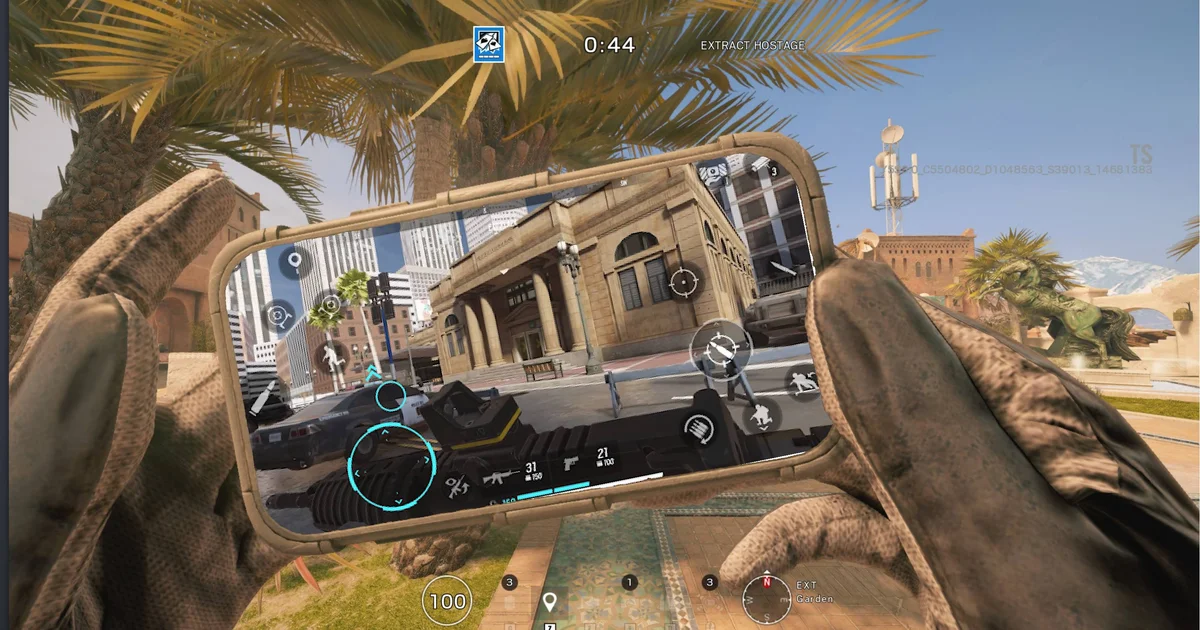
Among the most recognizable names in the first-person shooter space, Rainbow Six has now made the jump to mobile—at a moment that could hardly be more interesting. Mobile gaming continues to expand rapidly, while the rising price of devices and the ever-growing competition for attention and budgets are pulling more players away from their PCs and consoles. For many people, a smartphone is slowly becoming their go-to source of entertainment.
Rainbow Six has already carved out a strong presence on PC and consoles, but will it be able to hold its ground in a market that’s even put pressure on major franchises like Call of Duty? Can it do well right now, as Ubisoft seems to be struggling to regain its footing? And, perhaps most importantly, can a tactical, competitive shooter like this truly translate to the mobile format?
“Condensing” Rainbow Six’s tactical feel into a version that works on phones was “the biggest challenge,” Rainbow Six Mobile game director Olivier Albarracin admits in our conversation earlier this month. “Keeping spatial awareness, the maps, the destructibility, and Operator teamwork… mobile requires touch controls and those controls change depending on the device. So we had to sharpen in-game readability and also tweak the tempo, all while making sure we kept the strategic identity we inherited from Siege.”
To narrow the gap between what PCs or consoles can deliver and what typical smartphones support, Rainbow Six Mobile uses shorter match times and simplifies the long-winded arc of a traditional Siege game. The maps have been redesigned to speed up the flow of play. Even the planning stages—when players set up defenses or collect intelligence—have been streamlined to keep things efficient. The goal throughout is to protect the core experience that longtime fans value—or, at minimum, to aim for that result.
Even with these changes, Albarracin is convinced that intense tactics and mobile gameplay can absolutely go hand in hand, despite the skepticism. “I think everything blends together on mobile; it’s the biggest gaming platform out there,” Albarracin says. “We’re aiming to welcome players who might not be familiar with how Siege plays, so we reduced the friction—without lowering the skill ceiling.”
Pressed on how that balance is achieved, he laughed. “It’s certainly a tough job! Still, we continue focusing on improving the experience. One method is adding systems like auto-shoot. We also have features such as lean-sliding: you press the aim-down-sight button to slide and lean. Auto-vaulting—many automated systems that cut down on the number of buttons shown on-screen.”
Rainbow Six Mobile seems to be off to a strong start, already surpassing 10 million downloads according to the Google Play Store. While a PR representative noted that the figure includes both pre-launch tests and the post-launch player base, it’s still a noteworthy milestone just over two weeks after release. That said, the mobile space remains fiercely competitive. Call of Duty Warzone Mobile—built as a follow-up to the hugely popular Call of Duty mobile—offers a clear example, particularly after the recent announcement that its servers would be shutting down this April. If Call of Duty is struggling in the mobile ecosystem, what does that mean for Rainbow Six?
“Our team has put a lot of effort into building a game that our players will want to keep coming back to for the long term,” Albarracin said. “To do that, we’ve iterated on stability so it’s solid, ensured the FPS stays steady across hundreds of devices, and made sure connections are dependable. Since this is a competitive title, we want to prevent players from getting stuck with poor matchmaking. As long as we deliver what players are looking for—mastery, competitive integrity, and engaging content—we’ll be in a good position. This is something we’ve already put in place, and we have plans to keep improving continuously; it’s a key focus for us.”
At the same time, Ubisoft appears to be looking for a win right now. The publisher has recently gone through extensive layoffs, as well as a range of game delays and cancellations.
Asked how important Rainbow Six Mobile’s success would be for the company, Albarracin paused before answering. “I think Siege is an outstanding game, and mobile is the biggest medium. Bringing Rainbow Six onto this platform feels like a logical step if we want Rainbow Six to become a worldwide brand. It opens the experience to players who don’t have access to hardware like PCs and consoles, so they can enjoy the distinctive Siege gameplay. That’s essentially what it’s all about.”
This naturally raises another question: what would success mean for Rainbow Six Mobile? With a challenging platform, and the aim of winning over both newcomers and returning players, what does building a “global brand” actually involve? When asked what Albarracin imagines for the months—or even years—ahead, he answered cheerfully: “decades!”
When further asked what he hopes for Rainbow Six Mobile decades from now, he closed with: “If we create a game that serves our players, keeping it competitive and sustaining a healthy player community while we keep releasing seasons and features—that’s the objective. In the end, it all comes back to player enjoyment. If we can make sure the foundation is strong and scalable, with the possibility of esports down the road, that’s what we’re aiming for, and we have a roadmap to work toward it.”