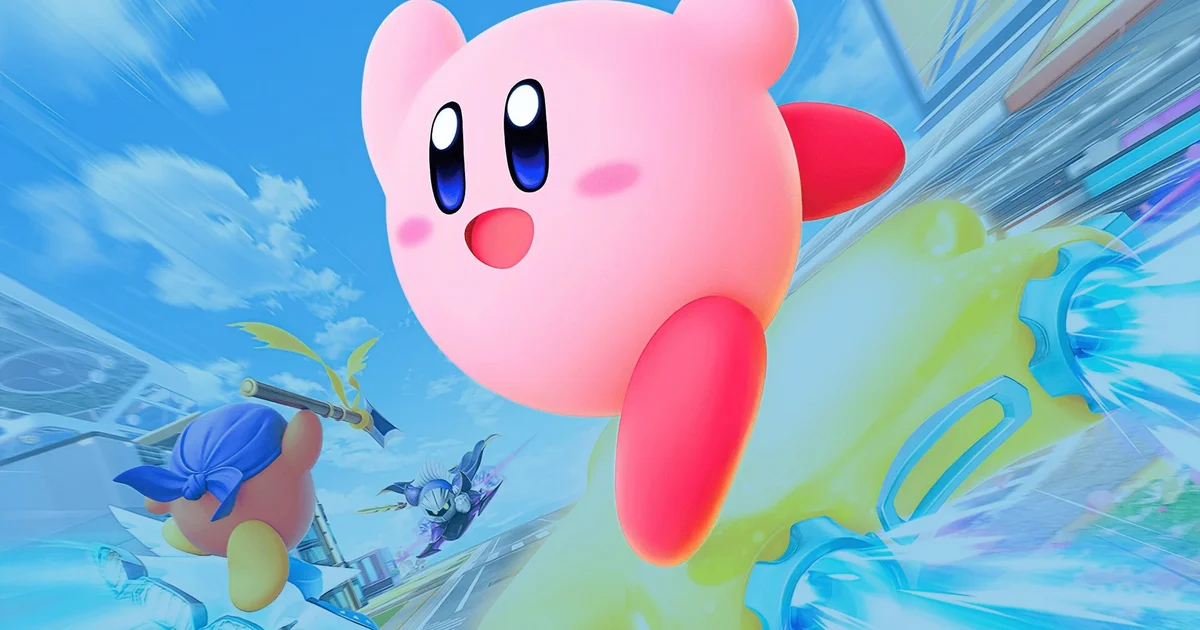
Let me begin with a confession: I never found much to enjoy in Kirby Air Ride from 2003. I’m aware that a lot of people treat it like a standout GameCube title, but that isn’t how I see it. So when Kirby Air Riders wrapped up the big Switch 2 reveal in Nintendo Direct, my reaction was pretty lukewarm. A sequel to that—the final bow of the whole event?
Nintendo has a knack for shifting my perspective, and this time it only took a full Nintendo Direct rundown plus a quick 30-minute hands-on session. I get it now. I still can’t explain why some fans loved the original as much as they did—that part remains baffling—but I understand why Nintendo, along with Smash creator Masahiro Sakurai, wanted to build another entry. As the Direct itself joked, it could look a lot like Mario Kart. Still, if I’m being honest, it feels closer to Smash.
Kirby Air Riders is a strange little game. It’s simple on the surface, with clear goals and a control layout that mostly relies on just a handful of buttons to get moving. Yet beneath that, there’s plenty going on—during the hands-on segment, Nintendo had a presenter walk each player through a set of lessons while the screen was packed with tutorials, which made it obvious they expected some players could struggle to grasp all the deeper mechanics.
That contrast feels very much like Sakurai. It’s the footprint of someone who, perhaps accidentally, helped create one of the most fiercely competitive fighting games ever. Melee’s razor-sharp combat grew out of making a party game for kids, but through glitches, system exploits, and mechanics colliding in unexpected ways, it turned into a high-stakes fantasy. Even if Sakurai’s instinct since then has been to design against that kind of chaos in every Smash Bros release, you can see the same blend here: easy-to-understand basics paired with hidden layers.
While it’s clearly aiming to be a gentler racer than Mario Kart’s wild extremes and the tough, blue-shell moments, the game expands and reshapes that idea by pursuing depth without taking away the welcoming entry point.

When you step into the Air Rider tracks, the game immediately shows you how straightforward it can be. After all, it’s a circuit race with six racers on the track, automatic acceleration, and barriers that keep you from drifting too far off the route. The whole thing comes across as soft and approachable—much like Kirby itself. The controls reinforce that impression, too: you really only need to know that the left stick steers you side-to-side, and the B button handles braking. That’s enough for a kid to ‘get through’—at least at first. Of course, there’s more than that.
Each control option is layered in subtle ways. For example, the stick doesn’t just steer; it can also tilt the front of your vehicle up or down, which can matter when you try to pull off more involved maneuvers. Braking while making a sharp turn lets you initiate a controlled drift, and keeping the brake held charges up a boost. The tracks are designed with lots of twists and turns, and it’s through drifting and boosting that you can still influence your top speed in a racer that otherwise keeps acceleration on auto.
There’s plenty beyond those basics—things like grabbing enemies, using special moves, and even collecting items. But at its core, it sticks to a fairly simple race setup. The biggest upgrade is found in the stats of the different vehicles and riders, which won’t feel unfamiliar. Mario Kart and Sonic Racing Crossworlds both use approaches like this, but in Kirby Air Riders, the impact seems like it could be even more noticeable.
If you want to see what makes it click, the fastest path is City Trial mode. This was part of the GameCube original and defenders of that version often pointed to it as its hidden strength—and it looks like that’s true here as well. The track racing with its upbeat, entertaining pace worked well enough for me, but City Trial is where I truly got pulled in—and where I finally ‘understood’ it.
In City Trial, you and other players are dropped into a compact open area. For a limited stretch of time, you can drive around freely while items, opponents, and messy chaos events pop in around you. Your job is to put together a strong ‘build’ before time expires, and you do that by gathering power-ups scattered through the environment. You can even swap vehicles—this game calls them machines—or disrupt other participants to throw off their plans and take control of power-up collection. Before long, it gets properly hectic.
City Trial really puts the spotlight on the natural strengths of each character and vehicle by essentially erasing them from the equation. The nine categories of power-ups you collect boost your maximum speed, acceleration, offensive and defensive abilities, and more, and they also affect how long your vehicles can last before they blow up. The overall idea is to grab as much power as you can within the City Trial time limit, and then you’ll be shifted into a mini-game where your empowered form lets you fight for the win.
At this stage, it stops feeling like a conventional racing game. You can practically see Sakurai’s thinking come to the surface, taking center stage in the way the genre is built. In a way, City Trial is to racing what Smash is to fighting games. It is… with one big caveat. It is… except it isn’t. Except it is.
As you move around the City Trial map, learning the mechanics becomes essential. Coming to a sudden stop to avoid obstacles or other racers, boosting to reach items before everyone else, launching off ramps, then staying in the air with careful glides to snag floating power-ups… like I said, this is when you start to lock in.
You crave that kind of thrill as well. That spellbinding moment when it’s just you, the game, and everything else fades into the background. Since power-up drops are unpredictable, yet you still have a hand in what you pick, you’ll be forced to make fast calls. What sort of “vehicle” arrangement am I trying to build here? Should I prioritize more speed? Better glide control? Then, right in the middle of all the chaos, you’re suddenly making rapid, almost instinct-driven judgments. A lot of that comes down to feel—rather than poring over the numbers from what you’ve collected, you’re leaning on the straightforward nature of the controls, the mass of your machine, its turning behavior, how quickly it accelerates, and how it handles braking, and then deciding what else it needs.
If you’re good at grabbing power-ups (and, to avoid underselling it, I was exceptionally good), you can almost steamroll the experience. A Nintendo representative was stunned by how many speed power-ups I managed to collect—at that point, the game became hard to keep under control because of how fast my vehicle kept going. Even the camera couldn’t keep up.
That’s when I started to see why Air Riders, despite looking relatively restrained, is such a good fit for Switch 2: it has to be ready to support that kind of outrageous speed along with the intense visual chaos. In the end, I had to move away from my naturally quick setup and use one that runs slower, just to balance out the frankly absurd pace I was able to reach. Compared with GameCube, it’s clear this game should gain a lot from online multiplayer.
I really enjoy moments like this. City Trial is five minutes of nonstop mayhem that genuinely brings to mind a similar energy to Smash. It then transitions into a randomly chosen mini-game, splitting the larger group of City Trial players into teams of four to battle for the highest prize. The results you rack up during City Trial will strongly shape how the next game plays out. And if you get unlucky, your configuration might even work against you—so the person who finishes first in City Trial doesn’t always end up winning overall.
Still, it’s a blast. It’s messy. It feels fragile on purpose, and I guess that can be read either way. Everything is turned up to eleven, from the sheer number of tutorial options for a game that’s otherwise simple, to the full-blown pandemonium that can break out during City Trial.
All of this may sound familiar to anyone who loved the GameCube original, but there’s something distinct here. Something deeper. Maybe the first game was simply a starting point and proof of concept for turning a Kirby racer into a party-style experience—and Air Riders, two decades later, could represent the complete fulfillment of that idea. We’ll find out in November just how far those concepts can be pushed.